Why Flat Roofs Need More Attention Than Sloped Roofs
The term "flat roof" is slightly misleading. A well-built low-slope roof is not truly flat; it is designed with a gentle pitch (often around a quarter-inch of fall per foot) so water drifts toward drains, scuppers, or gutters. Over years, that slope can be compromised by settling, sagging insulation, or compressed membrane, and the moment water stops moving it begins to find weaknesses. This is the core reason flat roofs demand a maintenance mindset: gravity is doing far less of the work for you than it does on a pitched roof.
Most flat roofs are covered by a continuous membrane rather than overlapping shingles. Common systems include single-ply membranes such as TPO, PVC, and EPDM (rubber), as well as modified bitumen and built-up roofing (BUR), and increasingly fluid-applied or spray-foam coatings. Each behaves differently as it ages, but they share a vulnerability: the entire system relies on the integrity of its seams, flashings, and penetrations. A single failed seam or a cracked boot around a vent pipe can let water travel far from the entry point before it shows up as a stain inside.
Because the roof is low and often out of sight from the ground, problems develop quietly. Many owners do not learn there is an issue until an interior ceiling stains or insulation gets saturated, by which point repairs are larger and costlier. Consistent, scheduled maintenance turns those silent problems into small, planned fixes.
- Single-ply (TPO, PVC, EPDM): watch seams, shrinkage, punctures, and UV wear
- Modified bitumen / built-up (BUR): watch blistering, alligatoring, and granule loss
- Coatings / spray foam: watch for thinning, cracking, and exposed substrate
- Every system: flashings, penetrations, and drains are the most failure-prone spots
Build an Inspection Routine: What to Check and How Often
The single most valuable flat-roof habit is a routine inspection done at least twice a year, ideally in spring and fall, plus an extra look after any major storm, hail, high wind, or heavy snow. Spring inspections catch damage from winter freeze-thaw and ice; fall inspections clear debris and confirm the roof is ready for the harsh season. Twice-yearly checks are a widely recommended baseline, and roofs in severe climates or with heavy tree cover benefit from more frequent visits.
A thorough walkover follows a logical order so nothing is missed. Start at the drains and work outward, then examine the field of the membrane, then the perimeter and every penetration. Move carefully and never walk a wet, icy, or visibly soft roof; soft or spongy areas can indicate saturated insulation beneath and may not be safe to stand on. If your roof has no safe permanent access, or you are not comfortable on a low-slope surface, this is a sensible task to hand to a professional.
Keep a simple log with dates, photos, and notes. A photo record makes it easy to see whether a small blister or a pooling spot is stable or getting worse over time, and it gives any roofer you call a useful baseline.
- Drains, scuppers, and gutters: clear of leaves, gravel, and sediment; water flows freely
- Membrane field: blisters, bubbles, cracks, punctures, tears, or open seams
- Flashings: secure at walls, curbs, and edges; no lifting, gaps, or failed sealant
- Penetrations: vent pipes, HVAC curbs, skylights, and pipe boots intact and sealed
- Surface debris: branches, trash, and standing grit that traps moisture and abrades the membrane
- Interior signs: ceiling stains, peeling paint, musty smell, or daylight in the attic/deck
Drainage and Ponding Water: The Number-One Threat
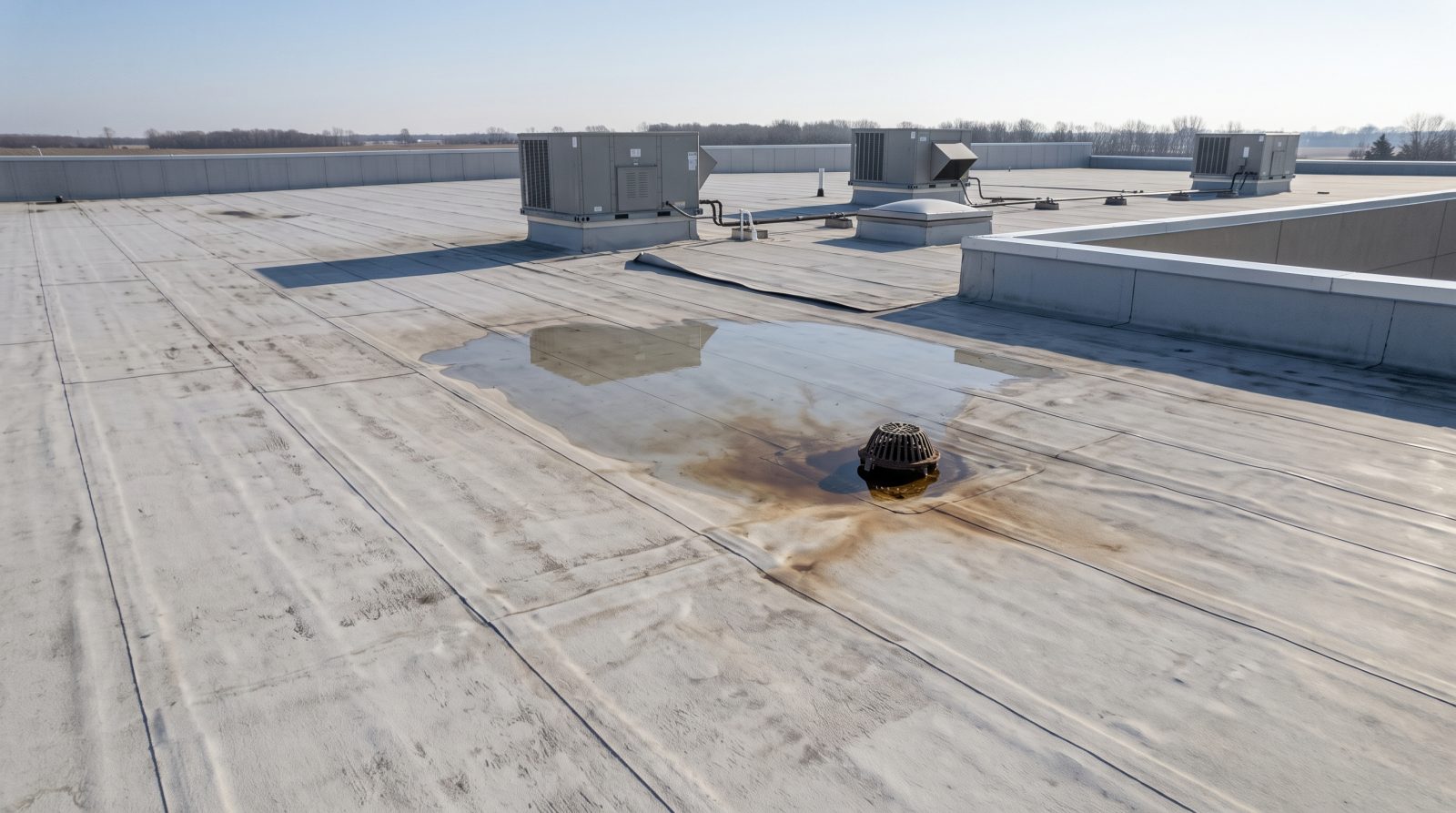
If you fix only one thing on a flat roof, make it drainage. Water that lingers on the surface is the leading cause of premature flat-roof failure. A common industry guideline is that water remaining on the roof more than 48 hours after rain is considered ponding, and it deserves attention. Standing water adds dead-load weight, accelerates membrane breakdown under UV exposure, encourages algae and vegetation growth, and concentrates stress exactly where seams and patches are most likely to give way.
Most ponding traces back to one of a few causes: clogged or undersized drains, low spots where insulation has compressed or the deck has sagged, or debris damming the natural flow. Routine cleaning of drains, strainers, scuppers, and gutters solves a large share of cases on its own. Persistent ponding in the same spot after the drains are clear usually points to a slope or substrate problem that a roofing professional should evaluate, since the fix may involve tapered insulation or added drainage rather than simple cleaning.
Drainage demands change with climate. In rainy regions and during storm season, drain capacity and frequent debris clearing matter most. In cold-winter regions, the same drains and scuppers must handle snowmelt, and ice can block them precisely when you need them working, which is one reason fall preparation is so important in northern climates.
- Clear all drains, strainers, scuppers, and gutters every season and after big storms
- Treat water sitting longer than ~48 hours as ponding worth investigating
- Recurring ponding after cleaning usually signals a slope or deck issue
- Never let debris pile against drains where it can dam and back up water
Caring for the Membrane, Seams, Flashings, and Penetrations
The membrane is your waterproof barrier, and most leaks begin not in the open field but at its edges and interruptions: seams, flashings, and penetrations. Seams can pull apart as a roof expands and contracts through daily and seasonal temperature swings; this thermal movement is relentless and is why aging seams need periodic attention. Flashings at parapet walls, curbs, and roof edges can lift or lose their sealant, and the rubber boots around vent pipes are notorious for cracking and shrinking as they age, opening a direct path for water.
General membrane care means keeping the surface clean and free of standing debris, addressing punctures and small tears promptly, and resealing penetrations before they fail outright. Rooftop foot traffic is a frequent and avoidable source of damage; HVAC service, satellite installs, and casual access all scuff and puncture membranes, so concentrate traffic on walk pads or designated paths where possible. Keep overhanging branches trimmed back so limbs cannot scrape the surface or drop debris into drains.
Repair materials and methods must match the specific membrane. A patch or sealant formulated for EPDM is not interchangeable with one for TPO or PVC, and the wrong product can fail or even damage the roof. This is one of the strongest arguments for involving a roofing professional on repairs: correct diagnosis, compatible materials, and proper preparation are what make a repair last rather than buy a few months. Reflective coatings can extend the life of some systems and reduce heat load, but suitability depends on the existing membrane and its condition, so confirm compatibility before applying anything.
- Inspect and reseal seams and flashings as they age; thermal movement loosens them over time
- Replace cracked or shrunken pipe boots and penetration seals promptly
- Limit and route foot traffic; use walk pads near equipment to prevent punctures
- Match every repair product to your specific membrane type (TPO, PVC, EPDM, etc.)
- Keep overhanging limbs trimmed to reduce abrasion and debris
Seasonal and Regional Maintenance: One Roof, Many Climates
Flat-roof care across the United States follows the same fundamentals but shifts emphasis by season and region. The constants are clean drains, clear debris, intact seams and flashings, and prompt attention to anything that changed since the last look. What varies is which threat is most urgent at a given time of year.
In cold and snowy regions, winter brings the heaviest demands. Snow load adds significant weight, freeze-thaw cycles work water into tiny cracks and widen them, and ice can dam drains and scuppers. Fall preparation, clearing drains and confirming flashings are sound, pays off most here, and snow may need safe removal after major storms to manage load. In hot and high-UV regions of the South and Southwest, sun exposure is the dominant aging force; UV degrades membranes, dries out sealants, and makes reflective coatings and surface care especially valuable. In rainy and coastal regions, drainage capacity, debris control, and wind-driven damage take priority, and storm-season inspections become routine. Areas with frequent hail or high winds warrant a careful look after every significant event, since impact and uplift damage is easy to miss from the ground.
Tailor the calendar to your own building and climate rather than a single national template. A roof under heavy tree cover needs more frequent debris clearing everywhere; a roof with rooftop equipment needs more attention to traffic damage; and an older membrane near the end of its service life needs closer monitoring regardless of where it sits.
- Cold/snowy: prioritize fall prep, drain clearing, freeze-thaw cracks, and safe snow-load management
- Hot/high-UV: prioritize membrane and sealant condition; consider compatible reflective coatings
- Rainy/coastal: prioritize drainage capacity, debris control, and post-storm checks
- Hail/high-wind areas: inspect after every major weather event for impact and uplift damage
Typical Costs and When to Call a Professional
Maintenance is far cheaper than the damage it prevents, but actual figures vary widely. The ranges below are typical industry estimates meant only as a planning frame; real pricing depends on your region, roof size and height, membrane type, accessibility, and the scope of work. A professional inspection and minor maintenance visit is generally a modest, predictable expense. Spot repairs of seams, flashings, or small punctures typically run in the low hundreds to low thousands of dollars depending on extent and access. Larger work, such as correcting drainage, replacing saturated insulation, or recoating, climbs from there, and a full replacement is a major capital expense that good maintenance is specifically designed to postpone.
Some tasks are reasonable for a capable owner: visual inspections from a safe vantage point, clearing drains and gutters, removing light debris, and keeping a photo log. Other tasks belong with a professional, including walking a soft or wet roof, diagnosing the source of a leak (which often surfaces far from its origin), making membrane-specific repairs, and any work that requires height safety equipment or roof access you do not have. There is no shame in handing off a low-slope roof; these surfaces are genuinely hazardous when wet, iced, or structurally weakened, and a misdiagnosed or mismatched repair can cost more than doing it right the first time.
Call for professional help promptly if you see interior water stains, a soft or spongy spot underfoot, ponding that persists after the drains are clear, open or lifting seams and flashings, or any damage after a major storm. Catching these early is what keeps a roof in repair-and-maintain mode instead of replace mode. For nationwide roofing help and a free roof assessment, call Roof Repairs at (669) 259-2777 and get experienced eyes on your flat roof before a small issue becomes a big one.
- DIY-friendly: safe visual checks, clearing drains/gutters, light debris removal, photo logs
- Pro territory: leak diagnosis, membrane-specific repairs, soft/wet roofs, height-access work
- Cost drivers: region, roof size and height, membrane type, access, and scope
- Call right away for: ceiling stains, spongy spots, persistent ponding, failed seams, or post-storm damage