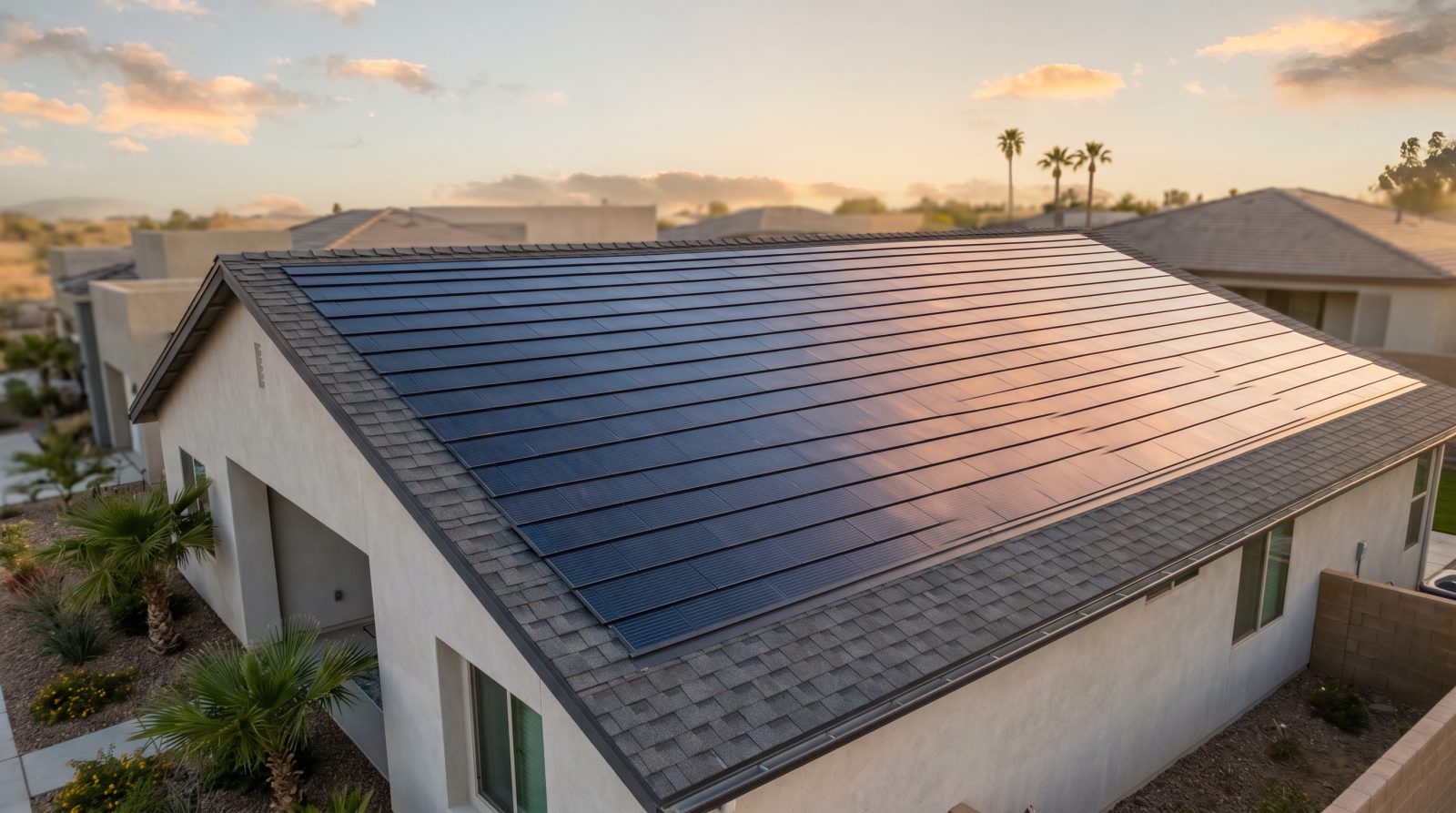
Solar Shingles vs. Solar Panels vs. Solar-Ready Roofing
Most homeowners lump all rooftop solar together, but there are three distinct paths, and choosing the wrong one can cost thousands in rework. Understanding the difference up front is the single most valuable thing you can do before signing anything.
Solar shingles (also called solar roof tiles or building-integrated photovoltaics) replace your roofing material itself. Each shingle is both a weatherproofing layer and a small solar generator, so the roof and the energy system are one product installed at the same time. The appeal is aesthetic and structural: a low-profile, uniform roof with no racking or panels bolted on top. The trade-offs are higher cost per watt, a smaller pool of qualified installers, and tighter dependence on a single manufacturer's ecosystem for repairs and replacement parts.
Solar panels are the traditional approach: rigid photovoltaic modules mounted on racking that is anchored through your existing roof. They deliver the most watts per dollar, work on nearly any roof type, and can be serviced or upgraded independently of the roof beneath them. The visual footprint is more pronounced, and every roof penetration is a potential leak point if flashed poorly.
Solar-ready roofing is not solar at all yet. It is a roof deliberately built or replaced to accept panels cleanly later: correct decking, reinforced attachment zones, conduit pathways, and a roof covering with enough remaining life that you will not have to tear it off under a live array. This is often the smartest, lowest-regret move for homeowners who want solar eventually but are not installing this year.
- Solar shingles: best for aesthetics and new roofs where roof + power are installed together; highest cost per watt.
- Solar panels: best value per watt, broadest installer availability, easiest to service or expand later.
- Solar-ready roof: best when your roof is near end of life or you plan to add solar in the next few years.
Why Roof Age and Condition Come First
The most expensive solar mistake is putting a 25-year system on a 5-year roof. Asphalt shingle roofs commonly last roughly 15 to 25 years depending on material grade and climate, while a quality solar array is designed to produce for 25 years or more. If your roof is more than about halfway through its life, you should seriously consider replacing it before, or at the same time as, going solar.
Here is why the timing is unforgiving. Once panels are installed, the roof beneath them is effectively sealed off. If that roof later fails, a roofer typically has to remove the array, re-roof, and reinstall the system, an added labor expense that can run into the thousands and is rarely covered by either the roofing or solar warranty. Pairing a re-roof with a solar install means you open and close the roof once, not twice.
Condition matters as much as age. Before any solar work, the roof should be inspected for soft or rotted decking, inadequate ventilation, prior leak history, and flashing integrity around penetrations. A roof that cannot pass a basic structural and moisture check is not a candidate for a multi-decade rooftop system, no matter how good the panels are.
This is the moment to get an honest, solar-aware roofing assessment. The goal is a clear answer to one question: will this roof comfortably outlive the solar system you are about to attach to it?
- Re-roof first if your existing roof is past roughly half its expected life.
- Bundling re-roof + solar avoids paying twice to remove and reinstall the array.
- Insist on a pre-solar inspection: decking, ventilation, leak history, flashing.
- Confirm the roof's remaining life meets or exceeds the solar system's design life.
Typical Costs and What Drives Them
Solar roofing costs vary widely, and any figures here are typical industry ranges that vary by region, roof size and pitch, material choice, electrical scope, and local labor and permitting. Always get a written, itemized estimate for your specific home.
As a general frame, conventional solar panel systems are usually the lowest cost per watt, since the modules and racking are commodity hardware installed over your existing roof. Integrated solar shingles typically cost more per watt because you are buying a premium roofing material and the energy system at once, and the labor is more specialized. A solar-ready roof, by contrast, is priced like a quality re-roof plus modest provisions (reinforcement, conduit, attachment planning) for future panels.
Several factors move the number in either direction. Roof complexity, steep pitch, multiple facets, dormers, and hard-to-access areas, raises labor. Electrical upgrades such as a new main panel, conduit runs, or battery storage add cost but can be essential for safety and capacity. Region matters too: snow-load engineering in the North, wind-uplift requirements along hurricane-prone coasts, and wildfire-rated assemblies in parts of the West can all change both materials and price.
Incentives can meaningfully offset solar costs. Federal, state, local, and utility programs change over time and vary by location, so verify current eligibility for your address with a qualified tax professional and your utility before assuming any savings. Treat incentives as a bonus to confirm, not a number to bank on.
- Cost per watt (typical, lowest to highest): conventional panels, then solar-ready provisions, then integrated solar shingles.
- Price drivers: roof size, pitch, number of facets, and accessibility.
- Electrical scope (panel upgrade, conduit, battery) is often a large line item.
- Climate engineering, snow, wind, wildfire, can change materials and cost by region.
- Verify current incentive eligibility with a tax professional and your utility before counting on savings.
Durability, Weather, and Warranty Across U.S. Climates
A solar roof has to be two things at once: a weatherproof roof and a long-lived power plant. Its durability depends heavily on installation quality and on matching the assembly to your regional climate.
In northern and mountain regions, snow load and ice are the dominant concerns. Panels and integrated solar shingles must be engineered for the weight of accumulated snow, and the roof structure beneath them should be sound. Ironically, panels often shed snow reasonably well once sun hits them, but attachment and flashing must be detailed correctly so freeze-thaw cycles do not open leaks at penetrations.
Along the Gulf and Atlantic coasts and in tornado-prone areas, wind uplift is the priority. Attachment spacing, fastener engineering, and the underlying roof's wind rating all determine whether a system stays put in a major storm. In the arid and wildfire-exposed West, fire-rated roofing assemblies and proper clearances matter, and intense UV and heat make material quality and ventilation important for long-term performance.
Warranties are where the integrated-versus-panel distinction becomes very real. With separate panels on a conventional roof, you typically have distinct warranties: one for the roof, one for the panels or modules, and sometimes another for workmanship. With integrated solar shingles, the roofing and energy warranties are often tied to one manufacturer's product and installer network. Either way, read the terms closely: understand what is covered, for how long, who performs warranty repairs, and critically, whether any future roof work would void coverage. Proper flashing and penetration detailing is the difference between a roof that protects your investment and one that quietly leaks above your living space.
- North/mountain: design for snow load and ice; detail flashing for freeze-thaw.
- Coastal/storm regions: prioritize wind-uplift engineering and fastener/attachment spacing.
- Arid/wildfire West: use fire-rated assemblies; account for intense UV, heat, and ventilation.
- Clarify every warranty: roof, modules, and workmanship, plus who repairs and what voids coverage.
- Quality flashing at every penetration is the single biggest defense against future leaks.
How to Plan a Solar Roof the Right Way
Sequencing is everything with solar roofing. The homeowners who avoid expensive surprises tend to follow the same disciplined order, regardless of which product they ultimately choose.
Start with an independent roof assessment that evaluates age, condition, structure, ventilation, and orientation, before you talk system size. From there, decide the path: re-roof now and add solar, install integrated solar shingles as a combined roof-and-power project, or build a solar-ready roof and add panels later. Each path has a clearly best moment, and that moment is usually dictated by the condition of your current roof.
Coordinate roofing and solar work so the two trades are aligned on attachment, flashing, and warranty responsibility. When the roofing scope and the solar scope are planned together, penetrations are placed and sealed correctly the first time, and there is no finger-pointing later about who is responsible for a leak. Insist on itemized estimates, documented materials, and clarity on warranty ownership for both the roof and the energy system.
Finally, plan for the future. Even if you are only re-roofing today, a solar-aware roofer can leave you in a strong position to add panels later with minimal rework. Thinking one step ahead now is far cheaper than retrofitting later. To get a clear, honest read on your roof and the smartest solar path for your home, call (669) 259-2777 for a free roof assessment and quote.
- Step 1: Independent roof assessment, age, condition, structure, ventilation, orientation.
- Step 2: Choose your path, re-roof + solar, integrated solar shingles, or solar-ready roof.
- Step 3: Coordinate roofing and solar trades so flashing and warranty are handled cleanly.
- Step 4: Get itemized estimates and confirm warranty ownership for roof and system.
- Step 5: Build in future-readiness so adding panels later is simple, not a teardown.