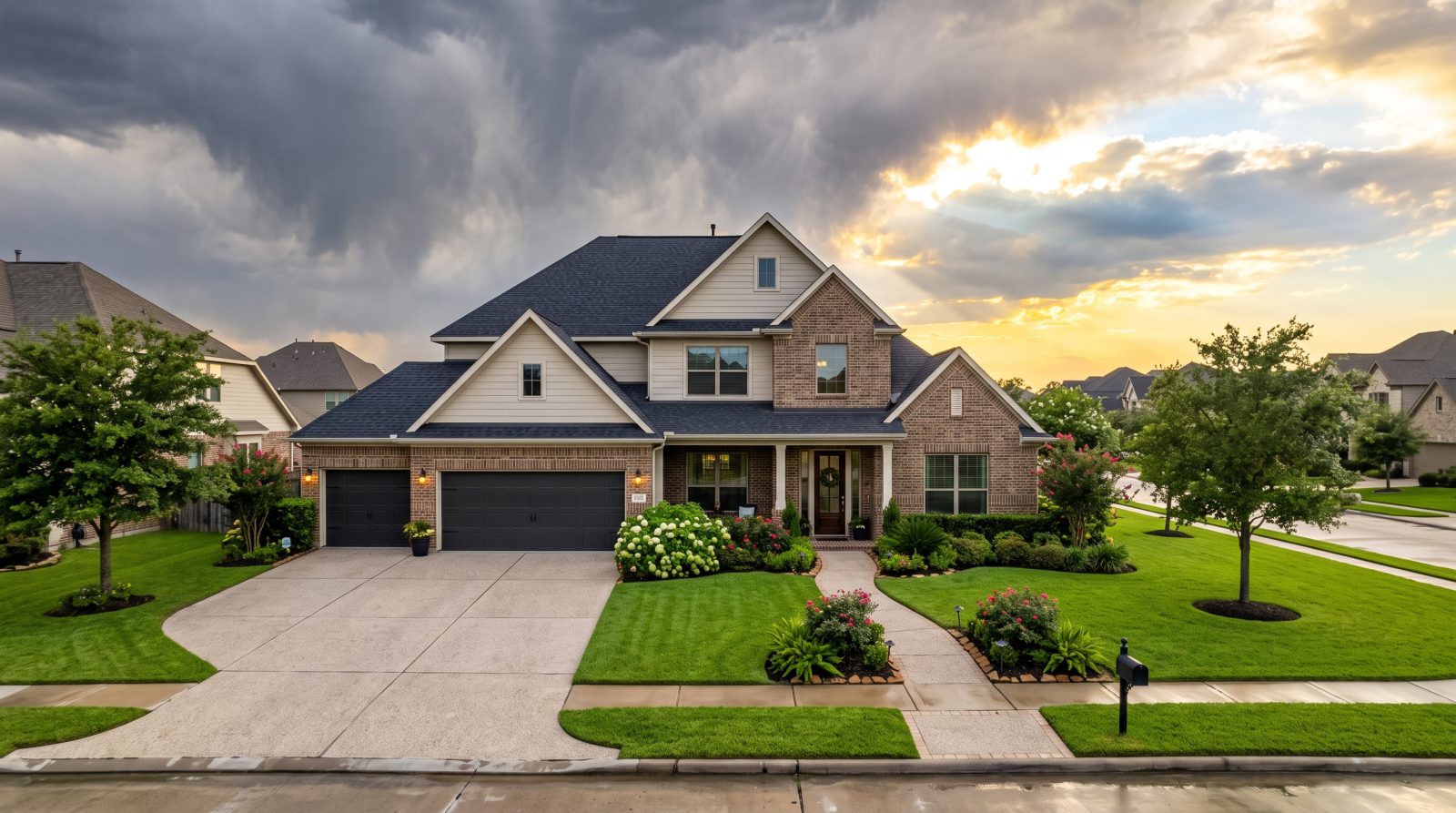
What Houston's Gulf Coast Climate Does to Your Roof
Houston sits in one of the harshest roofing environments in the country, and it is the combination of stresses, not any single one, that wears roofs down. The metro endures Atlantic hurricane season from June through November, frequent spring and early-summer hailstorms, sustained heat that regularly pushes attic temperatures well past what shingles are rated to handle, and humidity that keeps moisture lingering long after the rain stops.
Each of these attacks the roof differently. UV and heat bake the oils out of asphalt shingles, making them brittle and curling the edges. High winds lift and crease shingles or peel back flashing. Hail bruises the shingle mat, knocking off the protective granules that shield it from the sun. Humidity and trapped attic moisture feed rot in decking and fasteners. A roof that looks fine from the street can be quietly losing its weather resistance year after year.
- Intense UV and heat: granule loss, brittle shingles, premature aging, and thermal cycling that loosens fasteners
- Hail: bruised and fractured shingle mats, dented metal, and accelerated granule loss that shortens roof life
- Hurricane and high winds: lifted, creased, or missing shingles, displaced ridge caps, and torn flashing
- Humidity and ponding: moisture intrusion, attic condensation, decking rot, and mold-friendly conditions
- Heavy downpours: fast, high-volume rain that finds even small flashing and seam failures
The Most Common Roofing Problems We See Across the Metro
Most Houston repair calls trace back to a handful of recurring issues, and many of them start small before becoming visible inside the home. Catching them early is almost always cheaper than waiting until a ceiling stain or a soaked attic forces the issue.
Storm seasons tend to cluster these problems. After a line of severe weather moves through, we commonly see wind and hail calls grouped across the same neighborhoods, because nearby homes of similar age and roof type tend to fail in similar ways at the same time.
- Leaks around flashing at chimneys, skylights, valleys, and vent pipes, which are the most common entry points
- Wind-blown, creased, or missing shingles after storms, often concentrated on the windward slope
- Hail-bruised shingles with accelerated granule loss that may not leak yet but shorten remaining roof life
- Ponding water and seam failures on flat or low-slope commercial roofs
- Failed pipe boots and dried-out sealant, a frequent and inexpensive source of slow leaks
- Sagging or soft decking from long-term moisture, which signals damage beneath the surface
Roofing Materials Common in Houston Homes and Businesses
The right repair depends heavily on what is already on your roof, and Houston has a fairly predictable mix across residential and commercial buildings. Knowing your roof type helps you understand both how it tends to fail and what a sensible repair looks like.
Asphalt shingles dominate residential roofs across Katy, Sugar Land, Pearland, and The Woodlands because they balance cost and performance, with architectural (dimensional) shingles being the common upgrade for better wind resistance. Metal roofing has grown in popularity for its longevity and wind performance, especially on custom and rural-edge properties. Commercial and many flat or low-slope sections rely on modified bitumen, built-up roofing, or single-ply membranes designed to shed Houston's heavy rain.
- Asphalt shingles (3-tab and architectural): the most common residential roof; repairs focus on replacing damaged shingles and resealing flashing
- Metal roofing: durable and wind-resistant; repairs center on fasteners, panel seams, and flashing details
- Modified bitumen and built-up roofing: common on flat and low-slope sections; repairs address seams, blisters, and ponding areas
- Single-ply membranes (such as TPO): used on many commercial buildings; repairs target punctures and seam separation
- Tile (less common but present): repairs involve replacing cracked tiles and restoring the underlayment beneath
Storm and Hail Damage: Why Fast Repair Matters
After a Houston storm, the clock starts the moment the roof is compromised. Even a small wind or hail breach lets water into the decking and attic, and in this humidity that moisture does not dry out quickly. What begins as a single missing shingle can become saturated insulation, stained drywall, and rotted decking within weeks, turning a modest repair into a major one.
Storm season also creates a practical bottleneck. When a severe system moves across the metro, demand for repairs spikes and roofs in the hardest-hit areas all need attention at once. Getting an assessment done promptly, and a temporary protective measure in place if needed, helps prevent the secondary interior damage that is so often the most expensive part of a storm claim.
It is worth being clear-eyed here: not every storm leaves damage that warrants a full claim, and we will tell you honestly what we find. A straightforward, documented assessment is the best starting point, whether the right answer turns out to be a small repair or a larger conversation.
- Small breaches let water reach decking and attic fast, and high humidity keeps it from drying
- Delays turn minor shingle damage into interior leaks, insulation damage, and decking rot
- Prompt assessment and temporary protection limit secondary interior damage after a storm
- An honest inspection clarifies whether you are looking at a quick fix or a larger repair
Insurance Claim Realities for Houston Homeowners
Storm and hail damage in Houston often involves an insurance claim, and understanding how the process generally works helps you make better decisions. Most policies cover sudden storm-related damage but not wear and tear or long-deferred maintenance, which is one reason timely documentation matters so much. Texas roofs also commonly carry a separate, often percentage-based wind and hail deductible, so it is worth checking your policy before assuming a claim makes financial sense.
A clear, photo-documented inspection report gives you a factual basis for any conversation with your insurer. We can document what we find and explain it in plain language, but the coverage decision rests with your insurance company and your specific policy.
If you do move forward, keep records of the storm date, your inspection, and any temporary repairs. Good documentation tends to make the entire process smoother, whatever the outcome.
- Policies typically cover sudden storm damage, not gradual wear or deferred maintenance
- Texas roofs often have a separate wind/hail deductible, frequently a percentage of the dwelling value
- Clear photo documentation of damage supports your conversation with the insurer
- Coverage decisions rest with your insurance company and your specific policy
Seasonal Timing and Honest Cost Expectations
Timing your roof work around Houston's calendar can save money and stress. The ideal window for non-emergency repairs and inspections is often late fall through winter, after hurricane season winds down and before the next round of spring hail. Scheduling proactive inspections before storm season means you head into the riskiest months with a roof that is already in good shape, rather than scrambling for help when everyone else needs it too.
On cost, the honest answer is that it varies widely by the size and type of repair, the roofing material, the slope, and how much underlying damage is present once we look closely. A minor repair such as replacing a few shingles or a worn pipe boot sits at the low end, while repairs involving flashing rebuilds, decking replacement, or large flat-roof seam work cost more because they involve more labor and material. These are general ranges, not quotes, and the only way to know your actual number is an on-site look at your specific roof.
We serve Houston and the surrounding areas, including Harris County, Katy, Sugar Land, The Woodlands, and Pearland, for both residential and commercial roofs. If you are seeing a leak, missing shingles, or simply want to know where your roof stands before the next storm, call to schedule a free roof assessment and get a clear, honest picture of what your roof actually needs.
- Best window for planned repairs and inspections: late fall through winter, between storm seasons
- Schedule inspections before hurricane and hail season to avoid the post-storm rush
- Minor repairs (a few shingles, a pipe boot) fall at the low end of the range
- Flashing rebuilds, decking replacement, and flat-roof seam work cost more due to added labor and materials
- All figures are general ranges; an on-site assessment is the only way to get your real number