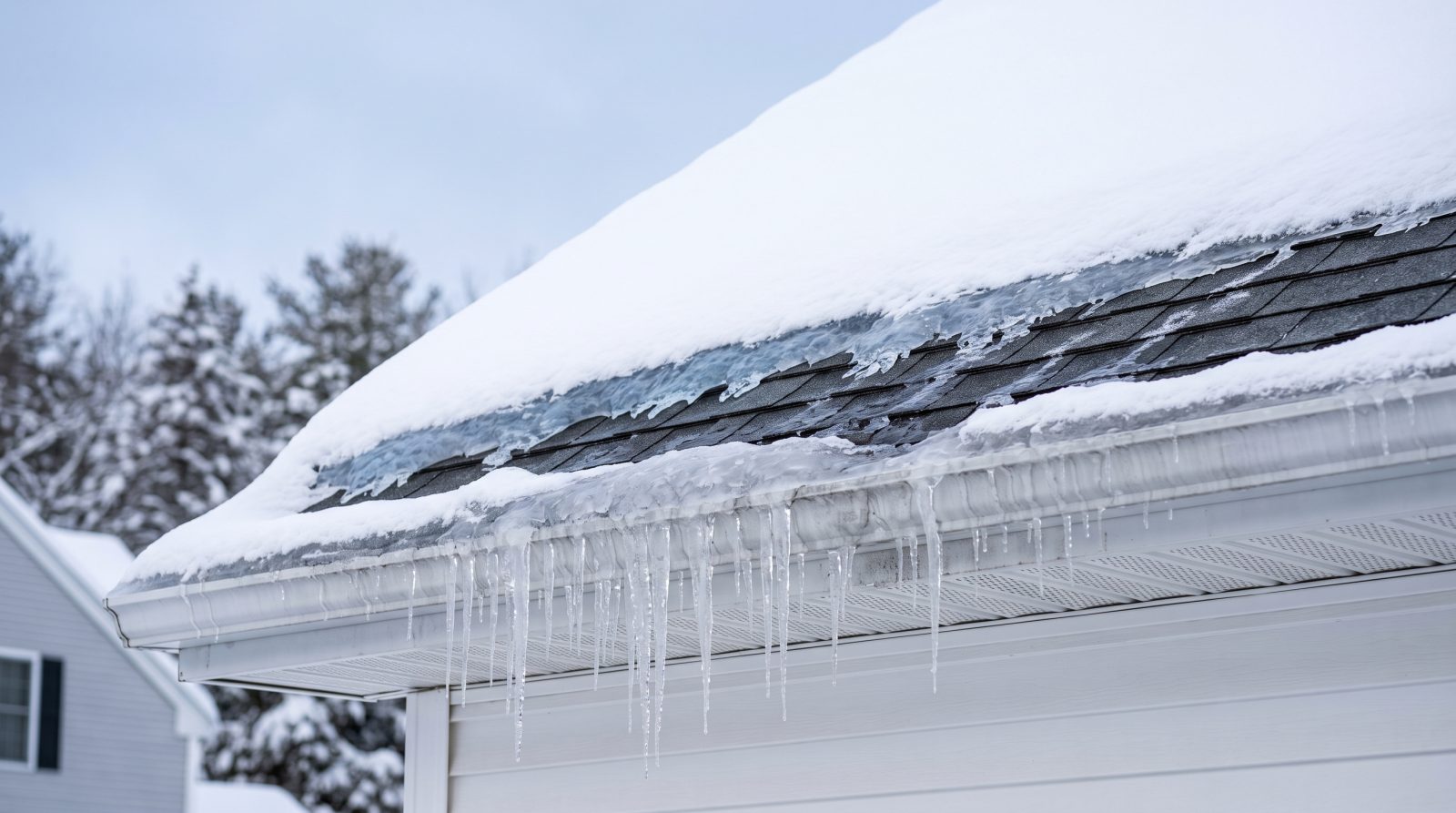
What an Ice Dam Actually Is
An ice dam is a ridge of ice that forms at the edge of a roof and prevents melting snow from draining off the way it should. Instead of running down the slope and into the gutters, the water pools behind the ice ridge. Because shingles are designed to shed water that flows downhill — not water that sits or backs up — that trapped meltwater can work its way under the shingles and into the structure below.
The damage from an ice dam rarely shows up on the roof's surface first. It tends to appear inside the home: water stains spreading across ceilings, paint bubbling along the tops of exterior walls, damp or compressed attic insulation, and in severe cases, mold growth or rotted roof decking. By the time most homeowners notice the interior symptoms, water has already been finding its way in for days or weeks.
It is worth separating ice dams from ordinary icicles. A few small icicles hanging from a gutter are common and usually harmless. But a thick band of ice along the eaves, large icicles fed by water dripping from behind that ice, or icicles forming on the underside of the roof edge are warning signs that an ice dam is actively trapping water on your roof.
- The ice forms at the cold edge of the roof (the eaves and gutters), not at the warmer center.
- The real threat is the pooled water behind the ice, not the ice itself.
- Most ice dam damage is discovered indoors before it is ever seen on the roof.
- Persistent thick eave ice — not occasional small icicles — is the red flag to watch for.
Why Ice Dams Form: The Heat-Loss Cycle
Ice dams are driven by a temperature difference across a single roof. The upper part of the roof sits above 32°F while the lower edge stays below freezing. Snow on the warm upper section melts, the water runs down the slope, and when it reaches the cold overhang at the eaves — which extends past the heated living space — it refreezes. Each freeze-thaw cycle adds another layer, and the ridge of ice grows until it blocks drainage entirely.
Here is the key insight that changes how homeowners approach the problem: in most homes the upper roof is warm because heat is escaping from inside the house into the attic, not because of the sun. Warm air leaks up through ceiling penetrations, recessed lights, attic hatches, and gaps around plumbing and wiring. That warm air heats the underside of the roof deck, melts the snow above it, and feeds the cycle. This is why two identical houses on the same street can have wildly different ice dam problems — the difference is what is happening in the attic.
Climate sets the stage, but it is not the whole story. Ice dams are most common in cold and mixed climates that get repeated snowfall followed by sub-freezing nights — much of the Northeast, Upper Midwest, Mountain West, and higher elevations elsewhere. In milder southern regions they appear mainly during unusual cold snaps. But within any region prone to them, the homes that suffer worst are almost always the ones losing the most heat through the roof. That is good news: the part you can actually control — your attic — is the part that matters most.
- Ice dams need three things at once: snow on the roof, a roof surface above freezing higher up, and a roof edge below freezing.
- Escaping household heat is the most common reason the upper roof gets warm enough to melt snow.
- Common heat-leak points: recessed lights, attic access hatches, bathroom and kitchen exhaust fans, and gaps around plumbing stacks and wiring.
- Regions with repeated snow-then-freeze cycles see the most ice dams, but heat loss decides which individual homes are hit hardest.
The Three Pillars of Ice Dam Prevention
Because ice dams are fundamentally a heat-loss problem, the most reliable long-term fix is to keep the entire roof deck cold and uniform in temperature. Roofing and building-science professionals generally approach this through three connected strategies: air sealing, insulation, and ventilation. They work as a system — strengthening only one while ignoring the others usually delivers disappointing results.
Air sealing is almost always the highest-impact first step. Sealing the gaps where warm, moist air escapes from the living space into the attic stops heat at its source. This means sealing around recessed light housings (using fixtures and covers rated for it), weatherstripping the attic hatch, and closing penetrations around plumbing vents, chimneys, wiring, and ductwork with appropriate sealants. Air sealing also reduces the moisture that can otherwise condense and damage the attic.
Insulation is the second pillar. Adequate, evenly distributed attic insulation slows the heat that does make it into the attic from reaching the roof deck. Recommended insulation levels vary by climate — colder regions call for more — so the right target depends on where you live. Just as important as the total amount is full coverage: thin spots, compressed batts, and gaps over exterior walls are exactly where heat sneaks through and warms the roof above.
Ventilation is the third pillar. A properly vented attic lets cold outside air flow in at the eaves (through soffit vents) and out near the peak (through ridge or other high vents), flushing away any heat that escapes and keeping the roof deck close to the outdoor temperature. Ventilation does not replace air sealing and insulation — it manages what gets past them. When all three pillars work together, the snow on your roof melts evenly and drains, rather than melting at the top and refreezing at the edge.
- Air seal first: stop warm air from leaking into the attic at hatches, can lights, and penetrations.
- Insulate fully and evenly, to a level appropriate for your climate, with special attention to the area above exterior walls.
- Ventilate so cold air flows from soffit to ridge and keeps the roof deck uniformly cold.
- Keep soffit vents clear — insulation pushed into the eaves blocks airflow and quietly defeats the system.
Roof-Side Defenses and Maintenance
Even with a well-sealed, well-insulated, well-ventilated attic, there are roof-level measures that add protection — especially in regions where heavy snow and deep cold are routine. The most important is a self-adhering ice-and-water shield membrane installed along the eaves beneath the shingles. This waterproof underlayment is required by code in many cold-climate areas and provides a second line of defense: even if some water backs up behind ice, the membrane helps keep it from reaching the roof deck and the rooms below. It is most practical to add during a re-roof or repair, since it sits under the shingles.
Routine seasonal maintenance also reduces risk. Keeping gutters and downspouts clear in the fall helps meltwater drain rather than pool and freeze at the edge. After heavy snowfall, carefully removing the lower few feet of snow from the roof edge with a long-handled roof rake (while standing on the ground) reduces the snow available to feed a dam. The goal is gentle snow removal, not scraping down to the shingles, which can damage the roofing.
A word of caution on the temporary fixes people reach for in an emergency: standing on an icy roof, chipping at ice with hammers or sharp tools, or aiming a torch at a dam are all genuinely dangerous and can crack shingles, tear flashing, or cause injury. If water is already entering the home, the safer path is to relieve the immediate problem from the ground where possible and bring in professional help — both to address the active leak and to fix the underlying cause. Heated cables can melt drainage channels through a dam in some situations, but they treat the symptom rather than the heat loss behind it and should be considered a supplement, not a solution.
- Ask about ice-and-water shield underlayment at the eaves during any re-roof — it is a strong backup defense in cold climates.
- Clean gutters and downspouts before winter so meltwater can actually drain.
- Use a ground-operated roof rake to clear the lower roof edge after big storms; do not climb onto a snowy or icy roof.
- Avoid chipping, torching, or salting your way through a dam from on the roof — these damage roofing and risk injury.
Typical Costs and When to Call a Professional
Prevention costs vary widely, and any figures here are typical industry estimate ranges that shift with your region, roof size, attic access, materials, and the scope of work — they are not quotes. As general guidance, air sealing and added attic insulation are often the most cost-effective investments and tend to fall in the lower-to-moderate range for an average home, while improving ventilation, adding eave membrane during a re-roof, or installing heated cables sits higher and depends heavily on the specifics. Emergency water-intrusion repairs and interior damage restoration are typically the most expensive outcomes — which is exactly why prevention pays off.
Some steps are reasonable for a capable homeowner: clearing gutters, raking snow from the ground, and weatherstripping an attic hatch. Others are better left to professionals — particularly diagnosing where heat is escaping, working safely around electrical fixtures and combustion appliances when air sealing, balancing intake and exhaust ventilation, and any work that involves getting on the roof. A professional roof and attic assessment can pinpoint the actual cause rather than guessing, so your money goes toward the fix that will stop the dams instead of a patch that won't.
If you are seeing recurring thick ice at your eaves, interior water stains after snow, or large icicles fed from behind the roof edge, it is worth having your roof and attic evaluated before the next storm. A clear assessment will tell you whether the priority is air sealing, insulation, ventilation, roof-side defenses, or a combination — and what it should realistically cost in your area. For nationwide roofing help and a free roof assessment or quote, call Roof Repairs at (669) 259-2777.
- Cost figures are typical estimate ranges that vary by region, roof, and scope rather than a set price.
- DIY-friendly: gutter cleaning, ground-level snow raking, hatch weatherstripping.
- Pro-recommended: heat-loss diagnosis, air sealing near electrical and combustion equipment, ventilation balancing, and any rooftop work.
- Recurring eave ice or interior staining after snow is a signal to get a professional assessment before the next storm.