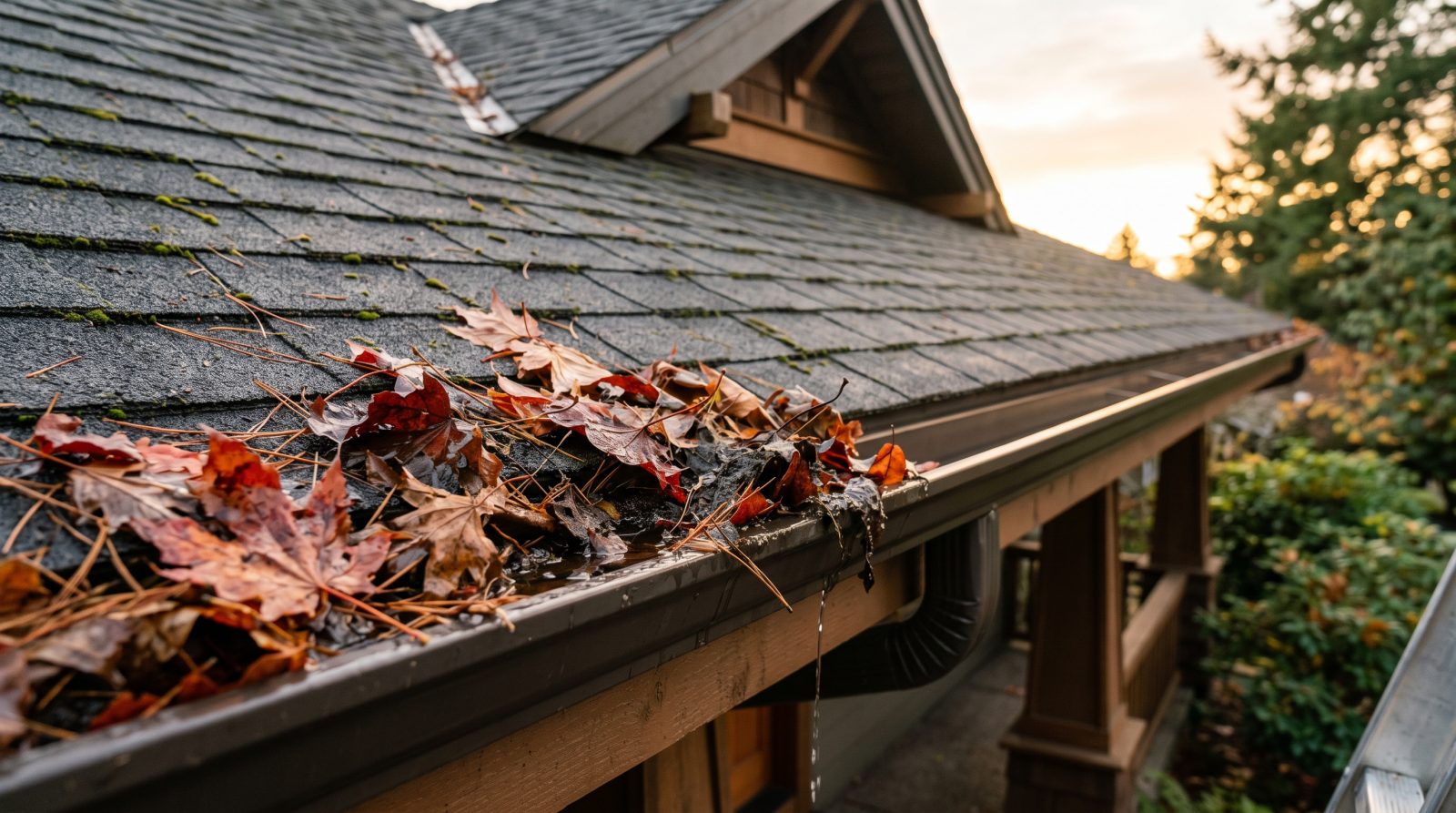
Why Gutters Matter More Than Most Homeowners Realize
It is easy to think of gutters as a minor accessory bolted to the edge of the roof. In reality, they are a water-management system that directs every gallon of rain off your roof and away from your home in a controlled path. A typical roof can shed hundreds of gallons of water during a single heavy storm, and gutters exist to channel that volume to downspouts and out beyond the foundation. When that path is blocked, water finds its own route, and that route almost always runs through something expensive.
The damage from neglected gutters tends to be slow and hidden, which is exactly what makes it dangerous. Water that overflows the back edge of a clogged gutter soaks into the fascia board and roof decking, leading to wood rot that you may not notice until a section feels soft or a stain appears on an interior ceiling. Water that pours straight down beside the house erodes soil, saturates the area around the foundation, and over time can contribute to cracks, settling, and basement or crawlspace moisture.
Functioning gutters also protect things people rarely connect to roofing: exterior paint and siding, window frames, walkways, garden beds, and the grading around the home. Because the cost of gutter maintenance is small compared to the cost of repairing rotted fascia, a damaged roof edge, or a wet foundation, gutter care is one of the highest-return maintenance habits a homeowner can build.
- Protects the roof edge: prevents rot in fascia boards and roof decking from overflow.
- Protects the foundation: keeps concentrated water away from soil and footings.
- Protects siding and paint: stops sheeting water and splash-back staining exterior walls.
- Protects landscaping and walkways: prevents soil erosion and pooling near the home.
- Prevents pest habitats: standing debris in gutters attracts insects and nesting birds.
How Often Should You Clean Your Gutters?
The standard guideline is to clean gutters at least twice a year, typically in late spring and late fall. But that baseline is just a starting point, because the right frequency depends heavily on your trees, your climate, and your roof. A home surrounded by mature trees, especially pines, oaks, or maples, can need cleaning three or four times a year, while a home in an open lot with few overhanging branches may do fine with two.
Climate and region change the math considerably across the country. In the Northeast and Midwest, the heavy autumn leaf drop makes fall cleaning essential before snow and ice arrive, since clogged gutters are a leading cause of ice dams. In the Pacific Northwest and other rainy regions, near-constant moisture and pine needles mean debris breaks down into a dense, slow-draining sludge that may require more frequent attention. In the South and Gulf states, intense storm seasons and fast-growing vegetation can fill gutters quickly, and in arid Southwestern regions, dust, seed pods, and occasional monsoon bursts create their own buildup pattern.
Beyond the calendar, certain events should always trigger an inspection regardless of season. After a major windstorm, a hurricane or tropical system, or any stretch of heavy rain, it is worth checking whether debris has shifted, whether downspouts are flowing, and whether any sections have loosened. The goal is not to follow a rigid schedule but to keep gutters clear before the next heavy rain, not after the damage is done.
- Heavily wooded lots: plan on 3 to 4 cleanings per year, with extra attention in fall.
- Open lots with few trees: twice a year is often sufficient.
- Cold-winter regions: always clear gutters before the first freeze to reduce ice dam risk.
- Rainy or pine-heavy regions: check more often, since needles and sludge drain slowly.
- After major storms: inspect for shifted debris, clogs, and loosened sections.
How to Clean Your Gutters Safely, Step by Step
Gutter cleaning is straightforward, but it happens on a ladder above hard ground, so safety planning matters more than speed. Before anything else, choose a stable, properly rated extension or step ladder, set it on firm level ground, and never lean it against the gutter itself, which can bend or detach the section. Many injuries come from overreaching, so the rule of thumb is to keep your hips between the ladder rails and move the ladder rather than stretching for that last foot of gutter.
The work itself follows a simple sequence. Start by removing the large debris by hand or with a scoop, working away from the downspout so you are not pushing clumps toward the drain. Drop debris into a bucket or onto a tarp below rather than scattering it across the roof. Once the bulk is out, flush the gutter with a garden hose from the far end toward the downspout to confirm the slope is carrying water correctly and to wash out the fine grit that scoops miss. If water backs up at the downspout, you have found a clog that needs clearing from the top or bottom outlet.
While you are up there, take a few minutes to inspect rather than just clean. Look for sagging sections, separated seams, loose or missing fasteners, rust spots on metal gutters, and any gap where the gutter has pulled away from the fascia. Check that downspouts are firmly connected and that their extensions actually carry water several feet away from the foundation. This combined clean-and-inspect approach turns a chore into early detection, which is where most of the savings come from. If you are uncomfortable on a ladder, have a steep or high roof, or notice damage you cannot reach safely, that is the right moment to bring in a professional.
- Gear up: gloves, eye protection, a sturdy bucket or scoop, and a stable rated ladder.
- Have a helper: someone to steady the ladder and hand up tools reduces risk.
- Work toward the downspout: remove large debris first, then flush fine grit with a hose.
- Confirm flow: water should run freely to the downspout and discharge well away from the home.
- Inspect as you go: note sagging, separated seams, rust, loose fasteners, and pulled-away sections.
- Know your limit: steep, high, or multi-story roofs are a job for a professional, not a guess on a tall ladder.
Warning Signs Your Gutters Need Attention Now
Gutters tell you when they are failing if you know what to look for, and most of the signs are visible from the ground. During or right after rain, watch how water behaves. Water spilling over the front or back edge instead of running to the downspout is the clearest sign of a clog or a slope problem. Streaks of dirt on the outside of the gutter, called tiger striping, often mean overflow has been happening for a while.
Other signs show up between storms. Gutters that visibly sag, pull away from the fascia, or tilt the wrong way have lost the secure pitch they need to drain. Peeling paint, rust streaks, or rotting wood along the fascia and soffit point to chronic moisture from overflow. On the ground, look for eroded soil, pooling water, or splash marks on the lower siding directly beneath gutter joints and downspouts, all of which suggest water is landing where it should not. Plant growth inside the gutter, or birds and insects treating it like a planter box, means organic debris has been sitting long enough to hold soil and seeds.
Inside the home, certain symptoms trace back to gutters more often than people expect. Water stains on upper ceilings or walls near the roofline, a damp basement or crawlspace after rain, or a musty smell that worsens during wet weather can all stem from water that gutters failed to carry away. None of these signs should be ignored, because each one represents water already going somewhere it does not belong, and the longer it continues, the more it costs to undo.
- Water overflowing the gutter edge during rain instead of reaching the downspout.
- Sagging, tilting, or sections visibly pulling away from the roofline.
- Peeling paint, rust streaks, or soft, rotting fascia and soffit wood.
- Eroded soil, pooling water, or splash stains on siding beneath the gutters.
- Plants growing in the gutter, or nesting birds and insects in the channel.
- Interior clues: ceiling stains near the roofline, a damp basement, or a musty smell after rain.
Seasonal Gutter Care Across U.S. Climates
Gutter maintenance works best as a seasonal rhythm tailored to your region rather than a one-size-fits-all checklist. Spring is the time to clear out the seed pods, blossoms, and winter debris that accumulate as everything begins to grow again, and to confirm that gutters survived winter without coming loose. It is also a smart moment to check that downspout extensions are repositioned to handle spring rains.
Summer is the lighter season in most regions, but it is the ideal window for repairs and upgrades because the weather is dry and stable. This is when loose fasteners, separated seams, or sagging runs are easiest to address, and when many homeowners consider gutter guards. In storm-prone regions, late summer is also the time to make sure everything is secure ahead of hurricane and severe-storm season. Fall is the most critical cleaning of the year almost everywhere, because falling leaves are the single largest source of clogs, and in colder regions a clean gutter going into winter is the best defense against ice dams.
Winter care depends entirely on where you live. In cold climates, the priority is preventing and watching for ice dams, those ridges of ice that form when heat escaping the roof melts snow that then refreezes at the cold gutter line, forcing water back under the shingles. Keeping gutters clear before the freeze, improving attic insulation and ventilation, and safely removing excess snow from the roof edge all help. In milder and rainy regions, winter is simply the wet season, so the focus stays on keeping water flowing freely. Across every climate, the underlying principle is the same: anticipate the season ahead and clear the path before the weather tests it.
- Spring: clear seed pods and winter debris, reset downspout extensions, check for winter damage.
- Summer: tackle repairs and consider gutter guards while the weather is dry; secure for storm season.
- Fall: the most important cleaning of the year; remove leaves before winter and ice dam season.
- Winter (cold regions): watch for ice dams; improve attic insulation and ventilation; clear roof-edge snow safely.
- Winter (mild/rainy regions): keep channels and downspouts flowing through the wet season.
Gutter Guards, Repairs, and When to Call a Pro
Gutter guards are a popular way to reduce, though not eliminate, cleaning. They come in several styles, from inexpensive mesh screens to micro-mesh, surface-tension, and brush or foam inserts, each with trade-offs in cost, durability, and how well they handle fine debris like pine needles and shingle grit. Quality guards can dramatically cut how often you need to clear large debris, but they still require periodic inspection and occasional cleaning, especially in heavily wooded areas. Costs vary widely depending on the product type, the length of gutter, and your roof, so it is best to weigh the upfront investment against how much cleaning hassle you are trying to avoid.
Many common gutter problems are repairable rather than requiring full replacement. Resealing leaky seams, re-securing loose hangers, correcting the slope so water drains to the downspout, and replacing a damaged section are all routine fixes. Repair generally makes sense when the gutters are structurally sound and the issue is localized. Replacement becomes the better choice when gutters are extensively rusted, repeatedly pulling away, undersized for the roof, or so old that piecemeal fixes no longer hold. Because labor and materials differ by region, gutter and downspout costs are best understood as typical industry ranges that shift with material, linear footage, roof height, and scope, so a hands-on look at your home is the only way to get an accurate number.
Knowing when to bring in a professional is part of good maintenance, not a failure of it. Steep, high, or complex multi-story roofs, signs of fascia or soffit rot, persistent overflow despite cleaning, suspected ice dam damage, or any situation that would put you on a tall ladder in unsafe conditions all warrant a professional assessment. A pro can also evaluate whether the issue is truly the gutters or a deeper roof problem revealing itself at the edge. If you want a clear-eyed look at your gutters, roof edge, and overall roof condition, you can call Roof Repairs at (669) 259-2777 for a free roof assessment and quote. We provide nationwide roofing help and can talk through what your specific situation needs before any work begins.
- Guard types: mesh, micro-mesh, surface-tension, and brush or foam, each with cost and performance trade-offs.
- Guards reduce but do not eliminate maintenance, especially under pines and heavy tree cover.
- Repairable issues: leaky seams, loose hangers, incorrect slope, and isolated damaged sections.
- Consider replacement when gutters are heavily rusted, undersized, or repeatedly failing.
- Call a pro for steep or high roofs, fascia or soffit rot, persistent overflow, or suspected ice dam damage.