What a flat roof membrane actually is (and why low-slope roofs are different)
A "flat" roof is rarely truly flat. Almost every low-slope roof is built with a slight pitch — often around a quarter-inch of fall per foot — so water drains toward scuppers, internal drains, or gutters instead of pooling. Because that slope is so gentle, water sits on the surface far longer than it does on a steep roof, and it can be driven sideways under laps and flashings. That changes everything about how the roof has to be built. Instead of overlapping shingles that each shed water to the one below, a low-slope roof needs a single continuous waterproof layer with as few seams as possible, and every seam and penetration has to be sealed as carefully as the field of the roof itself.
That continuous layer is the membrane. The three dominant single-ply membranes used across the U.S. — TPO, EPDM, and PVC — are large sheets, typically rolled out across the roof deck and then joined at the seams. TPO and PVC seams are usually heat-welded, which fuses neighboring sheets into what is effectively one piece of material. EPDM seams are bonded with adhesive seam tape. How those seams are made is one of the biggest predictors of how long the roof lasts, because seams and flashings — not the open field — are where the overwhelming majority of low-slope leaks begin.
Below the membrane sits the rest of the assembly, and it matters just as much as the top layer: the structural deck, a layer of rigid insulation (which also helps establish slope on some roofs via tapered boards), and often a cover board that protects the membrane from the insulation and from foot traffic. A premium flat roof is a system, not a single product. The best membrane installed over wet insulation or a failing deck will still fail.
- Membrane: the waterproof top layer (TPO, EPDM, or PVC) that you actually see
- Seams: where sheets join — heat-welded (TPO/PVC) or tape-bonded (EPDM); the #1 leak point
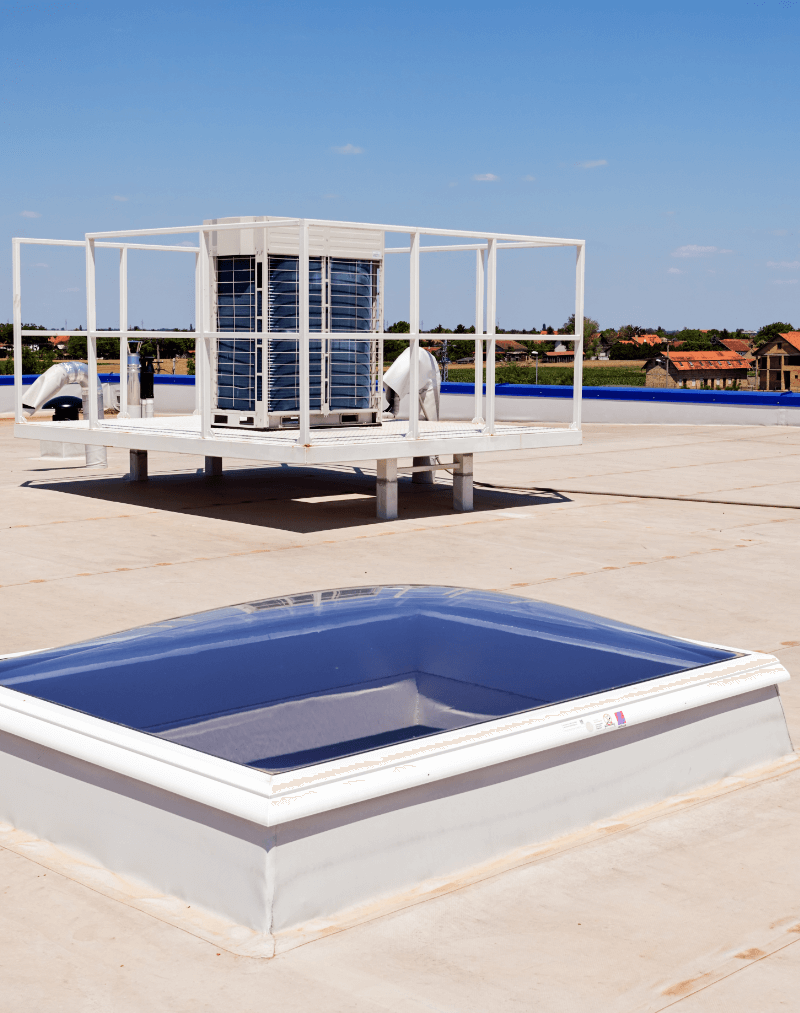
- Flashings: the detailing around walls, curbs, pipes, drains, and HVAC units — the #2 leak point
- Insulation + cover board: what's under the membrane; drives energy performance and durability
- Deck: the structural surface everything is fastened or adhered to
TPO vs. EPDM vs. PVC: how the three single-ply membranes compare
TPO (thermoplastic polyolefin) is the most widely installed commercial low-slope membrane in the country today, and it's increasingly common on residential flat roofs too. It's usually white, which reflects sunlight and can reduce cooling loads in hot climates — a meaningful advantage in the South and Southwest. Its seams are hot-air welded, creating strong, monolithic joints. TPO has matured a great deal over the years, and reputable manufacturers now offer long warranties on quality formulations. As with any product category, the cheapest membranes are not the ones that age best, so the specific product and thickness matter.
EPDM (ethylene propylene diene monomer) is a synthetic rubber membrane and the long-established veteran of the category — it has decades of real-world track record on roofs across the country. It's most often black, which makes it a strong performer in cold northern climates where its dark surface helps shed snow and absorb warmth, though reflective (white) EPDM and coatings exist. EPDM is prized for flexibility and resistance to weathering and UV, and it handles temperature swings well. Its traditional weak point has historically been seams, which are adhered with tape rather than welded; modern seam systems are reliable when installed correctly, but seam quality is heavily dependent on workmanship.
PVC (polyvinyl chloride) is the premium single-ply membrane and typically the most expensive of the three. Like TPO, it's heat-welded and usually light-colored and reflective. PVC's signature strength is chemical resistance — it stands up to grease, oils, and animal fats far better than TPO or EPDM, which is why it's the default choice for restaurants and any building venting kitchen exhaust onto the roof. It's also highly resistant to fire and ponding water. For demanding commercial environments, PVC often justifies its higher price; for a simple residential flat roof with no chemical exposure, it may be more membrane than the job requires.
There's no single "best" membrane — there's a best fit for your climate, your roof's exposures, your budget, and the quality of the crew installing it. A correctly installed mid-grade membrane will outlast a premium membrane that was rushed.
- TPO — reflective (usually white), heat-welded seams, strong value, popular in hot climates; choose quality formulations and adequate thickness
- EPDM — rubber, very durable and flexible, taped seams, often black and well-suited to cold/snowy regions; seam workmanship is critical
- PVC — heat-welded, reflective, best chemical/grease resistance, premium price; the standard for restaurants and harsh commercial exposures
- Across all three: thickness (mil/gauge), attachment method, and installer skill matter more than the brand name on the roll
How membranes are attached — and why it affects performance
The same membrane can be installed several different ways, and the attachment method affects wind performance, energy efficiency, and how the roof handles a building's movement. The three common approaches are mechanically fastened, fully adhered, and ballasted. Understanding the trade-offs helps you ask better questions and recognize whether a bid is matched to your building.
A mechanically fastened system uses plates and screws to anchor the membrane to the deck along the seams, then welds or tapes the next sheet over the fasteners. It's generally the most economical and installs quickly, but the membrane can flutter slightly in high wind, and the fasteners create thermal bridges. A fully adhered system glues the entire membrane down to the substrate, producing a smooth, taut surface with excellent wind uplift resistance and a cleaner look — at a higher material and labor cost. A ballasted system lays the membrane loose and holds it down with stone ballast or pavers; it's economical and protects the membrane from UV, but it adds significant weight the structure must support and complicates leak tracing.
Wind matters more than many homeowners expect. In hurricane-prone coastal regions and high-wind zones, the attachment method and fastening pattern are often dictated by local building code and manufacturer wind ratings, not just preference. A reputable roofer designs the attachment to the building's exposure and the code in your jurisdiction, which vary considerably from a calm inland suburb to a Gulf Coast or Florida property.
- Mechanically fastened — economical and fast; good general-purpose choice; some movement in high wind
- Fully adhered — smooth, taut, excellent wind resistance; higher cost; common where uplift or aesthetics matter
- Ballasted — loose-laid under stone/pavers; protects membrane from UV but adds weight and makes leaks harder to find
- Coastal and high-wind areas often have code-driven fastening requirements — confirm these before signing a bid
What flat roof membrane roofing typically costs
Cost is one of the first questions homeowners and building owners ask, and the real number depends on factors no one can see from the curb. The figures below are typical industry ranges intended for planning, not a quote. Your actual price varies with your region and local labor rates, the size and complexity of the roof, the membrane type and thickness you choose, the attachment method, how much insulation is added or replaced, the number of penetrations and curbs that need flashing, and whether old roofing has to be torn off or can be recovered.
As a rough guide, professionally installed single-ply membrane roofing commonly falls somewhere in the range of several dollars to roughly a dozen-plus dollars per square foot for the finished system, with EPDM and TPO generally occupying the lower-to-middle portion of that band and PVC typically landing at the higher end. Tear-off of an old roof, new tapered insulation, structural deck repairs, or heavy detailing around rooftop equipment can push a project well beyond the simple per-square-foot math. Conversely, a straightforward recover over a sound existing roof can come in lower.
The most expensive flat roof is usually the one that has to be redone because it was installed cheaply. When you compare bids, compare the whole scope — membrane type and thickness, insulation R-value, attachment method, flashing details, drainage corrections, and the warranty — not just the bottom-line number. The lowest bid often wins by quietly leaving something out. To get a figure for your specific roof, call (669) 259-2777 for a free assessment.
- Costs vary widely by region, roof size, membrane, and scope — figures here are typical industry estimates for planning, not a quote
- Biggest cost drivers: roof size/complexity, membrane type and thickness, insulation, tear-off vs. recover, and detailing
- EPDM and TPO usually sit lower-to-mid range; PVC typically commands a premium for its chemical and fire resistance
- Compare full scope and warranty across bids, not just price — the cheapest bid often omits insulation or detailing
Choosing the right membrane for your roof and climate
The right membrane starts with three honest answers: what's your climate, what does your roof get exposed to, and what's your budget over the life of the roof rather than just at install. In hot, sun-heavy regions, a reflective white membrane like TPO or PVC can lower attic and cooling loads, and the reflectivity also slows UV degradation. In cold, snowy northern climates, EPDM's dark, flexible rubber has a long, proven track record and tolerates freeze-thaw cycling well. These are general tendencies, not absolutes — a well-specified version of any of the three can perform in most regions.
Exposure is the tiebreaker that catches people off guard. If your roof vents kitchen grease, sees industrial chemicals, or collects oily runoff, PVC is the safe long-term choice because TPO and EPDM degrade faster under those conditions. If your roof tends to hold water — a poorly drained low-slope roof with persistent ponding — that's both a reason to favor a ponding-resistant membrane and, more importantly, a signal to fix the drainage and slope, because standing water shortens the life of any membrane and voids many warranties.
Finally, weigh the warranty and the installer together, because one is worthless without the other. Manufacturer warranties on quality single-ply systems can be long, but most require certified installation and proper detailing to remain valid — a warranty is only as good as the crew that earns it. Don't choose a membrane in a vacuum; choose the membrane-plus-installer combination that fits your building. A nationwide roofing resource and service like Roof Repairs can walk you through the trade-offs for your specific roof, climate, and budget. Call (669) 259-2777 for a free roof assessment and a straight answer on which system fits.
- Hot/sunny regions: reflective TPO or PVC can reduce cooling load and slow UV wear
- Cold/snowy regions: EPDM's flexible rubber has a long, proven cold-climate track record
- Grease, chemicals, or oils on the roof: PVC is the durable long-term choice
- Persistent ponding water: correct the drainage and slope first — standing water shortens any membrane's life and can void warranties
- Always evaluate the membrane and the installer together — certification and detailing keep the warranty valid