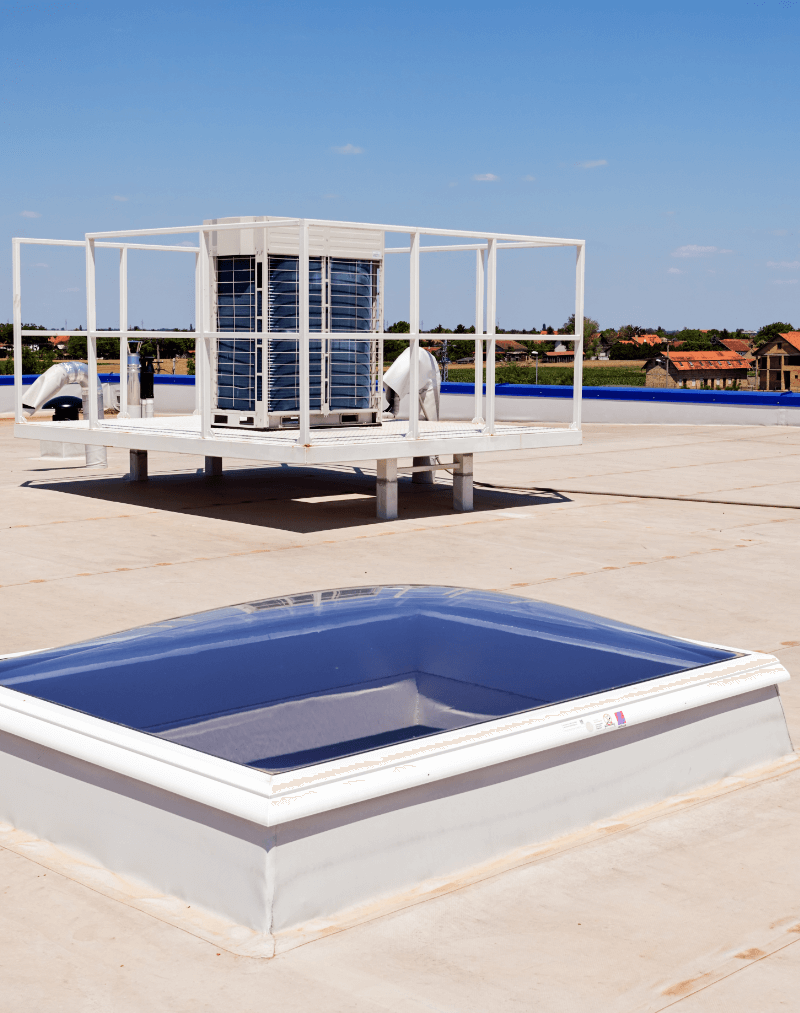
What "flat" really means (and why slope still matters)
A flat roof is almost never perfectly flat. In the trade it's called a low-slope roof, and a well-built one carries a slight pitch — often somewhere around a quarter-inch of fall per foot — so that water is nudged toward drains rather than left to sit. That subtle slope is the single most important thing separating a flat roof that lasts decades from one that fails early. When water ponds and lingers for more than a day or two after rain, it accelerates membrane breakdown, magnifies any weakness at a seam, and adds weight the structure was not meant to hold indefinitely.
Flat roofing is common on commercial buildings, modern and mid-century homes, additions, porches, garages, and dormers. The appeal is real: usable rooftop space, simpler geometry, easier access for HVAC equipment, and a clean architectural line. The trade-off is that a low-slope roof depends almost entirely on a continuous waterproof membrane and properly detailed edges, rather than on gravity and overlapping shingles. There's less margin for sloppy work, which is exactly why material choice and installation quality matter so much.
- Low slope means water is directed, not drained by gravity — so drainage design is critical
- Ponding water (standing more than 48 hours after rain) is a warning sign, not a cosmetic quirk
- The membrane and the flashing details, not the field of the roof, are where most failures begin
- Common on commercial buildings, modern homes, additions, garages, porches, and dormers
The main flat roofing systems, compared
Most flat roofs today use one of a handful of proven systems, and choosing well depends on your climate, your budget, how the roof is used, and how long you plan to stay. Below are the systems a reputable roofer will discuss with you. None is universally "best" — each has a place.
TPO (thermoplastic polyolefin) is a single-ply membrane that has become extremely popular, especially in commercial work. It's heat-welded at the seams to create a continuous bond, and its light-colored surface reflects sunlight, which can help in hot climates. EPDM (a durable synthetic rubber, often dark) is one of the longest-tenured single-ply systems, valued for flexibility in cold weather and a long track record. PVC membrane is also heat-welded and is prized for resistance to grease, chemicals, and ponding — a reason it's frequently chosen for restaurants and buildings with rooftop equipment. Modified bitumen is an asphalt-based system applied in layers, a modern evolution of traditional built-up roofing that suits foot traffic and many residential low-slope applications. Built-up roofing (the classic "tar and gravel" approach) layers asphalt and reinforcing felts and still performs well where it's appropriate. Spray polyurethane foam (SPF) is sprayed as a seamless, insulating layer and recoated periodically.
A good roofer matches the system to the building rather than to whatever they install most. Ask why they're recommending a particular membrane, how its seams are joined, what insulation goes underneath, and how the edges and penetrations will be flashed — that's where systems live or die.
- TPO — heat-welded single-ply, reflective surface; popular on commercial and many homes
- EPDM — long-proven rubber membrane; flexible and resilient in cold climates
- PVC — heat-welded, strong against grease, chemicals, and ponding; common over kitchens/equipment
- Modified bitumen — layered asphalt system; handles foot traffic, common on residential low-slope
- Built-up roofing (BUR) — traditional layered "tar and gravel," still effective where suited
- Spray foam (SPF) — seamless, insulating, periodically recoated
Flat roof installation and replacement: what to expect
A proper flat roof installation is a sequence, not a single act. It starts with tearing off or evaluating the existing roof, inspecting and repairing the deck, and confirming the slope and drainage actually move water where it needs to go. Insulation is installed to the right thickness and, where needed, tapered to build positive slope. The membrane is then laid and bonded — mechanically fastened, fully adhered, or ballasted depending on the system — and every seam is welded or sealed. Finally, the details that cause most leaks are addressed: flashing at walls and curbs, boots around pipes, edge metal, and the drains or scuppers themselves.
Replacement is the same process with the added decision of how much of the old assembly to remove. Sometimes a tear-off down to a sound deck is the right call; other times a recover or restoration is viable. A trustworthy roofer explains the condition they actually found and recommends accordingly, rather than defaulting to the most expensive option. Permitting and local code requirements vary widely by jurisdiction, and a professional should handle that as part of the job.
Timeline depends on size, access, the system, and weather. A modest residential flat roof may be a short job; a large commercial roof with rooftop equipment takes longer and more planning. Weather is a real constraint — membranes and adhesives need appropriate conditions to bond correctly.
- Deck inspection and repair before anything else — a bad deck dooms a good membrane
- Insulation and tapered slope to eliminate ponding and improve energy performance
- Membrane installed and seams welded/sealed per the chosen system
- Flashing, pipe boots, edge metal, and drains detailed carefully — the usual leak points
- Tear-off vs. recover/restoration decided by actual deck and membrane condition
- Permits and code handled by the contractor; timeline varies with size, access, and weather
Flat roof repair: common problems and how they're fixed
Most flat roof leaks don't come from the wide-open field of the membrane — they come from the transitions and the spots where water concentrates. Knowing the usual suspects helps you describe the problem accurately and understand the fix.
Seam failures occur when welded or adhered joints separate over time, letting water under the membrane. Flashing problems at walls, curbs, skylights, and parapets are extremely common, since those vertical transitions take constant stress. Pipe boots and penetrations crack and let water in around vents and conduits. Ponding water that never drains will degrade almost any membrane and often points to a slope or drain problem rather than the membrane itself. Punctures and blisters can come from dropped tools, foot traffic, debris, or trapped moisture. Failing or undersized drains and clogged scuppers back water up onto the roof, turning a drainage issue into a leak.
Repairs range from spot work — re-welding a seam, patching a puncture, rebuilding a flashing detail, replacing a cracked pipe boot, clearing or adding drains — to recoating or restoring an aging but structurally sound membrane to extend its life. The honest first step is always a real inspection. A leak that shows up inside a room is often traveling from an entry point feet away, so chasing the interior stain rarely finds the true source. If you're dealing with an active leak, it's worth getting eyes on the roof before water finds its way into insulation and decking. Roof Repairs offers nationwide flat roof repair help — call (669) 259-2777 to talk it through.
- Seam separation — re-welded or re-sealed
- Flashing failures at walls, curbs, skylights, parapets — rebuilt and re-detailed
- Cracked pipe boots and penetrations — sealed or replaced
- Ponding water — addressed at the drainage/slope level, not just the surface
- Punctures and blisters — patched; trapped-moisture blisters investigated, not just covered
- Clogged or undersized drains/scuppers — cleared, repaired, or upgraded
Cost factors and typical ranges (estimates that vary)
There's no honest single price for a flat roof, because the number depends on real variables: the size and complexity of the roof, the membrane system you choose, how much tear-off and deck repair is needed, insulation, the number of penetrations and edges to flash, access and safety requirements, and local labor and material costs — which differ meaningfully by region. The figures below are typical industry ranges meant for orientation only; they are estimates that vary by region, material, roof size, and scope, not a quote.
As a rough frame of reference, flat roof repairs commonly fall anywhere from a few hundred dollars for a small, localized fix to a few thousand dollars when flashing, drains, or a larger area are involved. Full installation or replacement is usually priced per square foot of roof area and can range widely with the system and scope — a simple residential low-slope roof sits at the lower end, while a large or complex commercial roof with significant tear-off, insulation, and equipment around it sits much higher. Premium systems, heavy tear-off, structural deck repair, and difficult access all push costs up.
The right way to get a real number is a roof-specific assessment. A reputable roofer measures the roof, inspects the deck and existing system, and gives you a written estimate that spells out the scope — not a guess over the phone. Be cautious of any quote given without someone actually evaluating the roof. To get a free roof assessment for your building, call (669) 259-2777.
- Roof size and complexity (penetrations, edges, equipment, parapets)
- Membrane system chosen and the insulation beneath it
- Amount of tear-off and any structural deck repair required
- Drainage work — drains, scuppers, tapered insulation to fix ponding
- Access, safety, and height requirements
- Regional labor and material costs — these vary significantly across the U.S.
Lifespan, maintenance, and regional climate
A flat roof's lifespan depends far more on installation quality and maintenance than on the brochure number for any given membrane. With sound installation and regular care, modern flat roofing systems routinely deliver many years — and often a couple of decades or more — of service. Neglect, ponding, and unaddressed small leaks are what cut that short. The cheapest roofing dollar you'll ever spend is the one that catches a problem while it's still a patch instead of a replacement.
Climate shapes both the choice of system and the maintenance rhythm. In hot, sunny regions, UV exposure and heat are the dominant stressors, and reflective membranes plus periodic recoating help. In cold and snowy regions, freeze-thaw cycles, ice, and the weight and meltwater of snow demand flexible membranes and flawless drainage. In areas with heavy rain or storms, drainage capacity and wind-rated edge details matter most. In humid or coastal climates, ongoing moisture and debris make routine clearing of drains essential. A roofer who knows your region will weigh these factors rather than installing the same thing everywhere.
Good maintenance is simple and high-leverage: inspect at least a couple of times a year and after major storms, keep drains and scuppers clear, remove debris, look for ponding and address its cause, and have seams, flashing, and penetrations checked by a professional periodically. Catching the small stuff is how a flat roof reaches the upper end of its potential life. If you'd like your flat roof assessed by a professional, Roof Repairs provides nationwide help — call (669) 259-2777 for a free roof assessment.
- Lifespan tracks installation quality and upkeep more than any single material spec
- Hot/sunny climates — UV and heat; reflective surfaces and recoating help
- Cold/snowy climates — freeze-thaw, ice, and snow load; flexibility and drainage are key
- Rainy/stormy regions — drainage capacity and wind-rated edges matter most
- Maintenance basics: inspect twice a year and after storms, keep drains clear, fix ponding causes, address small leaks early