Why Knowing Roofing Terms Actually Saves You Money
A roof is a system, not a single product. The shingles you see from the street are the last layer in a stack that includes decking, underlayment, flashing, ventilation, and drainage details — and a failure in any one of those layers can cause a leak even when the shingles look perfect. When you understand the vocabulary, you can read an estimate the way a pro does: line by line, checking that the parts that matter are actually included.
Vague estimates are where money quietly disappears. A proposal that says 'replace roof' tells you almost nothing. A proposal that specifies tear-off versus overlay, the underlayment type, new flashing at the chimney and walls, ridge ventilation, and the number of squares tells you exactly what you're paying for — and lets you compare bids on equal footing. Two quotes can differ by thousands of dollars simply because one includes new flashing and proper ventilation and the other reuses the old materials.
The terms below are grouped roughly the way a roof is built, from the structure up to the surface and the details that keep water out. You don't need to memorize them. Skim for the words you've seen on your own estimate, and use this as a reference you can come back to.
Structure and Underlayers: What Holds the Roof Up
Before any visible roofing goes on, there's a structural foundation and a set of protective layers beneath the surface. These are the parts most homeowners never see — and the parts most likely to be quietly skipped or reused on a cheap job. Understanding them helps you judge whether an estimate covers the full system or just the top layer.
Climate matters here. In cold-winter regions, the underlayers do extra work defending against ice and trapped moisture, while in hot, sun-baked regions the focus shifts toward heat tolerance and ventilation. A good contractor adjusts the spec to your conditions rather than installing the same stack everywhere.
- Decking (sheathing): The structural wood surface — usually plywood or OSB — nailed to the rafters or trusses. Everything else fastens to it. Soft, rotted, or delaminated decking must be replaced before new roofing goes on; many estimates list a per-sheet price for unexpected deck replacement found during tear-off.
- Rafters / trusses: The framing members beneath the decking that carry the roof's load. Rafters are individual sloped beams; trusses are prefabricated triangular frameworks. These are part of the structure rather than the roof covering, but sagging here points to a deeper problem.
- Underlayment: A water-resistant layer installed over the decking and under the shingles. Traditional felt (tar paper) is being widely replaced by synthetic underlayment, which is lighter, tougher, and more resistant to tearing and moisture.
- Ice and water shield: A self-adhering, waterproof membrane installed in leak-prone areas — eaves, valleys, around penetrations, and along walls. In cold climates it's a key defense against ice dams; many local codes require it along the eaves.
- Drip edge: A metal strip installed along the eaves and rakes that directs runoff into the gutters and away from the fascia and decking. It's inexpensive, code-required in most areas, and frequently omitted on low-bid jobs.
- Fascia: The horizontal board running along the roof's lower edge, behind the gutters. It supports the gutter system and is a common spot for rot when water overflows or backs up.
Roofing Materials and How They're Measured
The covering is what most people picture when they think 'roof.' Materials vary widely in cost, lifespan, weight, and how they perform in different climates — there's no single best choice for the whole country. The right material depends on your roof's slope, your local weather, your budget, and how long you plan to own the building.
Measurement language trips up almost everyone. Roofers price and order by the 'square,' not the square foot, and the slope of your roof changes how much material a given footprint actually requires. Knowing these units helps you sanity-check an estimate and understand why a steeper or more complex roof costs more.
As a general guide, asphalt shingles are the most common and affordable option nationwide, while metal, tile, and slate cost more upfront but can last much longer. Any cost figures you see should be treated as typical industry ranges that vary significantly by region, material grade, roof size, slope, and complexity — never a fixed quote.
- Asphalt shingles: The most widely used residential roofing in the U.S. 'Three-tab' shingles are flat and uniform; 'architectural' (dimensional/laminate) shingles are thicker, layered, and longer-lasting, with a more textured look.
- Metal roofing: Panels or shingles made of steel, aluminum, or other metals. Known for long lifespan, fire resistance, and shedding snow well; popular in both snowy and wildfire-prone regions, though pricing runs higher than asphalt.
- Tile (clay or concrete): Heavy, durable, and common in hot and coastal climates, especially the Southwest. Excellent longevity but requires a structure that can bear the weight.
- Slate: A natural stone roofing prized for its lifespan and appearance, at a premium cost and weight. Most often seen on historic or high-end homes.
- Flat-roof membranes (TPO, EPDM, modified bitumen): Single-ply or rolled systems used on low-slope and commercial roofs, where shingles can't shed water effectively.
- Square: The roofing unit of area — one square equals 100 square feet of roof surface. Roofs are measured and materials ordered in squares.
- Pitch / slope: How steep the roof is, expressed as rise over run (e.g., '6:12' means it rises 6 inches for every 12 horizontal inches). Steeper pitches are harder and costlier to work on and affect which materials are suitable.
- Course: A single horizontal row of shingles or other roofing material. Shingles are installed in overlapping courses from the bottom up.
- Exposure: The visible portion of each shingle that isn't covered by the course above it. Correct exposure is critical to weather resistance.
Flashing, Valleys, and the Details That Stop Leaks
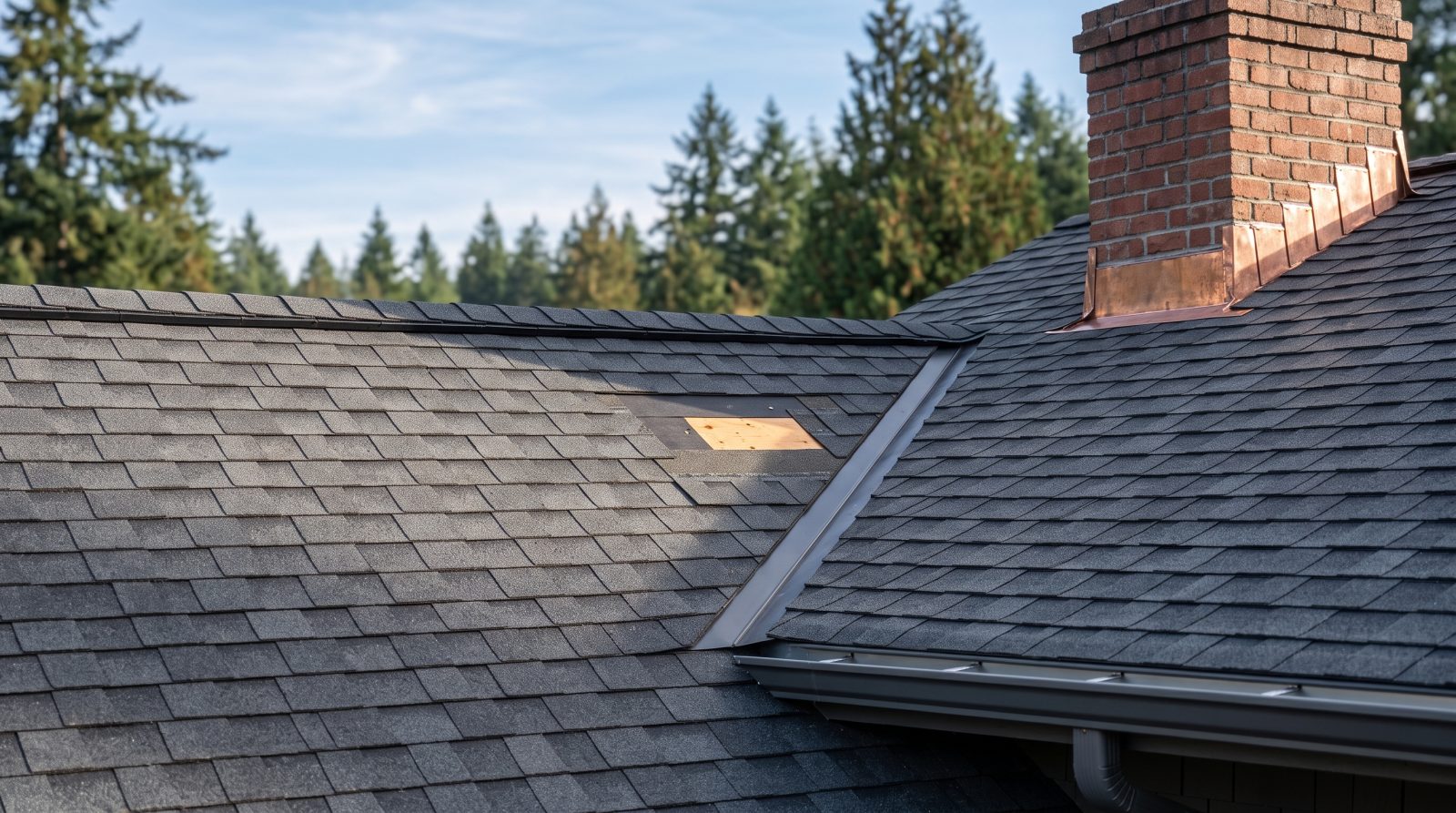
Most roof leaks don't start in the open field of shingles — they start at the transitions and penetrations, the places where the roof meets a wall, a chimney, a vent pipe, or another roof plane. These details are where workmanship matters most, and where corners get cut most often. Reusing old, rusted flashing to save money is one of the most common causes of leaks on an otherwise new roof.
When you compare estimates, pay close attention to whether flashing is being replaced or reused, and whether valleys and penetrations are addressed specifically. A line item like 'new step flashing at chimney and walls' is a sign of a thorough scope; silence on flashing is a red flag.
- Flashing: Thin metal pieces installed to seal joints and transitions against water — wherever the roof meets a wall, chimney, skylight, or another roof surface. The general category that includes the specialized types below.
- Step flashing: Individual L-shaped metal pieces woven into the courses where a roof plane meets a vertical wall. Each piece overlaps the one below, 'stepping' up the slope.
- Counter-flashing: A second layer of flashing — often set into a chimney's masonry — that covers the top edge of the base or step flashing to keep water from getting behind it.
- Valley: The internal angle where two roof planes meet and channel water downward. Valleys carry heavy water flow and are common leak points; they may be 'open' (exposed metal) or 'closed' (covered with shingles).
- Pipe boot (vent boot): A flexible collar that seals around plumbing vent pipes and other small penetrations. The rubber gasket commonly cracks with age and is a frequent, easily overlooked leak source.
- Eave: The lower edge of the roof that overhangs the exterior wall. The rake is the sloped edge at the gable end of the roof.
- Ridge: The horizontal peak where two roof planes meet at the top. The hip is the sloped external angle where two planes meet, running down from the ridge to the eave.
Ventilation, Drainage, and Common Problem Terms
A roof has to breathe and it has to drain. Proper attic ventilation moves heat and moisture out of the space below the decking, which protects the structure, helps shingles last, and reduces problems like ice dams in winter and excessive heat buildup in summer. Drainage — gutters, downspouts, and the slope of the roof itself — moves water off and away from the building. When either system is undersized or blocked, problems show up fast.
It also helps to recognize the words contractors use for things that go wrong. Knowing the difference between an ice dam, granule loss, and ponding water lets you describe what you're seeing accurately and understand a diagnosis when you get one. Many of these issues are caught early during a routine inspection, long before they become a major repair.
- Soffit: The underside of the eaves, often vented to let fresh air enter the attic. Soffit vents work together with ridge or other exhaust vents to create airflow.
- Ridge vent: An exhaust vent running along the roof's peak that lets hot, moist air escape from the attic. Paired with soffit intake vents, it forms a balanced ventilation system.
- Ice dam: A ridge of ice that forms at the eave when heat escaping into the attic melts snow higher up, which then refreezes at the colder edge. The backed-up water can force its way under the shingles — a major concern in cold and snowy regions.
- Granules: The mineral coating on asphalt shingles that protects them from UV rays. Heavy granule loss (often visible as bald spots or grit in the gutters) signals aging or damaged shingles.
- Ponding water: Standing water that doesn't drain off within a reasonable time, most common on flat or low-slope roofs. Persistent ponding accelerates membrane wear and leaks.
- Tear-off vs. overlay: A tear-off removes the existing roofing down to the decking before installing new material; an overlay (re-roof) lays new shingles over the old. Overlay can be cheaper but hides the decking's condition, adds weight, and isn't allowed everywhere by code.
- Penetration: Any object that passes through the roof surface — vent pipes, chimneys, skylights, exhaust fans. Each penetration needs proper flashing or a boot to stay watertight.
How to Use This Glossary When You Get an Estimate
When a roofing proposal lands in your inbox, read it with this glossary open. Confirm it specifies whether the job is a tear-off or an overlay, names the underlayment, and explicitly includes new flashing at every wall, chimney, and penetration. Check that ventilation is addressed and that drip edge is included. The presence of these line items tells you the contractor is pricing the full system, not just the surface.
If two estimates are far apart on price, the terms usually explain the gap. The lower bid may be reusing flashing, skipping the ice-and-water shield where code expects it, or planning an overlay instead of a tear-off. None of that is automatically wrong, but you deserve to know which corners are being cut and why. Ask the contractor to walk you through the scope in plain language — a good one will be glad to.
If you'd like a second set of eyes on your roof or your estimate, Roof Repairs offers nationwide roofing help and free roof assessments. Call (669) 259-2777 to talk through your roof's condition and get a clear explanation of what your roof actually needs.