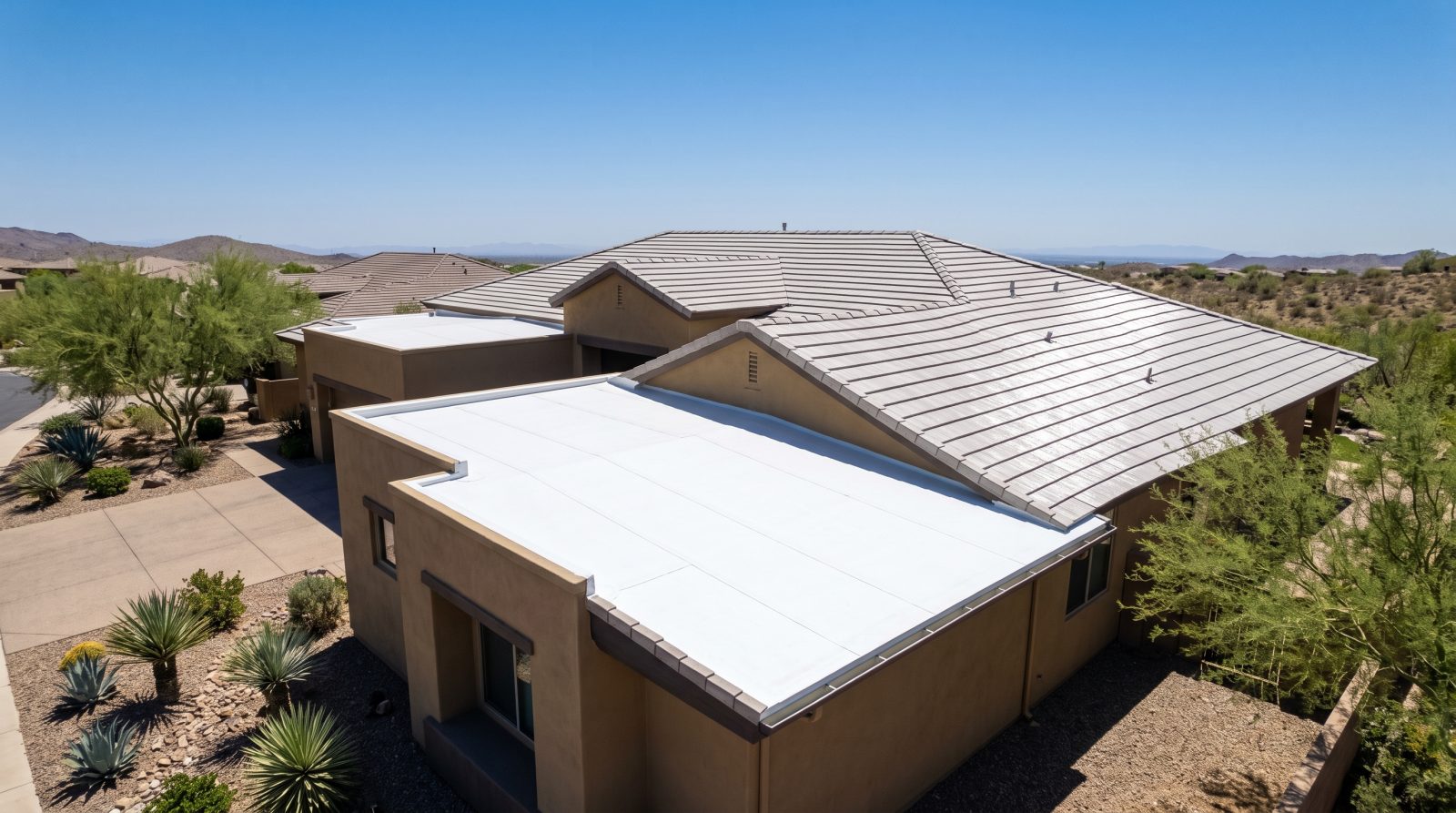
What Makes a Roof Energy-Efficient
Energy efficiency at the roof comes down to controlling three things: how much solar heat your roof absorbs, how quickly it releases the heat it does absorb, and how well your attic or roof assembly stops that heat from migrating into your living space. A dark, absorptive roof on a sunny day can reach 150-190°F on its surface, radiating heat downward all afternoon and well into the evening. A reflective, well-vented, well-insulated roof can run dramatically cooler, which means less heat pushing into the house and less work for your air conditioner.
The phrase 'cool roof' specifically refers to roofing engineered to reflect more sunlight and emit absorbed heat more efficiently than a standard roof. But a truly energy-efficient roof is a system, not a single product. The covering matters, but so does the underlayment, the radiant barrier or above-deck insulation, the attic insulation, and — critically — the ventilation that lets hot air escape instead of baking the underside of your deck. Upgrading one layer while ignoring the others leaves savings on the table.
It's also worth understanding that efficiency isn't only a summer story. In colder regions, the same insulation and air-sealing that keep cool air in during summer keep expensive heat from escaping in winter. The right balance of reflectivity, insulation, and ventilation depends heavily on where you live, which is why a one-size-fits-all answer rarely serves a homeowner well.
- Solar reflectance: how much sunlight the surface bounces away instead of absorbing
- Thermal emittance: how readily the surface sheds heat it has absorbed
- Insulation: the attic or above-deck barrier that slows heat transfer into the home
- Ventilation: intake and exhaust airflow that flushes hot air out of the attic
- Air-sealing: closing gaps so conditioned air stays inside year-round
Understanding Cool-Roof Ratings: SRI, Reflectance & Emittance
When you shop for energy-efficient roofing, you'll encounter a few technical numbers. Solar Reflectance (SR) is measured on a 0-to-1 scale and tells you what fraction of sunlight the surface reflects — higher is cooler. Thermal Emittance (TE), also 0 to 1, measures how efficiently the material radiates absorbed heat back out rather than holding it. The Solar Reflectance Index (SRI) combines both into a single, easier-to-compare number where higher generally means a cooler-running roof.
A widely recognized independent organization, the Cool Roof Rating Council (CRRC), tests and publishes these values for roofing products so you can compare apples to apples instead of trusting marketing claims. The ENERGY STAR program also certifies qualifying reflective roofing. When a contractor or manufacturer cites these ratings, you can ask to see the product's listed values rather than relying on general descriptions like 'reflective' or 'cool.'
Ratings matter most in hot and sunny climates, where a high-reflectance roof can meaningfully reduce attic and indoor temperatures. In predominantly cold climates, very high reflectance offers smaller benefits and the focus shifts toward insulation, air-sealing, and managing snow and ice. This is the kind of regional nuance worth discussing before you commit to a specific product.
- Solar Reflectance (SR): 0-1, higher reflects more sunlight
- Thermal Emittance (TE): 0-1, higher sheds absorbed heat faster
- Solar Reflectance Index (SRI): combined score, higher tends to run cooler
- Look for CRRC-listed values and ENERGY STAR certification on the actual product
- Reflectance pays off most in hot, sun-heavy regions; insulation leads in cold ones
Energy-Efficient Roofing Materials Compared
Almost every roofing category now offers an energy-efficient option, so the right choice depends on your climate, budget, roof slope, and how long you plan to stay in the home. Reflective and 'cool' asphalt shingles use specially engineered granules to bounce more sunlight than standard shingles, making them an accessible upgrade for many homeowners who want the familiar look of asphalt with better performance.
Metal roofing is one of the strongest performers for energy efficiency. Bare or light-colored metal is naturally reflective, and reflective coatings push performance further. Metal also tends to be long-lived and pairs well with above-deck insulation and ventilation. Tile and clay roofs — common in warmer regions — have natural thermal mass and an air gap under the tile that can reduce heat transfer, and they're available in lighter, more reflective finishes.
On flat or low-slope roofs, single-ply membranes such as TPO and PVC are frequently chosen in bright white for very high reflectance. Slate and some composite products offer durability with respectable performance depending on color and finish. The key takeaway: within almost any material you prefer, there is usually a lighter-colored, higher-reflectance, or coated version that improves efficiency without forcing you into an unfamiliar roof type.
- Reflective / cool asphalt shingles: familiar look, accessible upgrade path
- Metal roofing: naturally reflective, long-lived, great with added insulation
- Tile & clay: thermal mass plus an air gap; strong in hot, sunny regions
- TPO / PVC membranes: high reflectance for flat and low-slope roofs (often white)
- Color matters: lighter finishes generally reflect more and run cooler
- Coatings: reflective coatings can boost an existing or new roof's performance
Insulation, Ventilation & the Whole-System Approach
A reflective covering is only as effective as the system beneath it. Attic insulation is the workhorse of year-round efficiency: it slows heat from entering in summer and escaping in winter. Many older homes are under-insulated by today's standards, and adding insulation is often one of the most cost-effective efficiency improvements you can make alongside a roof project. Recommended insulation levels vary by climate zone, with colder regions calling for substantially more than mild ones.
Ventilation is the partner to insulation. A balanced system of intake vents (typically at the soffits/eaves) and exhaust vents (at or near the ridge) lets hot, moist air flush out of the attic instead of accumulating. Good ventilation reduces attic temperatures in summer, helps prevent moisture problems and premature shingle aging, and in cold climates plays a key role in reducing ice dams by keeping the roof deck closer to outdoor temperature.
Radiant barriers and above-deck (continuous) insulation are additional tools, especially in hot climates. A radiant barrier reflects heat away from the attic, and continuous insulation over the deck reduces the thermal bridging that happens through rafters. The smartest projects look at all of these together — covering, insulation, ventilation, air-sealing — so each dollar contributes to a roof that performs as a unified system rather than a patchwork.
- Attic insulation: the biggest year-round lever; target levels rise in colder zones
- Balanced ventilation: intake at the eaves plus exhaust at the ridge
- Radiant barriers: reflect attic heat, most valuable in hot, sunny climates
- Above-deck insulation: cuts heat loss through rafters (thermal bridging)
- Air-sealing: close attic-to-living-space gaps before adding insulation
Costs, Savings & Payback (Typical Industry Ranges)
Energy-efficient roofing usually carries a modest premium over a standard version of the same material — reflective shingles cost a bit more than basic shingles, coated or premium metal costs more than the most basic panels, and so on. The exact figures vary widely by region, roof size and pitch, material grade, tear-off and disposal needs, and local labor rates, so any number here should be treated as a general industry estimate, not a quote. As a rough frame, energy-focused upgrades and add-ons (like reflective coatings, added insulation, or improved ventilation) often add a meaningful but manageable amount to a roofing budget rather than doubling it.
On the savings side, the benefit shows up mainly as lower cooling costs in hot, sunny climates, with additional comfort gains like a cooler upstairs and a less oppressive attic. Heating savings come primarily from better insulation and air-sealing. Actual dollar savings depend on your climate, energy prices, how your home is built, your current insulation, and how much you run your HVAC — which is why estimates are best expressed as ranges and comfort improvements rather than a fixed monthly figure.
Beyond utility bills, there are often financial sweeteners worth investigating: federal tax incentives for certain energy-efficiency improvements, plus utility rebates and local programs that change frequently and vary by location. Because these come and go and differ by jurisdiction, confirm current availability with your utility, a tax professional, and official program sources. When you weigh payback, factor in the roof's longevity, comfort, and potential resale appeal — not just the month-to-month bill.
- Efficiency upgrades typically add a modest premium over standard versions
- Cost drivers: region, roof size/pitch, material grade, tear-off, labor rates
- Cooling savings are largest in hot, sunny climates; heating savings come from insulation/air-sealing
- All figures are estimates that vary by region, material, roof size, and scope — not a fixed quote or guarantee
- Check current federal tax incentives, utility rebates, and local programs before buying
- Value also includes comfort, durability, and resale appeal
Choosing the Right Efficient Roof for Your Region
Climate should drive the strategy. In hot, sunny regions of the South and Southwest, prioritize high solar reflectance and emittance, strong attic ventilation, and radiant barriers — keeping the roof and attic cool is the dominant goal. Light-colored metal, tile, and reflective shingles or membranes all shine here. In hot-humid coastal areas, also weigh moisture management and wind resistance alongside reflectivity.
In cold and mixed climates of the North and Midwest, the emphasis shifts toward generous insulation, careful air-sealing, and ventilation that helps manage snow and reduce ice dams. Very high reflectance offers smaller summer wins here, so material choice often hinges more on durability, snow shedding, and insulation strategy than on reflectance alone. Mixed climates in between benefit from a balanced approach that captures both summer and winter savings.
Because the best system genuinely depends on your local conditions, roof design, and goals, a knowledgeable assessment is the most reliable path to a roof that pays you back in comfort and lower bills. Roof Repairs provides nationwide roofing help for homeowners and businesses, and can walk you through efficient options suited to your climate and budget. For a free, no-pressure roof assessment, call (669) 259-2777 — we'll help you understand your choices before you spend a dollar.
- Hot & sunny (South/Southwest): maximize reflectance, ventilation, radiant barriers
- Hot-humid coastal: balance reflectivity with moisture and wind resistance
- Cold & mixed (North/Midwest): lead with insulation, air-sealing, ice-dam control
- Mixed climates: a balanced approach captures summer and winter savings
- Get a climate-specific assessment before committing to a material