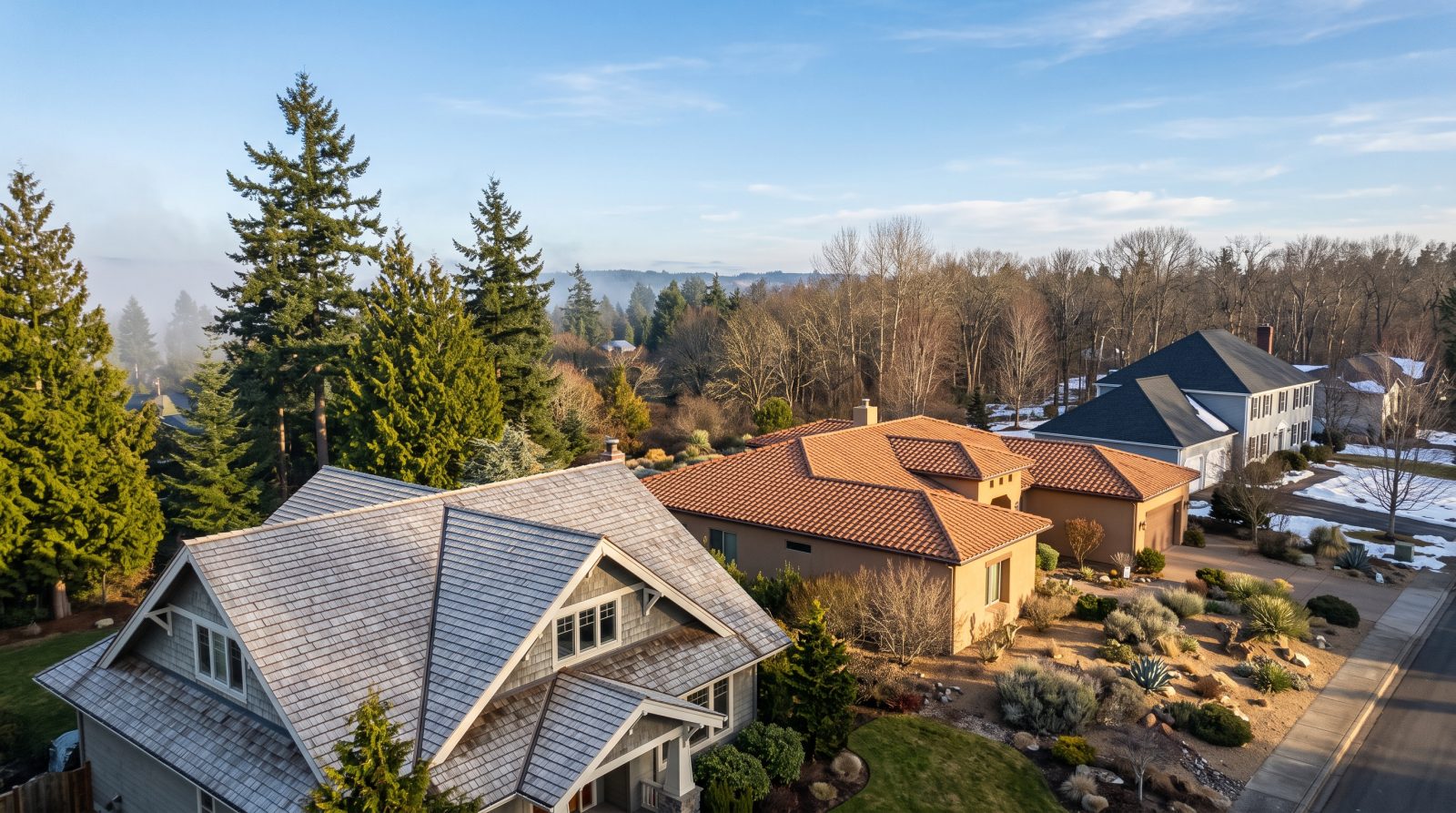
Why roofing cost varies so much across the country
Roofing is one of the most location-sensitive home improvements there is. A roof in coastal Florida and a roof in northern Minnesota are solving completely different problems — one is fighting hurricane-force uplift and relentless UV, the other is shedding heavy snow loads and surviving freeze-thaw cycles. Those different demands push regions toward different materials, thicker underlayments, stronger fastening patterns, and different code requirements, and each of those choices moves the price.
On top of the physical demands, the cost of getting work done varies. Labor rates in high-cost metro areas can be two to three times what they are in lower-cost rural markets. Permit fees, inspection requirements, and disposal or landfill charges differ by city and county. Even the cost of getting materials to your roof — freight, local supplier markups, and seasonal demand — changes the bottom line.
Because of all this, a single national 'average' number you saw online is rarely useful. A far more practical approach is to understand the three or four factors that drive your local price, then size your budget around a realistic range for your specific region, roof, and material. The figures below are typical industry ranges that shift with your conditions.
- Climate demands: snow load, wind uplift, hail, UV, and humidity all change what the roof must be built to handle.
- Local labor rates: crew wages and demand swing widely between metros and rural areas.
- Codes and permits: required underlayment, fastening, ice-and-water shield, and inspections vary by jurisdiction.
- Material logistics: freight distance, local supply, and seasonal demand affect what you pay per square.
Typical roofing cost ranges by US region
The ranges below reflect a full roof replacement on a typical single-family home (roughly 1,500–2,500 square feet of living space, which usually means more roof area once pitch and overhangs are counted). They assume mid-grade architectural asphalt shingles unless noted, and they bundle in tear-off, underlayment, flashing, disposal, and labor. Treat them as typical industry ranges that move with roof size, pitch, material, scope, and local conditions — your actual number could fall outside them.
These work best as a planning framework. A complex roof with steep pitches, multiple valleys, skylights, or extensive rot repair will land toward the high end or beyond, while a simple, accessible single-story ranch will sit lower. Repairs — as opposed to full replacements — are a fraction of these figures and are discussed further below.
Premium materials change the math significantly in every region. Metal roofing commonly runs well above asphalt, and slate, tile, or synthetic shingles can multiply the cost. In regions where tile or metal is the local norm (parts of the Southwest and Gulf Coast), those materials may be more competitively priced than in regions where they're unusual.
- Northeast & Mid-Atlantic: typically among the higher-cost regions due to labor rates, older or steeper homes, ice-and-water shield requirements, and dense urban access challenges.
- Southeast & Gulf Coast: moderate base costs, but wind and hurricane code upgrades, enhanced fastening, and sometimes secondary water barriers can add meaningfully — especially in coastal counties.
- Midwest & Great Lakes: often more affordable labor, but hail and freeze-thaw drive demand for impact-resistant shingles and quality ice-dam protection.
- Mountain West & Plains: snow load, high UV at altitude, and longer material freight distances can nudge costs up in remote areas; metro markets are more competitive.
- Southwest & desert: tile and 'cool roof' systems are common; intense UV and heat shorten the life of cheap materials, so spending up front often pays off.
- Pacific Coast & West: typically among the higher-cost regions, driven by elevated labor rates, strict codes (including wildfire and seismic considerations in places), and high cost of living.
How climate quietly drives your roofing budget
Climate is the hidden hand behind most regional price differences, because it dictates not just the material but the entire assembly. In cold, snowy regions, code and good practice call for ice-and-water shield membrane along eaves and in valleys to stop ice dams from forcing water under the shingles. That membrane, plus proper attic ventilation and insulation to prevent ice dams in the first place, adds cost that a homeowner in a mild climate simply doesn't pay.
In high-wind and hurricane-prone regions, the spending shifts toward resilience: enhanced nailing patterns, ring-shank fasteners, sealed roof decks, and shingles rated for higher wind speeds. Many coastal jurisdictions require these upgrades, and insurers increasingly reward — or demand — them. In hail country across the Plains and Midwest, impact-resistant (Class 4) shingles cost more up front but can reduce both damage and insurance premiums over time.
In hot, high-UV regions, longevity is the issue. Intense sun degrades asphalt faster, which is why tile, metal, and reflective 'cool roof' products are popular in the Southwest — they last longer and cut cooling bills, partially offsetting their higher purchase price. Humid Southeastern climates add another wrinkle: algae and moisture resistance matter, so algae-resistant shingles and good ventilation are worth budgeting for. The throughline is that the cheapest material is rarely the cheapest roof over its lifespan.
- Cold/snow regions: ice-and-water shield, ventilation, and ice-dam prevention add cost but prevent expensive water damage.
- Coastal/high-wind regions: upgraded fastening and wind-rated shingles, often code-required, raise the base price.
- Hail-prone regions: Class 4 impact-resistant shingles cost more but can lower long-term damage and premiums.
- Hot/high-UV regions: tile, metal, and cool-roof systems last longer and can reduce cooling costs.
The cost factors that matter more than your zip code
Region sets the backdrop, but several home-specific factors often swing the price more than geography. Roof size is the obvious one — pricing is typically calculated per 'square' (100 square feet), so a larger roof costs proportionally more. But two roofs of the same size can price very differently because of pitch and complexity. A steep roof is slower and riskier to work on, requiring more labor and safety equipment, and a roof chopped up with valleys, dormers, chimneys, skylights, and multiple planes takes more time and generates more cut waste and flashing work.
The number of existing layers and the condition of the decking underneath are big wildcards. If old shingles must be torn off (rather than roofed over, where allowed), that's added labor and disposal. And once the deck is exposed, any rotted or damaged sheathing has to be replaced — a cost that often can't be fully known until the tear-off begins. A reputable contractor will tell you their per-sheet rate for replacement decking up front so there are no surprises.
Finally, material grade and the small-but-critical components matter. Upgrading from three-tab to architectural to premium designer shingles changes the price tier, as does choosing metal, tile, or slate. The accessories — drip edge, flashing, ridge vent, pipe boots, and underlayment quality — are where corners get cut on cheap bids, and where a quality roof earns its longevity. When comparing quotes, make sure each one specifies the same scope, or you're not comparing the same roof.
- Roof size (measured in squares) and pitch or steepness.
- Complexity: valleys, dormers, skylights, chimneys, and number of roof planes.
- Tear-off vs. overlay, plus the condition of the decking underneath.
- Material grade (three-tab vs. architectural vs. designer; or metal, tile, slate).
- Quality of underlayment, flashing, ventilation, and other components.
Repair vs. replacement: budgeting for both
Not every roof problem means a full replacement, and the cost gap between a targeted repair and a complete tear-off is enormous. Many issues — a handful of missing or cracked shingles, a failed pipe boot, deteriorated flashing around a chimney, or a small localized leak — can be addressed as repairs at a small fraction of a replacement's cost. If your roof is generally sound and within its expected service life, a well-executed repair is usually the smart financial move.
Replacement starts to make more sense when damage is widespread, when the roof is near the end of its lifespan (asphalt shingles commonly last 15–30 years depending on grade and climate), or when you're facing repeated repairs that are adding up. Storm damage is a special case: if a covered weather event caused the damage, homeowners' insurance may help with repair or replacement, and documenting the damage promptly with photos and a professional assessment is important. Roof Repairs can help you understand the condition of your roof so you can make that repair-or-replace call with real information.
Whatever the scope, get clarity before work begins. A trustworthy assessment will identify the actual problem (not just the symptom), explain whether a repair will reliably solve it, and lay out the realistic range for the fix. For nationwide roofing help and a free, no-pressure roof assessment, call (669) 259-2777.
- Repairs handle localized issues — a few shingles, flashing, a boot, a small leak — at a fraction of replacement cost.
- Replacement makes sense for widespread damage, end-of-life roofs, or repeated, mounting repairs.
- Storm damage may be insurance-eligible — document it promptly with photos and a professional assessment.
- Always get the real diagnosis and a clear range before approving work.
How to get an accurate price for your roof
Online ranges are great for orientation, but the only way to know your number is an inspection of your actual roof. A proper assessment measures the real roof area (not just your home's footprint), evaluates pitch and complexity, checks the condition of existing materials and visible decking, and accounts for your local code and climate requirements. That's what turns a generic range into a real, scoped estimate.
When you collect quotes, compare them apples-to-apples. Confirm each includes the same material grade, the same scope (tear-off, deck repair allowance, underlayment, flashing, ventilation), the same warranty terms, and proper cleanup and disposal. The lowest bid is sometimes lowest because it leaves something out — thinner underlayment, reused flashing, or no allowance for rotted decking — which can cost you later. A clear, itemized estimate is a sign of a contractor who plans the job properly.
Roof Repairs provides nationwide roofing help for homeowners and businesses across the United States, with free roof assessments and clear pricing based on what your roof actually needs. To get an estimate for your home and region, call (669) 259-2777 and schedule your free roof assessment today.
- Insist on an on-site (or thorough) assessment of your real roof area, pitch, and condition.
- Compare quotes on identical scope, material grade, warranty, and cleanup terms.
- Watch for suspiciously low bids that omit underlayment, flashing, decking allowance, or disposal.
- Call (669) 259-2777 for a free roof assessment and a clear estimate.