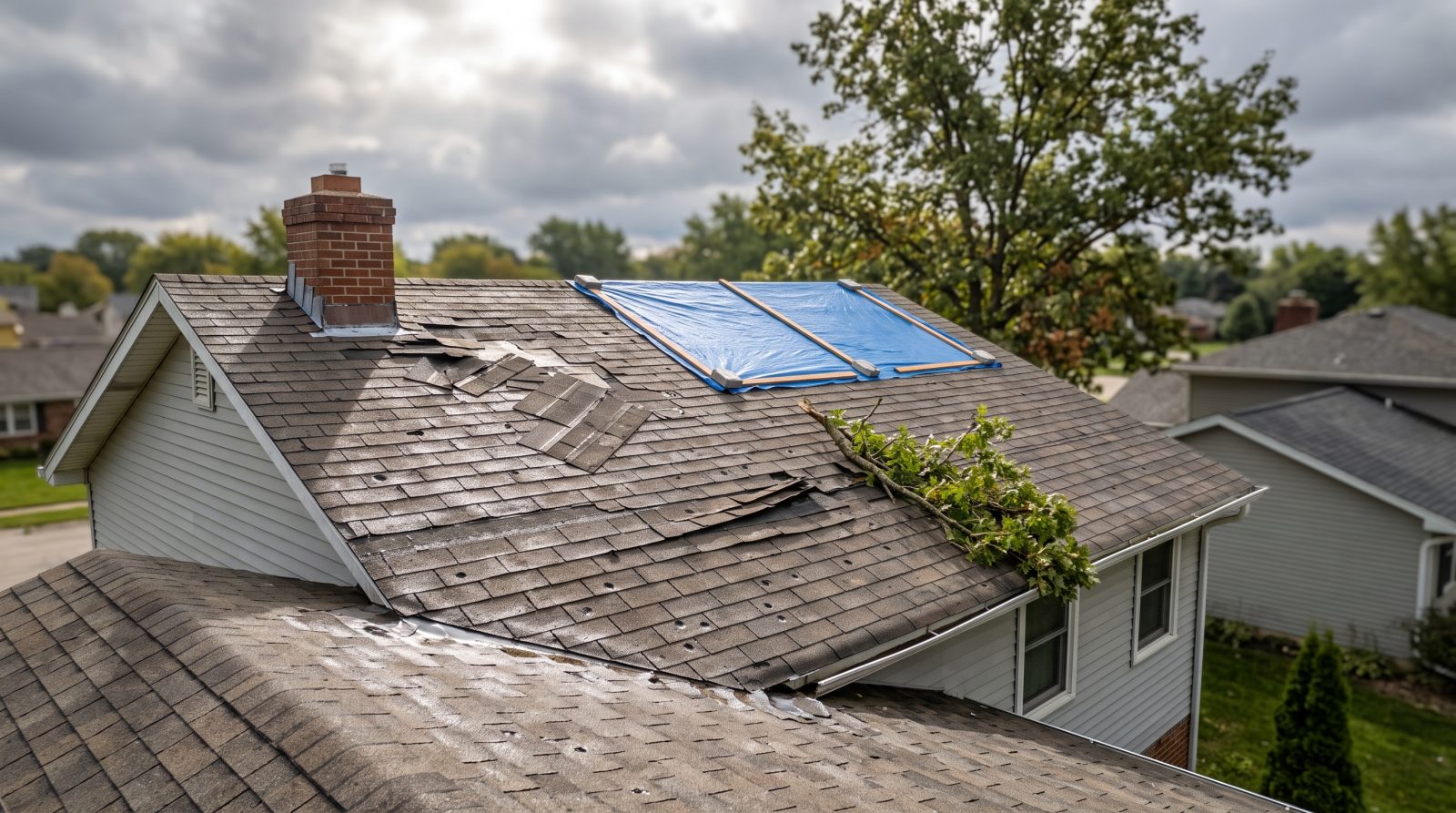
What Homeowners Insurance Usually Covers for Your Roof
A standard homeowners policy (commonly an HO-3 in the United States) is built around the idea of covering sudden, accidental damage from a 'covered peril' — not the slow march of age and wear. Your roof is part of the dwelling coverage (often listed as Coverage A), which protects the physical structure of your home. When a covered event suddenly damages the roof, the policy is generally designed to pay to repair or replace it, minus your deductible and subject to how your policy values the loss.
The list of covered perils is broad on most policies, but the cause of damage is what determines whether a claim is approved. The same shingle that blows off in a windstorm (typically covered) versus one that curls and cracks from twenty years of sun (typically not covered) can produce completely different outcomes — even though the visible result looks similar from the ground. This is the single most important concept in roof insurance: insurers pay for events, not for the natural end of a material's service life.
Coverage also extends beyond the roof deck itself. If a covered roof failure lets water into the home, the resulting interior damage — ceilings, drywall, insulation, and sometimes personal belongings under your contents coverage — is frequently part of the same claim. That's why documenting both the roof and the interior matters.
- Wind and windstorm damage — lifted, creased, or blown-off shingles and torn underlayment
- Hail damage — bruised or fractured shingles, dented metal, and granule loss from impact
- Falling objects — trees, large limbs, or debris that punctures or crushes the roof
- Fire, lightning, and smoke damage to the roof structure
- Weight of ice, snow, or sleet causing collapse or structural strain (common in northern climates)
- Sudden water damage inside the home caused by a covered roof failure
What Insurance Typically Will NOT Cover
The exclusions are where most denied claims come from, and almost all of them trace back to one principle: insurance is not a maintenance plan. Anything an insurer can attribute to age, neglect, or a homeowner's failure to maintain the roof is generally outside the policy. Understanding these exclusions before you file saves enormous frustration — and often points you toward the real, out-of-pocket repair conversation instead.
Wear and tear is the biggest one. Every roofing material has a service life, and as a roof approaches the end of it, shingles become brittle, sealant fails, and leaks appear. Insurers consider this expected and the homeowner's responsibility. Closely related is the matter of pre-existing damage: if an adjuster determines a leak or soft spot existed before the event you're claiming, the claim can be reduced or denied. Cosmetic-only damage that doesn't affect the roof's function is also commonly excluded, and some policies attach specific cosmetic exclusions to metal roofs.
Regional risk creates the other major category of gaps. In many hurricane-prone coastal states, wind and hurricane damage carries a separate, percentage-based deductible rather than your flat dollar deductible. Flooding — including water that enters because of rising water rather than a roof breach — is almost never covered by a standard policy and requires separate flood insurance. And in some hail- and wind-heavy regions, insurers increasingly write roofs on an actual cash value basis or exclude certain older roofs entirely, which dramatically changes what you'd receive.
- Normal wear, aging, deterioration, and general lack of maintenance
- Pre-existing damage or leaks that predate the claimed event
- Cosmetic damage that doesn't impair the roof's function (and some metal-roof cosmetic exclusions)
- Neglected repairs — a small known leak that was ignored until it became major
- Flood-related water intrusion (needs separate flood insurance)
- Damage from improper prior installation or unpermitted work
- Pest, mold, or rot damage that built up over time
How Roof Claim Payouts Are Calculated: ACV vs. RCV
Two policies can cover the exact same roof for the exact same storm and pay wildly different amounts. The reason is the valuation method written into your policy, and it's the detail homeowners most often overlook until a check arrives that's smaller than expected. The two methods are Actual Cash Value (ACV) and Replacement Cost Value (RCV).
Replacement Cost Value pays what it costs to replace the damaged roof with new materials of like kind and quality, without subtracting for age. Most RCV policies pay in two stages: first the depreciated amount, then the held-back 'recoverable depreciation' once the work is completed and invoiced. This is the more favorable structure for the homeowner and is what you generally want on a roof.
Actual Cash Value pays the replacement cost minus depreciation for the roof's age and condition. On a fifteen-year-old asphalt roof, depreciation can consume a large share of the payout, leaving you to fund much of the replacement yourself. Many insurers in high-risk regions have shifted older roofs to ACV settlements specifically to limit their exposure — which is why two neighbors with similar roofs can receive very different checks. The variable that ties it all together is your deductible, which is subtracted from any payout, and in wind/hurricane zones may be a percentage of your home's insured value rather than a flat amount.
- RCV (Replacement Cost Value): pays full like-kind replacement cost, often releasing recoverable depreciation after the job is finished
- ACV (Actual Cash Value): pays replacement cost minus depreciation for age and condition — smaller checks on older roofs
- Deductible: always subtracted from the payout; flat dollar amount on most policies
- Wind/hurricane deductible: in many coastal states this is a percentage (often 1%–5%) of the dwelling coverage, which can be thousands of dollars
- Roof-age schedules: some policies reduce coverage or shift to ACV once a roof passes a certain age
How to File a Roof Insurance Claim That Gets Paid
A well-documented claim is approved far more often than a vague one, and the work that determines the outcome happens in the first days after the damage. The goal is to prove three things to the adjuster: that a covered event occurred, when it occurred, and the full extent of what it damaged. The more clearly you establish those, the harder the claim is to reduce.
Start with safety and immediate documentation. Photograph and video everything — from the ground, from inside the attic, and of any interior water damage — before any temporary repairs. Most policies require you to take reasonable steps to prevent further damage (tarping a hole, for example), and they typically reimburse those emergency measures, so keep every receipt. Then review your declarations page so you know your deductible and whether you're on ACV or RCV before you ever speak to the adjuster.
A common and costly mistake is letting the insurance company's estimate be the only professional assessment on record. Having an independent, experienced roofing professional inspect and document the damage gives you a second, detailed account of scope and cost — which matters enormously when the adjuster's number is low. Roof Repairs can perform a free roof assessment and produce clear documentation of what we observe, giving you a thorough, honest record to bring to your insurer. The insurer ultimately decides what it approves, but solid documentation is your strongest footing. Call (669) 259-2777 to get that assessment scheduled.
- Document immediately — dated photos/video of the roof, attic, and interior before repairs
- Note the date and cause of the event (storm date, the tree that fell, etc.)
- Make reasonable temporary repairs to prevent further damage and keep all receipts
- Read your declarations page: deductible, ACV vs. RCV, and any wind/hail provisions
- File promptly — many policies require notice within a limited window
- Get an independent professional inspection so you're not relying solely on the adjuster's scope
- Keep a written log of every call, claim number, and adjuster name and date
Typical Roof Repair and Replacement Costs (Estimate Ranges)
Knowing rough cost ranges helps you sanity-check both an insurance payout and a repair quote. The figures below are typical national industry estimate ranges only — actual pricing varies significantly by region, material, roof size and pitch, accessibility, the extent of damage, and local labor rates. They are not a quote, a guarantee, or a substitute for an on-site assessment.
For minor work — a handful of replaced shingles, resealing flashing, or a small isolated leak — many homeowners see costs in the low hundreds to roughly $1,500. The catch with small repairs is that they often fall under your deductible, meaning a claim may not be worthwhile even when the damage is technically covered. Moderate repairs involving a roof section, valley, or several courses of shingles commonly land in the four-figure range.
Full roof replacement is where the numbers grow and where material choice drives everything. Asphalt shingle replacements typically run from several thousand dollars up into the low five figures for an average home, while premium materials such as metal, tile, or slate can cost considerably more — sometimes two to four times an asphalt roof — because of material and labor intensity. Climate matters here too: roofs in regions with severe hail, heavy snow load, hurricane exposure, or intense UV often justify more durable (and more expensive) systems that also tend to fare better in future claims. For an honest assessment and a clear quote specific to your roof, call (669) 259-2777.
- Minor repairs (a few shingles, flashing, small leak): roughly $150–$1,500 — often under the deductible
- Moderate repairs (a section, valley, or larger leak): typically four figures
- Asphalt shingle replacement: commonly several thousand to low five figures for an average home
- Metal, tile, or slate replacement: often substantially higher than asphalt due to material and labor
- All figures are estimate ranges that vary by region, material, roof size, pitch, and scope — not a fixed quote
Smart Moves Before and After Roof Damage
The homeowners who fare best with roof claims are the ones who did a little work before anything went wrong. Because insurers lean heavily on the wear-and-tear and pre-existing-damage exclusions, the best defense is a documented baseline of a maintained roof. Periodic professional inspections — especially after major storms and as a roof ages — create a paper trail showing the roof was in good condition, which directly counters a 'this is just old age' denial.
Maintenance also protects coverage itself. Many policies expect reasonable upkeep, and a roof allowed to deteriorate can give an insurer grounds to reduce a payout or, at renewal, to require repairs or non-renew. Keeping gutters clear, addressing small leaks before they spread, trimming overhanging limbs, and saving records of any work you've done all strengthen both your roof and your position if you ever file.
After a storm, resist two temptations: signing over your claim to whoever knocks on your door first, and assuming nothing is wrong because you don't see a leak. Wind and hail damage is frequently invisible from the ground and can shorten a roof's life or cause leaks months later. A calm, professional inspection tells you what's actually there. Roof Repairs offers nationwide roofing help and free roof assessments; whether the damage turns into a claim or a straightforward repair, you'll know exactly where you stand. Call (669) 259-2777 to schedule yours.
- Get periodic inspections to document a maintained roof and counter wear-and-tear denials
- Keep records of repairs, inspections, and the roof's installation date
- Maintain proactively: clear gutters, fix small leaks early, trim overhanging branches
- After storms, get an inspection even if you see no leak — wind/hail damage is often hidden
- Be cautious of high-pressure 'storm chasers' and never rush to sign over your claim