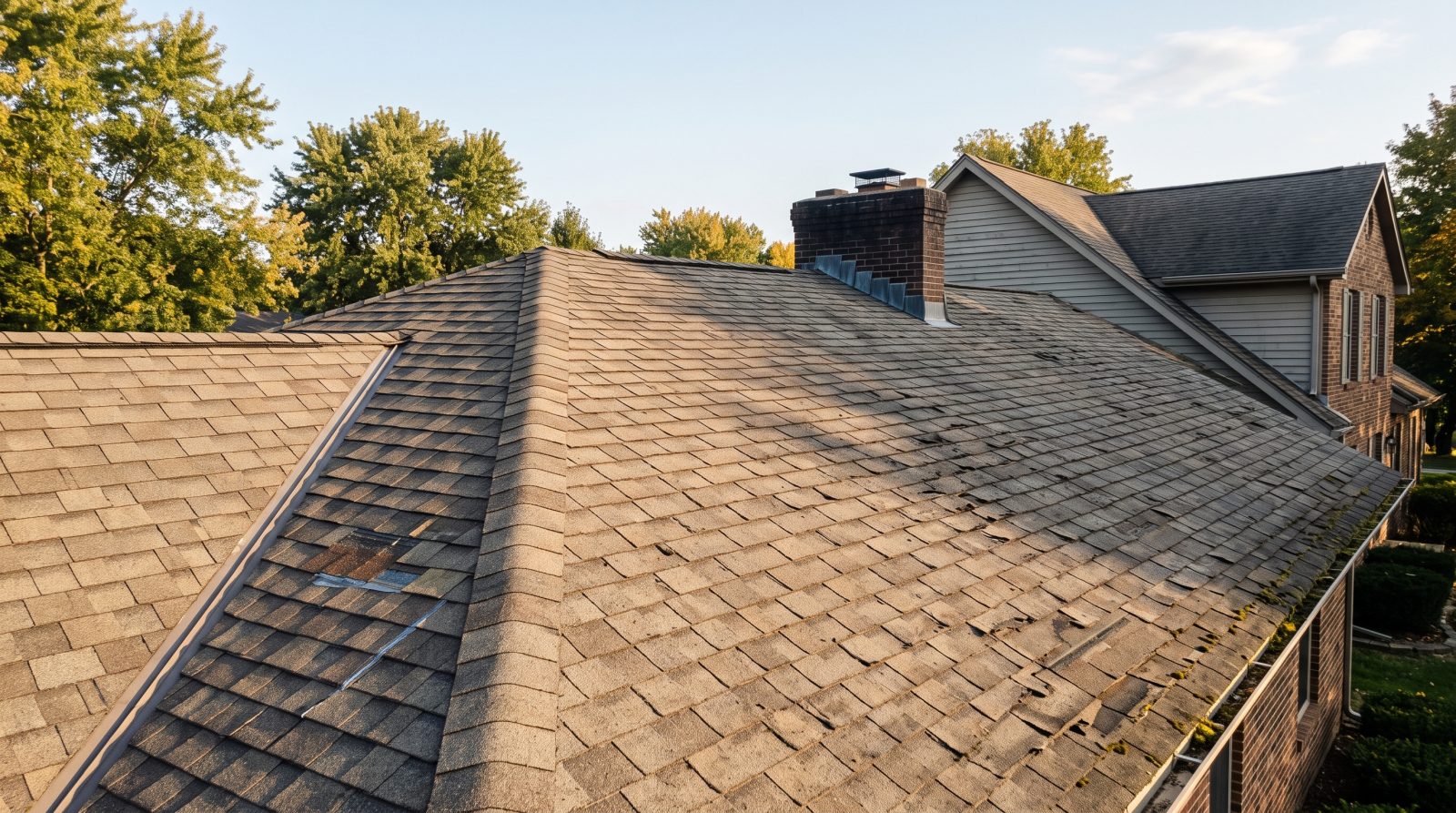
The Core Question: Are You Fixing a Symptom or a Failing System?
Every repair-versus-replace decision comes down to one diagnostic question: is the problem in front of you an isolated, contained issue, or is it a visible symptom of a roof system that is reaching the end of its service life? A single nail pop, a few wind-lifted shingles, or a flashing leak around one chimney is almost always a repair. A roof that is shedding granules across the whole field, sagging along a ridgeline, or leaking in multiple unrelated spots is usually telling you the underlying system is done.
A roof is not just the covering you see from the street. It is a layered system: the decking (the wood substrate), the underlayment (the water-resistant barrier), the field material (asphalt shingles, metal, tile, or a flat-roof membrane), and the details that tie it all together (flashing, ridge, valleys, vents, and edges). Repairs address one layer or one location. Replacement addresses the whole system at once, usually down to the deck. Knowing which layer is failing is the difference between a smart $600 fix and throwing good money after a roof that needs to come off entirely.
The honest professional framing is this: repairs buy time and solve localized problems; replacements solve age and systemic failure. When a contractor inspects your roof, they are not just looking at the leak you called about. They are reading the whole system to tell you whether you have a young roof with one injury or an old roof with one of many problems still to come.
- Repair territory: isolated leaks, a small number of damaged shingles, single-point flashing failures, one storm-damaged section, minor boot or vent seal failures.
- Replacement territory: widespread granule loss, multiple leaks in different areas, deck rot or sagging, an aging roof past its expected lifespan, or repeated repairs in the same season.
- Gray zone: significant storm damage on a mid-life roof, or a roof that is sound but cosmetically inconsistent after past patch jobs.
Age and Lifespan: The First Number That Matters
Before you analyze a single shingle, you need to know how old your roof is and what material it is, because expected lifespan frames everything else. A roof in the last fifth of its life is a poor candidate for an expensive repair: you would be investing in a system that is statistically likely to fail elsewhere soon. A roof in the first half of its life is usually worth repairing, sometimes several times, before replacement makes sense.
Material is the biggest driver of lifespan. Standard three-tab asphalt shingles, by far the most common roof in the United States, typically last in the neighborhood of 15 to 25 years; architectural (dimensional) asphalt shingles often reach 25 to 30 years. Metal roofing commonly lasts 40 to 70 years depending on the system. Clay and concrete tile and natural slate can last 50 years or well beyond, though their underlayment and flashing often need attention long before the tile itself fails. Flat and low-slope membranes vary widely by type and typically fall in the 15-to-30-year range. Treat these as general industry ranges, not promises: real lifespan depends heavily on installation quality, ventilation, and climate.
Climate accelerates or extends these numbers more than most homeowners realize. Intense UV and heat in the Southwest age asphalt faster. Freeze-thaw cycling in the North and Mountain West stresses every seam and fastener. Coastal salt air, Gulf and Atlantic hurricane exposure, and hail-prone corridors of the Plains and Midwest all shorten practical lifespan and raise the odds that storm damage, not simple age, forces the decision. If you do not know your roof's age, a roofing professional can usually estimate it from wear patterns, and prior permits or closing documents from your home purchase often record the last replacement.
- Asphalt three-tab: roughly 15 to 25 years (general range; varies by climate and install).
- Architectural asphalt: roughly 25 to 30 years.
- Metal: roughly 40 to 70 years depending on the system.
- Tile and slate: 50+ years for the material, though underlayment and flashing usually need service sooner.
- Flat / low-slope membranes: roughly 15 to 30 years depending on type.
- Rule of thumb: a roof in the final 20% of its expected life rarely justifies a major repair.
Reading the Damage: What the Roof Is Telling You
Once you know the roof's age, the next step is honestly assessing the type and extent of the damage. The single most useful distinction is localized versus widespread. Damage confined to one slope, one penetration, or one storm-hit section points toward repair. Damage that appears in unrelated areas, or that recurs after being fixed, points toward systemic failure and replacement.
Some warning signs are visible from the ground or a ladder: curling, cupping, or clawing shingles; bald spots where the protective granules have worn away; shingles that are cracked, torn, or missing; and a roof surface that looks uneven or wavy. Granules collecting in gutters and at downspout outlets are a classic late-life signal for asphalt roofs. Inside the home, look in the attic with a flashlight on a sunny day: pinholes of daylight through the deck, dark water staining on the underside of the sheathing, damp or compressed insulation, and any musty smell all indicate active or past water intrusion.
The most serious structural red flag is a sagging or dipping roofline, which can mean the decking is rotted or the structure beneath is compromised by long-term moisture. That is rarely a repair situation. By contrast, a leak that traces cleanly to failed flashing around a chimney, skylight, or vent, with sound shingles and a dry deck elsewhere, is one of the most common and most fixable problems in roofing. The goal of reading the damage is not to diagnose it yourself with certainty, but to know what you are looking at well enough to have an informed conversation and to recognize when a contractor is steering you wrong.
- Likely repairable: a few missing or torn shingles, a single flashing leak, a damaged vent boot, one storm-damaged section, isolated nail pops.
- Leaning toward replacement: widespread curling or balding, granules filling gutters, multiple leaks, repeated repairs in the same area, daylight visible through the deck.
- Stop-and-call-now structural signs: a sagging or wavy roofline, soft or spongy deck underfoot, and large interior water stains spreading over time.
- Always inspect after major storms: high wind, hail, and falling limbs can cause damage that is invisible from the ground but compromises the system.
The Cost Math: The 50% Rule and Cost Per Year
Money is usually the deciding factor, so it helps to use the same frameworks the trade uses. The first is the widely cited 50% rule: if the cost of repairs approaches roughly half the cost of a full replacement, replacement is generally the smarter long-term spend. Pouring half the price of a new roof into an old one buys you a patched system that is still old and still likely to need replacing soon. The 50% rule is a guideline, not a law, but it reliably flags the point where repair stops being economical.
The second framework is cost per year of service. Divide the price of each option by the years of additional roof life it realistically buys you. A $1,000 repair that gets a sound mid-life roof another 8 to 10 years is excellent value. The same $1,000 repair on a 22-year-old asphalt roof that may fail elsewhere within a year or two is poor value, even though the sticker price is low. Replacement looks expensive on day one but often wins on cost per year because it resets the entire system's clock at once.
For planning purposes, treat all dollar figures as typical industry ranges that vary widely by region, material, roof size and pitch, complexity, and current labor and material costs. Minor repairs commonly run from a few hundred to a couple thousand dollars. Larger repairs and partial re-roofs sit higher. Full replacements span a broad range driven mostly by material choice and square footage: asphalt is the most affordable, while metal, tile, and slate cost considerably more up front but last far longer. These are estimates, not quotes or guarantees; the only way to know your real number is an on-site assessment. Don't forget the indirect costs of choosing wrong, repeated service calls, interior repairs from ongoing leaks, and potential mold remediation can quietly exceed the cost of replacing the roof properly the first time.
Two more financial levers can change the math. First, insurance: damage from a covered sudden event such as a windstorm or hail may be partially or fully covered, while wear-and-tear and age-related failure generally are not. Document damage promptly and review your policy before assuming either outcome. Second, selling timelines: if you plan to sell soon, a clean, recent roof can be a meaningful selling point and may head off buyer or inspector objections, which sometimes justifies replacement even when a repair would technically hold.
- The 50% rule: when repair costs near half of replacement cost, replacement is usually the better long-term value.
- Cost per year: divide each option's price by the years of life it adds, then compare.
- Replacement is the most affordable in asphalt and rises significantly for metal, tile, and slate, all are typical ranges that vary by region and scope.
- Insurance may help with sudden storm damage but generally not with age or wear; document and check your policy early.
- Factor hidden costs: repeat repairs, interior damage, and mold remediation can outweigh a one-time replacement.
Regional and Situational Factors That Tip the Decision
Two homeowners with identical roofs can make opposite, equally correct decisions depending on where they live and what they plan to do with the home. Climate is the loudest of these factors. In hail- and wind-exposed regions, repeated minor damage is common, and at some point a fresh, impact-rated system is more economical than an endless cycle of repairs. In hot, high-UV climates, asphalt simply ages faster, which pulls older roofs toward replacement sooner. In freeze-thaw climates, water that gets past a marginal repair can expand in seams and fasteners and turn a small problem into a structural one over a few winters.
Your plans for the property matter just as much as the roof itself. If this is your long-term home, replacement spreads its cost over many years of worry-free service and is often the better value the moment a roof is clearly aging. If you expect to move within a couple of years, a sound repair may be the rational choice, unless the roof's condition would scare off buyers or fail an inspection, in which case replacement can pay for itself at the closing table. Energy efficiency is a quieter consideration: a full replacement is the natural moment to upgrade ventilation, underlayment, and reflective or higher-performance materials, improvements that are difficult to capture through spot repairs.
Finally, consider the trajectory of the roof, not just its current state. A roof that has already needed two or three repairs in recent seasons is signaling that it is entering systemic decline; the next repair is rarely the last. A roof with a single, clearly explained problem and an otherwise clean bill of health is a strong repair candidate. The best decisions weigh climate, timeline, and trajectory together rather than reacting to the most recent leak in isolation. Roof Repairs provides nationwide roofing help and can assess your specific roof, climate exposure, and goals to help you decide which path actually serves you.
- Hail and high-wind regions: recurring damage eventually favors a fresh, impact-rated replacement over repeated repairs.
- Hot, high-UV climates: asphalt ages faster, moving older roofs toward replacement sooner.
- Freeze-thaw climates: marginal repairs are riskier because trapped water expands and worsens over winters.
- Staying long-term: replacement usually wins on value once a roof is clearly aging.
- Selling soon: a sound repair may suffice, unless roof condition threatens the sale.
- Replacement is the right moment to upgrade ventilation, underlayment, and energy performance.
How to Make the Final Call (and Get a Second Opinion)
Put the pieces together in order. Start with age and material to see how much useful life the roof has left. Read the damage to determine whether it is localized or systemic. Run the cost math, the 50% rule and cost per year, to test whether a repair is genuinely economical. Then layer in your climate, your timeline, and the roof's repair history. When most of those signals point the same way, the decision is usually clear; when they conflict, that is exactly when a professional inspection earns its keep.
Be wary of two failure modes. The first is over-repairing: sinking money into a roof past its prime because the repair sticker price feels comforting, only to replace it within a couple of years anyway. The second is over-replacing: paying for a full tear-off when a competent, well-documented repair would have served for years. A trustworthy contractor will show you photos of the actual problem, explain what they see in the whole system, and give you a clear rationale for either path. If a recommendation feels rushed or one-sided, a second opinion is always worth the call.
If you are unsure, the lowest-cost next step is a professional assessment of your specific roof, its age, its damage, your climate, and your plans. Roof Repairs offers nationwide roofing help for homeowners and businesses and can give you a clear read on whether to repair or replace. Call (669) 259-2777 for a free roof assessment and quote, and get a straight answer before you commit to either path.
- Decision order: age and material, then damage extent, then cost math, then climate/timeline/history.
- Avoid over-repairing an end-of-life roof and over-replacing a sound one, both waste money.
- Insist on photos and a clear written rationale; get a second opinion if a recommendation feels rushed.
- When signals conflict, an on-site assessment is the cheapest way to decide correctly.