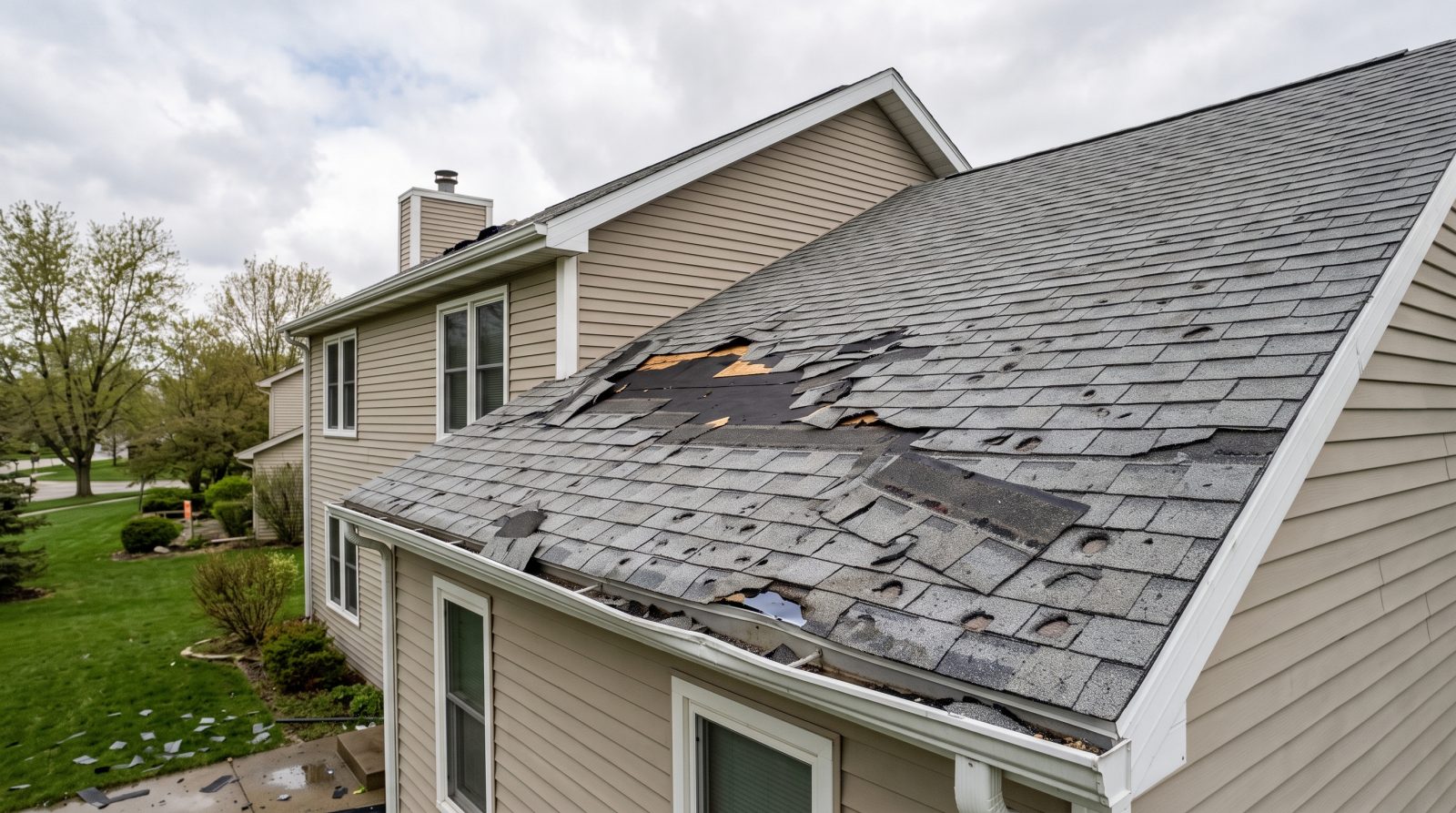
What roof damage insurance typically covers (and what it usually doesn't)
Most standard homeowners policies in the United States cover roof damage caused by a sudden, accidental, and named peril. The exact list varies by carrier and state, but the events most commonly covered are wind, hail, falling trees or branches, the weight of ice and snow, fire, and certain types of vandalism. If a covered event physically damages your roof and that damage then lets water into your home, the resulting interior damage is often covered too.
What insurance generally does not cover is wear and tear, age-related deterioration, neglect, and damage from a maintenance problem the homeowner should have addressed. This is the single biggest reason roof claims get denied: an adjuster decides the damage is the result of an old or poorly maintained roof rather than a specific storm. Cosmetic-only damage (marks that don't affect function) and gradual leaks that developed over months are also frequent exclusions.
Coverage also depends on how your policy pays. Some policies pay Replacement Cost Value (RCV), which covers what it actually costs to replace the roof today. Others pay Actual Cash Value (ACV), which subtracts depreciation for the age and condition of the roof, leaving you with a smaller check. Older roofs are increasingly written on ACV terms or capped schedules, especially in hail- and hurricane-prone regions. Knowing which one you have before you file changes everything about what to expect.
- Commonly covered: wind, hail, fallen trees/limbs, ice and snow weight, fire, sudden accidental events
- Commonly excluded: normal wear and tear, age, neglect, gradual leaks, cosmetic-only marks, manufacturer defects
- RCV vs. ACV: RCV pays today's replacement cost; ACV subtracts depreciation and pays less
- Regional reality: wind/hail coverage in the Plains and Southeast, ice-dam and snow-load concerns in the North, hurricane deductibles along the coasts
Step 1: Document the damage and protect your home from further loss
The moment it is safe to do so, document everything. Insurance companies pay claims based on evidence, and the strongest claims are built in the first 24 to 48 hours after the damage occurs. Take clear, dated photos and video from the ground, and capture both wide shots showing the whole roof and close-ups of specific damage such as missing or creased shingles, hail bruising, dented flashing or vents, and any interior water stains on ceilings and walls. The more documentation you have, the harder it is for anyone to argue the damage was old.
You also have a duty under almost every policy to prevent further damage after a loss. This is called mitigation. If water is coming in, place a tarp over the affected area, set out buckets, and move furniture and valuables away from the leak. Keep the receipts for any tarps, plywood, or emergency supplies, because reasonable emergency expenses are often reimbursable. Just as important: do not make permanent repairs before the adjuster inspects, since you may erase the evidence the claim depends on.
Safety comes first. Do not climb onto a wet, steep, or storm-damaged roof yourself. A qualified roofing professional can perform a documented inspection safely and give you a written assessment of the damage, which becomes a powerful piece of evidence for your claim.
- Photograph and video everything: wide shots, close-ups, interior stains, dated if possible
- Tarp leaks and protect interior belongings to fulfill your mitigation duty
- Save all receipts for emergency materials and temporary repairs
- Make only temporary repairs before the adjuster visits, not permanent ones
- Don't risk a damaged roof yourself, get a professional inspection
Step 2: Read your policy and understand your deductible before you call
Before you pick up the phone, pull out your policy declarations page and read the sections on covered perils, exclusions, deductibles, and claim deadlines. You want to know three things: whether your type of damage is covered, how your roof is paid out (RCV or ACV), and how much your deductible is. Filing a claim when the damage is clearly below your deductible can be a costly mistake, because the claim still goes on record and may affect your future premiums or renewability without producing any payout.
Pay special attention to your deductible structure. Many policies in storm-prone states carry a separate wind/hail or hurricane deductible that is a percentage of your home's insured value rather than a flat dollar amount. On a higher-value home, a 2 percent wind deductible can be several thousand dollars, which dramatically changes whether filing makes sense. Also check for any roof age limitations, cosmetic-damage exclusions, or matching clauses that affect whether the insurer pays to match new materials to existing ones.
Finally, note the claim-reporting deadline. Policies require you to report a loss within a reasonable time, and some carriers impose firm windows after a storm. Waiting too long gives the insurer an opening to argue the damage worsened due to delay, or to deny it outright. When in doubt about your specific terms, your insurer's policy-service line can clarify language, and a roofing professional can help you understand the practical repair scope.
- Confirm the peril is covered and whether you're paid RCV or ACV
- Compare the estimated repair cost to your deductible before filing
- Watch for percentage-based wind, hail, or hurricane deductibles in storm regions
- Check for roof-age limits, cosmetic exclusions, and matching provisions
- Note and respect the carrier's claim-reporting deadline
Step 3: File the claim and prepare for the adjuster
When you're ready, contact your insurance company to open the claim. You can usually do this by phone, through the carrier's app, or online. Be ready to provide the date and cause of the damage, a description of what happened, your documentation, and the temporary steps you've already taken. Stick to the facts. Describe the event and the damage you can see, but avoid speculating about cause or guessing at dollar amounts you aren't sure of. Write down your claim number and the name of every person you speak with, and keep a simple log of every call and email.
The insurer will assign an adjuster to inspect your roof. The adjuster works for the insurance company, and their job is to determine what is covered and how much the carrier will pay. It is completely reasonable, and often wise, to have your own roofing professional present during that inspection. A knowledgeable roofer can point out storm damage the adjuster might miss, speak the same technical language, and make sure the scope of the estimate reflects the full extent of the damage, including underlayment, flashing, and ventilation rather than just the surface shingles.
Get an independent, written repair estimate of your own. When your contractor's detailed estimate and the adjuster's findings are side by side, any gaps become obvious and easier to discuss. This is also where a nationwide roofing resource on your side helps, because the same storm-damage documentation standards apply whether you're in Texas, Ohio, Florida, or Colorado.
- Open the claim by phone, app, or online with your documentation in hand
- Record your claim number and keep a log of every conversation
- Have your own roofing professional present for the adjuster's inspection
- Obtain your own detailed, written repair estimate for comparison
- State facts about the event and damage, don't guess at causes or costs
Step 4: Review the settlement, then repair or appeal
After the inspection, the insurer issues a claim decision and, if approved, an estimate of what they'll pay. Read it carefully line by line. If you have an RCV policy, you'll typically receive an initial payment for the Actual Cash Value (the depreciated amount) and then a second payment for the held-back depreciation once the work is completed and you submit proof, such as the final invoice. Don't leave that recoverable depreciation on the table by failing to file the completion paperwork.
Compare the insurer's scope against your own contractor's estimate. Underpayment is common, and it usually shows up as missing line items: the adjuster covers the shingles but omits the underlayment, drip edge, flashing, ridge venting, code-required upgrades, or the labor to properly tear off the old roof. If your estimate is more thorough and you can document why each item is necessary, you have grounds to ask for a supplement. Insurers expect and routinely process supplemental requests when supported by clear evidence.
If your claim is denied or badly underpaid and you believe that's wrong, you have options. You can request a re-inspection, file a formal appeal in writing with supporting documentation, and, in many states, invoke the appraisal clause in your policy to resolve a value dispute through independent appraisers. Your state's department of insurance is also a free resource for understanding your rights. Throughout, choose a reputable roofing contractor: be cautious of anyone who pressures you to sign over your claim, promises to waive your deductible (which is illegal in many states), or asks you to commit before the scope is settled.
- Understand RCV pays in two parts, file completion paperwork to recover withheld depreciation
- Compare the insurer's scope to your contractor's estimate for missing line items
- Request a supplement, with documentation, for legitimately omitted work
- If denied or underpaid: re-inspection, written appeal, appraisal clause, or your state insurance department
- Avoid contractors who pressure you, claim to waive deductibles, or rush you to sign
Common mistakes that get roof claims denied or underpaid
Most claim problems trace back to a handful of avoidable errors. The first is waiting too long, which lets the insurer argue the damage spread because of neglect. The second is poor documentation, which leaves your account of events without proof. The third is making permanent repairs before the inspection, which destroys the evidence. And the fourth is accepting the first offer without comparing it to an independent estimate, which is how underpayment slips through unnoticed.
Another quiet killer is roof maintenance, or the lack of it. Insurers look for any sign that the roof was already failing before the storm. Routine upkeep (clearing debris, replacing the occasional damaged shingle, keeping gutters and flashing in good shape, and keeping records of inspections and repairs) builds a paper trail that supports a sudden-event claim and undercuts the wear-and-tear argument. Climate matters here too: ice dams in the North, UV and high heat in the Southwest, and repeated hail or wind cycles in the central states all age roofs differently, and a documented maintenance history helps prove the damage was new.
If the process feels overwhelming, you don't have to navigate it alone. A roofing professional who routinely works alongside insurance inspections can help you document storm damage correctly, build an accurate scope, and make sure nothing legitimate gets left out of your settlement. For a free roof assessment and a detailed written estimate you can take to your insurer, call Roof Repairs at (669) 259-2777.
- Filing late and inviting a neglect argument
- Thin documentation with no dated photos or professional assessment
- Permanent repairs made before the adjuster inspects
- Accepting the first offer without an independent estimate
- No maintenance records to counter a wear-and-tear denial