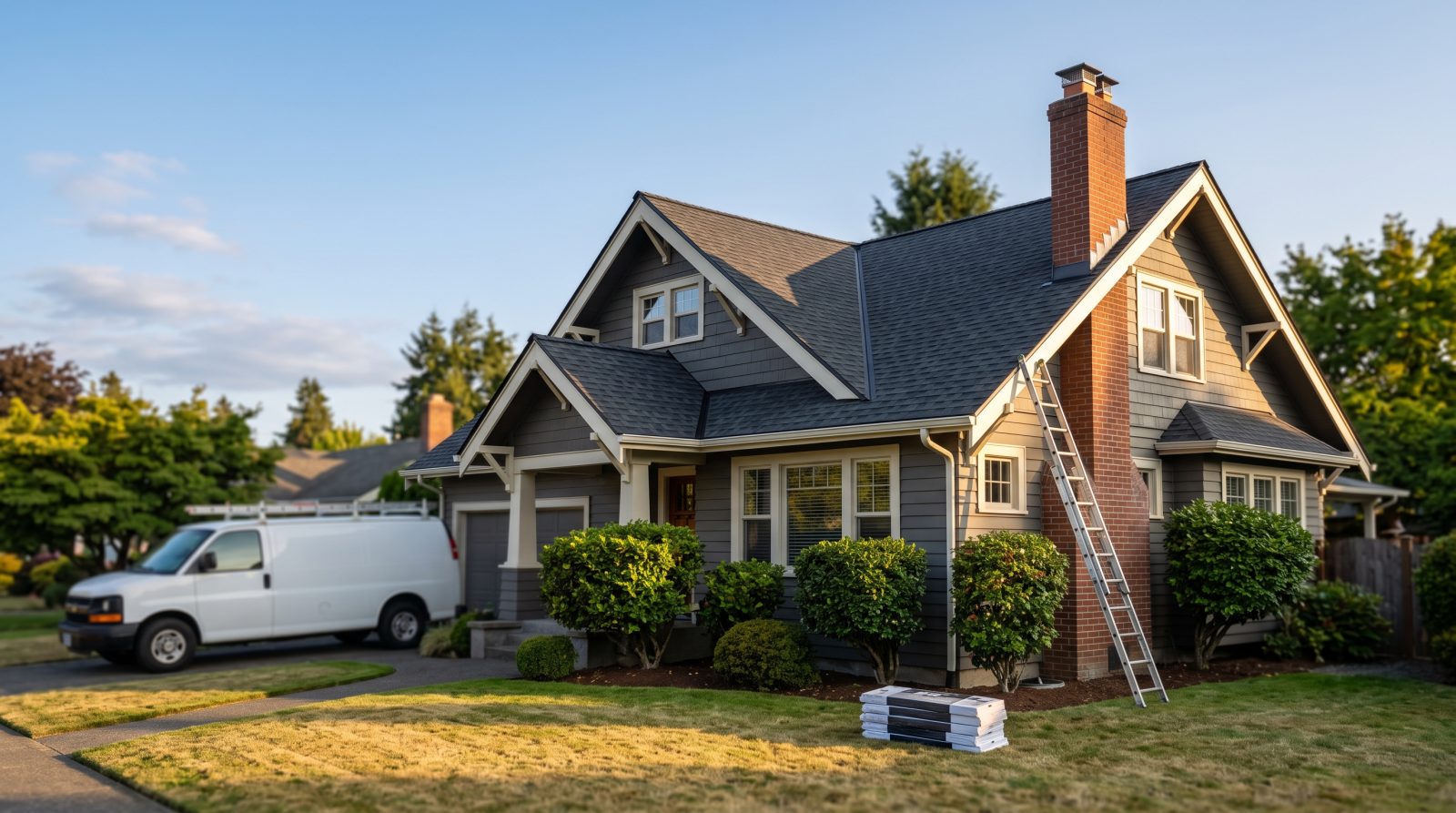
Why Choosing the Right Roofer Is the Real Decision
Most homeowners shop for a roof the way they shop for a price: they collect a few numbers and pick the lowest one. But roofing is a trade where the quality of the installation often matters more than the brand of material on top. A premium shingle installed poorly will fail early, while a mid-grade shingle installed correctly can outlast its warranty. You are not really buying a product; you are buying workmanship, and workmanship is only as good as the crew and the company standing behind it.
This is also a high-stakes decision because problems hide. A roof leak rarely shows up the week after install. It shows up two winters later, after the contractor has moved on, when water has already been tracking into your decking, insulation, and ceilings. By the time you notice a stain, the damage underneath is often far worse and far more expensive than the original repair would have been. That delay is exactly why fly-by-night operators can cut corners and disappear before anyone is the wiser.
The good news is that trustworthy roofers share a recognizable set of traits, and so do the risky ones. Once you know what separates a legitimate, accountable contractor from a high-pressure salesperson, the choice gets much clearer, and you stop competing solely on price.
Verify the Non-Negotiables: License, Insurance, and Standing
Before you discuss color or cost, confirm the basics that protect you legally and financially. Licensing requirements for roofing contractors vary by state and sometimes by city or county, so what is required in Texas may differ from what is required in Florida, California, or Ohio. Some states license roofers directly; others regulate them under a general contractor license or at the local level. The right move is to ask which credentials apply where you live and then verify them yourself rather than taking a business card at face value.
Insurance is the line item you cannot skip. A reputable roofing company carries both general liability insurance (which covers damage to your property) and workers' compensation (which covers injuries to crew members on your roof). Without workers' comp, an injured worker could potentially pursue you, the homeowner, for medical costs. Ask for a certificate of insurance and confirm it is current; a serious contractor will not hesitate to provide one.
You should also gauge the company's standing and accountability. Look at how long and consistently they have operated, whether they have verifiable contact information, and how they handle questions. The goal is not a single magic stamp of approval but a pattern: a business that is reachable, transparent, and willing to put commitments in writing.
- Confirm the roofing license or contractor credential required in your specific state, city, or county, then verify it independently.
- Request a current certificate of insurance showing both general liability and workers' compensation coverage.
- Check that the business has consistent, verifiable contact details and is genuinely reachable.
- Ask how warranty claims and callbacks are handled after the job is done, not just during the sale.
Compare Bids the Right Way (Not Just the Bottom Line)
Collecting multiple written estimates is standard advice, and it is good advice, but only if you compare them on equal terms. Two bids that look hundreds or thousands of dollars apart may be describing completely different jobs. One might include tearing off the old roof down to the deck and replacing damaged plywood; another might quietly plan to install new shingles over the existing layer, which can be cheaper now and far more expensive later. A meaningful comparison requires every bid to spell out the same scope.
Pay close attention to what each estimate includes beyond shingles. Underlayment, ice-and-water shield in vulnerable areas, drip edge, flashing around chimneys and valleys, ventilation, and proper disposal of old materials all affect both price and roof longevity. A suspiciously low bid often achieves its number by leaving these elements vague or out entirely. When you see a price that is dramatically below the others, treat it as a question to investigate, not a deal to grab.
Finally, separate the salesperson from the substance. A confident pitch and a glossy brochure tell you nothing about how the crew will install your roof in the rain. Ask each bidder to explain their plan in plain language: how they will protect your landscaping, what happens if they uncover rotted decking mid-project, and how change orders are priced. The contractor who answers specifically and calmly is usually the one who has done this many times before.
- Get at least two to three detailed written estimates that describe the same scope of work.
- Confirm whether each bid includes a full tear-off or an overlay, and understand the long-term tradeoffs.
- Check that underlayment, flashing, ventilation, cleanup, and decking repair are itemized, not assumed.
- Treat any bid far below the others as a prompt to ask what is being left out.
Red Flags That Should Make You Pause
Some warning signs are subtle, but several are loud enough that they should stop the conversation. The most common is high-pressure urgency: a contractor who insists the price is only good today, who pushes you to sign before you have read the contract, or who needs a large cash payment up front before any work begins. Legitimate roofers understand this is a major decision and give you room to think. Demands for full or large up-front cash payment are a classic setup for work that is never finished.
Storm chasers deserve special mention. After major hail or wind events, crews sometimes flood a region knocking on doors, offering to handle your insurance claim, and pressuring quick signatures. Some are competent; many are not, and a few are simply there to collect deposits and vanish before the next county. Be especially cautious with anyone who appears unsolicited right after a storm, cannot point to a verifiable presence, or wants to inflate or manipulate your insurance claim. If a deal involves doing something dishonest with an insurer, walk away, because that exposure lands on you.
Other red flags are about substance and paper trail. Be wary of vague or verbal-only agreements, no written contract, no clear warranty terms, reluctance to provide proof of insurance, or an unwillingness to answer direct questions. Pressure, secrecy, and missing documentation are the three ingredients of nearly every roofing horror story, and any one of them is a reason to slow down.
- High-pressure 'sign today' tactics or demands for large up-front cash payments.
- Unsolicited door-knockers after a storm who can't show a verifiable presence.
- Anyone encouraging you to misrepresent or inflate an insurance claim.
- No written contract, vague scope, or refusal to put the warranty in writing.
- Reluctance to provide proof of license or insurance when asked.
Get It in Writing: Contracts, Warranties, and Payment
A trustworthy roofing project lives and dies by its paperwork. Before any work starts, you should have a written contract that clearly states the scope of work, the materials and their specifications, the total price, the payment schedule, the expected timeline, and how cleanup and disposal will be handled. If a promise matters to you, it belongs in the document, not in a handshake. A clear contract protects both sides and removes the ambiguity that disputes feed on.
Understand the two distinct warranties involved. The manufacturer's warranty covers the roofing materials themselves and has its own terms and conditions, while the contractor's workmanship warranty covers the quality of the installation. These are separate, and the workmanship warranty is often where the real protection lies, because most early roof failures trace back to installation, not the product. Ask how long the workmanship warranty lasts and exactly what it covers, and get those terms in writing.
Structure payments sensibly. A reasonable deposit is normal, but you should never owe the full balance before the job is complete and you have had a chance to inspect it. Tie payments to milestones where possible, and hold a final payment until the work passes a walkthrough and any required local inspection. This keeps the contractor motivated to finish properly and gives you leverage if something needs to be corrected.
- Insist on a written contract covering scope, materials, total price, payment schedule, and timeline.
- Distinguish the manufacturer's material warranty from the contractor's workmanship warranty, and get both terms in writing.
- Avoid paying the full balance up front; tie payments to milestones and hold final payment until inspection.
- Keep copies of the contract, insurance certificate, warranty documents, and all receipts.
What a Roof Really Costs
It helps to walk into bids with a rough sense of the numbers, but roofing costs vary widely, and any figure you read online is a general estimate rather than a price for your specific roof. What you actually pay depends on the size and pitch of your roof, the material you choose, the complexity of the structure (valleys, chimneys, skylights, and steep slopes all add labor), how many old layers must be removed, the condition of the decking underneath, and the labor market in your region. The same roof can cost noticeably more in a high-cost metro than in a rural area.
Material choice is one of the biggest variables. Asphalt shingles remain the most common and budget-friendly option for most U.S. homes, while metal, tile, slate, and synthetic products sit at higher price points and offer different lifespans and climate advantages. In hail-prone or high-wind regions, paying for impact-rated or wind-rated materials can be worth it; in hot southern climates, reflective or tile options may make more sense. The cheapest material is not automatically the best value once you account for how long it lasts where you live.
Because of all these variables, the most reliable cost figure is one based on an actual look at your roof. Use general ranges to sanity-check the bids you receive and to spot outliers, but treat the on-site assessment as the real number. A contractor who measures, inspects the decking and attic ventilation, and explains the drivers behind their price is giving you a far more trustworthy figure than any flat rate.
- Cost drivers include roof size and pitch, material, structural complexity, tear-off layers, decking condition, and regional labor.
- Asphalt shingles are typically the most affordable; metal, tile, and slate cost more but can last longer.
- In storm-prone regions, impact- or wind-rated materials may justify a higher price.
- Use general online ranges only to sanity-check bids; a true figure requires an on-site assessment.
Questions to Ask Before You Sign
A short list of direct questions will tell you most of what you need to know about a roofing contractor. The way they answer, whether they are specific, patient, and willing to commit in writing, is often more revealing than the answers themselves. Bring these to every estimate so you are comparing companies on the same footing.
If a contractor responds to these with clear, documented answers and no defensiveness, that is a strong signal. If they get evasive, rush you, or treat reasonable questions as an inconvenience, take it seriously. You are about to trust this company with the system that keeps water out of your home; they should welcome the scrutiny. When you are ready for a straightforward conversation and a free roof assessment, call Roof Repairs at (669) 259-2777.
- What license or credential do you hold for roofing work in my area, and can I verify it?
- Can you provide a current certificate of general liability and workers' compensation insurance?
- Will this be a full tear-off or an overlay, and what happens if you find rotted decking?
- What does your workmanship warranty cover, how long does it last, and is it in writing?
- What is the payment schedule, and how are change orders priced if the scope changes?
- How will you protect my property and handle cleanup and disposal of old materials?