Start With Age: The Single Most Telling Factor
Before you climb a ladder or scan your ceilings, the most useful number you can know is how old your roof is. Roofing materials have fairly predictable service lives, and a roof approaching the end of that window deserves scrutiny even if it looks fine from the curb. The materials simply wear out from the inside as well as the outside, losing their ability to shed water and resist wind long before the failure becomes obvious.
Typical service-life ranges vary by material and are general industry figures, not guarantees. Climate is a major variable: intense UV in the Southwest, freeze-thaw cycles in the North and Mountain regions, humidity and algae in the Southeast, and hail or high wind anywhere can all shorten a roof's real-world lifespan compared to the textbook number.
If your roof is in or past the ranges below and you're seeing any of the other warning signs in this guide, that combination is usually the strongest case for replacement rather than another patch.
- Asphalt 3-tab shingles: roughly 15-20 years, the shortest-lived common material
- Architectural (dimensional) asphalt shingles: roughly 20-30 years
- Wood shakes and shingles: roughly 20-30 years, shorter in wet climates without maintenance
- Metal roofing: roughly 40-70 years depending on the system and coating
- Clay and concrete tile: 50 years or more, though underlayment beneath often needs replacement sooner
- Slate: can last 75-100+ years, but fasteners and flashing fail long before the slate does
Roof-Surface Warning Signs You Can See
Many of the clearest signals are visible from the ground with binoculars or from a safe vantage point. You don't need to walk the roof yourself, and on steep or aging roofs you shouldn't. The goal is to spot patterns, not just a single damaged shingle, because widespread deterioration points toward replacement while an isolated problem usually means a repair.
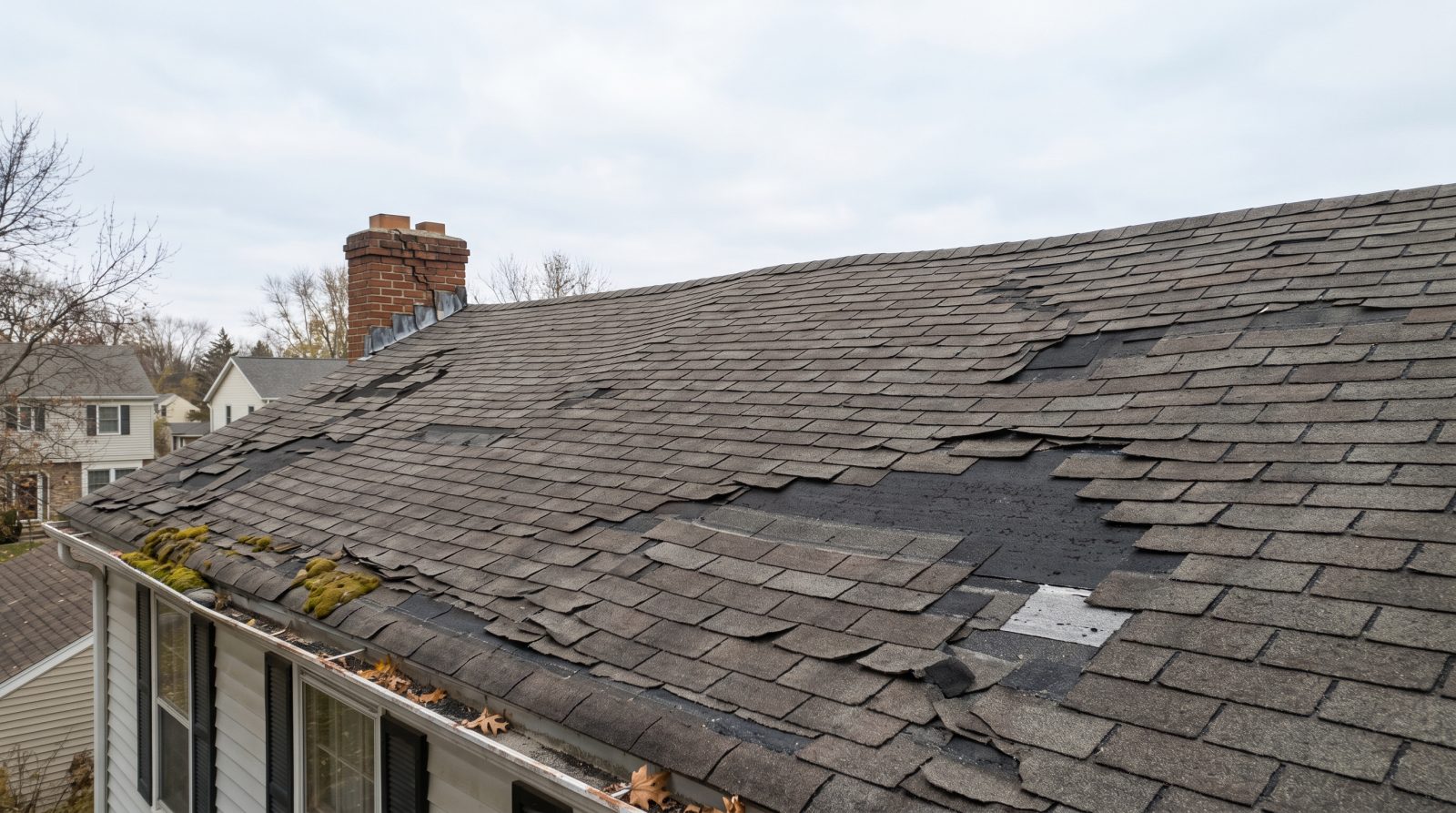
Curling, cupping, or clawing shingles indicate the material is drying out and losing its grip and water-shedding shape, which tends to happen as a whole roof ages rather than in one spot. Bald spots where the protective granules have worn away leave the asphalt mat exposed to UV, accelerating failure; if your gutters are full of sandy, granule-like grit, that's the roof shedding its sunscreen. Cracked, broken, or missing shingles after a storm may be repairable, but if you're losing shingles routinely, the field has likely become brittle.
On metal roofs, watch for loosened or backing-out fasteners, failed sealant at seams, rust or corrosion, and oil-canning that worsens over time. On tile and slate, slipped, cracked, or missing pieces often signal that the fasteners or underlayment beneath have failed even when most of the surface looks intact.
- Curling, cupping, or clawing shingle edges across large areas
- Granule loss (bald shingles) and granules collecting in gutters and downspouts
- Repeated missing or cracked shingles, not just one after a single storm
- Dark streaks (algae) or green moss holding moisture against the surface
- Visible daylight, rust at fasteners, or failed seam sealant on metal roofs
- Slipped, cracked, or missing tiles and slates
Inside-the-House Signs That Are Easy to Miss
Some of the most important evidence is inside, often in spaces you rarely visit. Your attic and ceilings record water intrusion long before it stains a visible wall, and they can reveal ventilation and insulation problems that quietly shorten a roof's life. Checking these on a sunny day and again during or after rain gives you two very different and useful views.
In the attic, look for daylight coming through the roof boards, dark or damp streaks on the rafters and decking, and any sponginess or rot in the wood. Moisture stains that have rings, like a coffee cup mark, usually indicate a recurring leak rather than a one-time event. Active drips during rain, a musty smell, or visible mold are all signs that water is getting past the roof's defenses.
In your living space, water stains on ceilings or upper walls, peeling paint near the roofline, and bubbling drywall point to intrusion above. A sudden, unexplained jump in heating or cooling bills can also be a roofing-and-ventilation symptom, because a failing or poorly ventilated roof loses its ability to regulate attic temperature and moisture. None of these prove you need a full replacement on their own, but several together usually do.
- Daylight visible through the roof deck from inside the attic
- Water stains, dark streaks, or active drips on rafters and decking
- Soft, spongy, or rotted roof sheathing underfoot or to the touch
- Recurring ring-shaped stains on ceilings or upper walls indoors
- Persistent musty odor, mold, or mildew in the attic
- Unexplained spikes in energy bills tied to attic temperature swings
Structural Red Flags: When It's No Longer Optional
A handful of signs move a roof from the maintenance category to the urgent category. These point to problems with the roof's structure or its water-management system rather than just its surface, and they tend to get worse and more expensive the longer they wait. If you see any of these, getting a professional assessment promptly is the prudent move.
A sagging or dipping roofline is the most serious. A roof should follow straight, even planes; a visible sag, wave, or dip suggests the decking, rafters, or supporting structure is compromised, often by long-term moisture or accumulated weight. This is not a cosmetic issue and should be evaluated quickly. Failed flashing around chimneys, skylights, vents, and valleys is another common culprit, because flashing handles the most leak-prone transitions on any roof; widespread flashing failure on an older roof often tips the decision toward replacement.
Damaged or detaching gutters, fascia, and soffits frequently accompany roof problems and can both cause and reveal water damage at the roof edge. And on a flat or low-slope roof, ponding water that lingers more than a day or two after rain signals drainage failure that will degrade the membrane and the structure beneath it.
- A sagging, dipping, or wavy roofline (get this evaluated promptly)
- Widespread flashing failure at chimneys, valleys, skylights, and vents
- Rotted, pulling-away fascia, soffits, or gutters at the roof edge
- Ponding water that doesn't drain on flat or low-slope roofs
- Multiple active leaks in different areas, not a single point
Repair vs. Replace: How to Make the Call
Not every problem on this list means replacement. The honest answer for most homeowners comes down to four questions: How old is the roof? How widespread is the damage? Is the underlying structure (decking and rafters) still sound? And how do the long-term economics compare?
A roof that's relatively young, structurally sound, and damaged in one defined area is usually a strong candidate for repair, and a good repair can buy many more years. A roof that's near or past its service-life range, leaking in multiple places, shedding granules across the whole field, or showing structural movement is usually telling you that repairs will become a recurring expense. As a rough rule of thumb many contractors use, when the cost of needed repairs approaches a large share of replacement cost, or when you'd be repairing an old roof you'll replace soon anyway, replacement is often the better long-term value.
It's also worth knowing that surface symptoms can hide deeper issues that only become clear once a section is opened up, which is why a hands-on professional assessment beats a guess from the ground. The ranges throughout this guide are typical industry estimates that vary widely by region, material, roof size, pitch, accessibility, and the scope of work; they are not a quote. The right next step is an inspection by an experienced roofer who can tell you which category your roof is actually in.
- Lean toward repair: young roof, sound structure, damage confined to one area
- Lean toward replacement: at/past service-life age, multiple leaks, whole-roof granule loss, or any structural sag
- Always investigate: hidden decking rot or flashing failure can change the answer
- Get it assessed: an in-person inspection is the only reliable way to choose with confidence
What to Do Next
If you've recognized your roof in several of the signs above, you don't have to diagnose it alone, and you shouldn't risk an injury climbing an aging roof to find out. A professional assessment will confirm whether you're looking at a targeted repair or a replacement, identify any hidden structural or flashing issues, and give you a clear, honest picture before you spend anything.
Roof Repairs offers nationwide roofing help for homeowners and businesses across the United States. For a free roof assessment and a straightforward recommendation on repair versus replacement, call (669) 259-2777. Catching these signs early almost always costs less than waiting for the leak to find you.