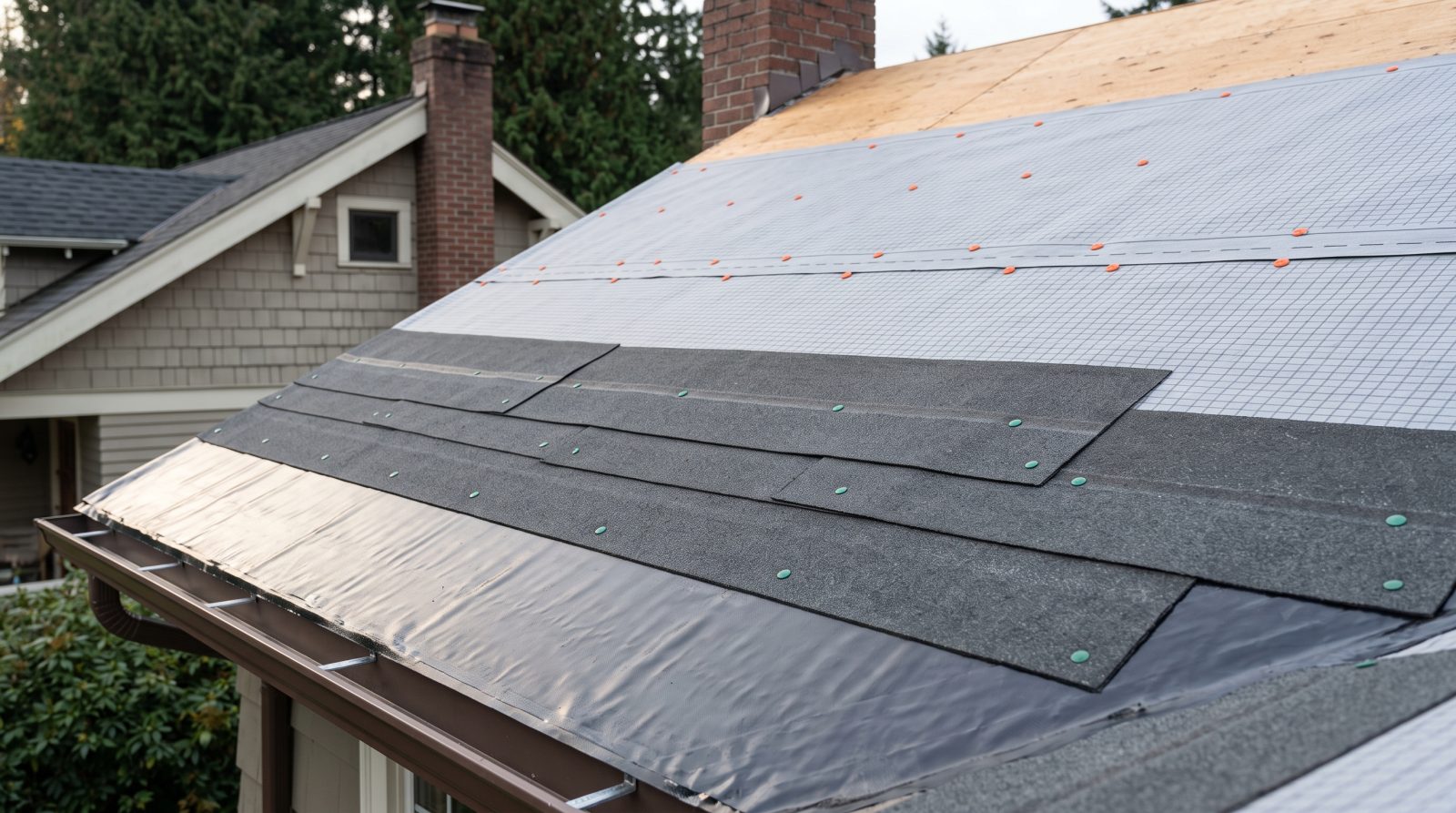
What Roof Underlayment Actually Is (and Why It Matters)
A roof is a system of layers, not a single skin. From the bottom up, a typical steep-slope roof consists of the structural decking (usually plywood or OSB), the underlayment, sometimes a separate ice-and-water barrier in vulnerable areas, and finally the visible roof covering such as asphalt shingles, tile, or metal. Underlayment is the continuous protective sheet installed directly over the deck before the covering goes on. You will never see it once the roof is finished, but it is doing quiet, critical work every day.
The primary job of underlayment is to serve as a secondary line of defense against water. Your shingles or panels are the first barrier, but no outer covering is perfect. Wind can lift shingles and drive rain underneath them. A branch can crack a tile. Ice can dam at the eaves and force meltwater backward up the slope. When water gets past the top layer, underlayment is what stops it from reaching the wood deck and the living space below. Without a sound underlayment, even a small breach in the covering can lead to rotted sheathing, stained ceilings, mold, and damaged insulation.
Underlayment also plays supporting roles that homeowners often overlook. It protects the deck from moisture during construction before the covering is installed, which can take days on a large or weather-delayed project. It provides a smoother, more uniform surface for the roof covering to sit on, and certain types add a measure of fire resistance and help the overall roof assembly meet local building code requirements. In short, underlayment is cheap insurance built into the roof, and skimping on it is one of the most common ways a roofing job goes wrong over the long term.
The Three Main Types of Roof Underlayment
There are three families of underlayment in wide use across the United States today: asphalt-saturated felt, synthetic underlayment, and self-adhered (peel-and-stick) membranes. Each has a clear role, and on many roofs the best answer is a combination rather than a single product. Understanding the differences helps you ask the right questions and recognize quality work.
Asphalt-saturated felt is the traditional product most people picture when they think of roofing paper. It is a flexible mat saturated with asphalt, sold most commonly in two weights, often labeled No. 15 and No. 30, with the heavier No. 30 offering more durability and tear resistance. Felt is inexpensive, widely available, and has decades of proven performance. Its drawbacks are real, however: it is heavier and bulkier to handle, it can absorb water and wrinkle if it gets wet before the covering goes on, it tears more easily in wind, and it can become brittle over many years of heat exposure.
Synthetic underlayment is a newer category made from woven or spun polymers such as polypropylene or polyethylene. It has become the default choice for many quality roofers because it is dramatically lighter, far stronger against tearing, more resistant to wrinkling and moisture, and generally safer to walk on. A single roll covers more area than felt, which speeds installation. Synthetics also tend to hold up better when left exposed to sunlight during a multi-day project, though exposure limits vary by product and should always be respected. The main trade-off is a higher material cost than basic felt, though many homeowners and roofers consider the performance gain well worth it.
Self-adhered, or peel-and-stick, membranes are the premium tier. These rubberized-asphalt or butyl-based sheets have a sticky backing that bonds directly to the deck and self-seals around nails and fasteners. That self-sealing quality is what makes them invaluable in the most leak-prone areas of a roof. They are the most expensive option per square foot, so they are typically used strategically in high-risk zones rather than across an entire field, except in severe climates or on low-slope sections where full coverage is warranted.
- Asphalt felt: low cost, proven, but heavier, tears easily, and can wrinkle when wet
- Synthetic: lightweight, strong, tear- and moisture-resistant, faster to install, higher cost than felt
- Peel-and-stick: self-sealing around fasteners, best leak protection, premium price, used in critical zones
- Many quality roofs combine types: peel-and-stick at eaves and valleys, synthetic across the main field
Where Each Type Belongs on Your Roof
Not every part of a roof faces the same risk, so the smartest underlayment strategy assigns the right product to the right zone. Roofers think in terms of vulnerable areas versus the broad open field of the roof, and the best results come from matching protection to exposure rather than using one product everywhere.
The eaves are the lower edge of the roof and one of the most failure-prone areas, especially in cold climates where ice dams form. An ice dam is a ridge of ice that builds up at the eave as snow melts higher on the warm roof and refreezes at the cold edge, trapping water that then works its way back up under the shingles. A self-adhered ice-and-water membrane along the eaves is the standard defense, and many building codes in snow-prone regions require it to extend a specific distance up the slope from the interior wall line. Valleys, where two roof planes meet and channel large volumes of water, are another classic spot for peel-and-stick protection because of the concentrated flow.
Penetrations and transitions deserve special attention as well. Anywhere the roof is interrupted, such as around chimneys, skylights, plumbing vents, dormers, and where the roof meets a vertical wall, water has more opportunity to find a path inside. These spots benefit from self-adhered membrane in addition to proper flashing. Low-slope sections, which shed water slowly and hold standing water longer, often call for fuller coverage of a self-adhered or specialized low-slope product because conventional shingle-style shedding cannot be relied upon.
Across the broad field of a steep-slope roof, where water runs off quickly and risk is lower, a quality synthetic underlayment is usually the right balance of protection, durability, and cost. This zoned approach, premium membrane in the high-risk areas and reliable synthetic across the open expanse, is how experienced roofers build a roof that holds up for the long haul without overspending on areas that do not need the most expensive product.
- Eaves: self-adhered ice-and-water membrane, especially critical in snow and ice regions
- Valleys: peel-and-stick to handle concentrated water flow where roof planes meet
- Penetrations (chimneys, skylights, vents, wall transitions): self-adhered membrane plus correct flashing
- Low-slope sections: fuller self-adhered or specialized coverage since water drains slowly
- Open field on steep slopes: quality synthetic for the best balance of cost and performance
How Climate and Region Change the Right Choice
The United States spans an enormous range of climates, and the underlayment that makes sense in one region can be inadequate or overbuilt in another. Because Roof Repairs provides nationwide roofing help, it is worth understanding how regional conditions shape a good underlayment plan so you can have an informed conversation about your own home.
In the cold and snowy North and at higher elevations, ice damming is the dominant concern. Self-adhered ice-and-water membrane at the eaves is essentially mandatory in much of this territory, and codes frequently dictate how far up the slope it must reach. Homeowners in these areas should expect more peel-and-stick coverage, not less, and proper attic insulation and ventilation also matter because they reduce the warm-roof conditions that create ice dams in the first place.
In hot, sun-baked climates such as the Southwest and much of the South, heat and ultraviolet exposure are the enemies. Underlayment in these regions endures extreme attic temperatures, which can age felt prematurely and make it brittle. High-temperature-rated synthetic or self-adhered products are often the better call, particularly under tile and metal roofs that can trap significant heat. In hurricane- and high-wind-prone coastal areas of the Gulf and Southeast, wind-driven rain is a constant threat, so tear-resistant synthetics and generous self-adhered coverage help keep water out when shingles are stressed or lifted.
In wet climates like the Pacific Northwest and the rainy Southeast, sustained moisture and slower drying conditions favor underlayments that resist water absorption and wrinkling, making synthetics and self-adhered membranes attractive. Mixed climates in the middle of the country experience a bit of everything across the seasons and reward a balanced, zoned approach. Wherever you live, local building codes set minimum requirements, and a knowledgeable roofer will tailor the underlayment plan to your specific climate, roof slope, and covering material rather than applying a one-size-fits-all spec.
- Cold and snowy regions: extensive ice-and-water membrane at eaves; ventilation and insulation reduce ice dams
- Hot and high-UV regions: high-temperature-rated synthetic or self-adhered, especially under tile and metal
- High-wind and coastal areas: tear-resistant synthetics plus generous self-adhered coverage
- Wet, rainy regions: moisture- and wrinkle-resistant synthetics and membranes
- Local codes always set the floor; a good roofer designs to your exact conditions
Signs Your Underlayment May Be Failing, and What It Costs
Because underlayment is hidden, problems usually announce themselves indirectly through the symptoms of water that has gotten past both the covering and the underlayment. Catching these signs early can be the difference between a minor repair and a major deck replacement. Watch for water stains on ceilings or in the attic, a musty smell that suggests trapped moisture, daylight visible through the roof boards in the attic, sagging or spongy areas on the roof surface, and granule loss or widespread shingle deterioration that indicates the covering is near the end of its life. If the outer roof is failing, the underlayment beneath it is often compromised too.
It is important to understand that underlayment is generally not replaced on its own. It lives under the roof covering, so accessing it means removing the shingles, tiles, or panels above it. For that reason, underlayment is almost always renewed as part of a full reroof or a sectional tear-off, not as a standalone job. The good news is that a reroof is the natural and most cost-effective moment to upgrade to a better underlayment, which is why it pays to discuss options before that work begins.
On cost, it helps to set expectations with typical industry ranges, keeping in mind these are estimates that vary widely by region, material, roof size, slope, complexity, and current labor and material prices. As a rough guide, basic asphalt felt is the least expensive material, synthetic underlayment commonly runs a few times the cost of felt per unit area, and self-adhered membrane is the priciest per square foot. Even so, underlayment is usually a modest fraction of a total roofing project compared with the covering and labor, so upgrading the underlayment is one of the higher-value decisions you can make during a reroof. The only way to know your real number is a hands-on assessment of your specific roof.
A few realities are worth stating plainly. Underlayment is a backup, not a substitute for a properly installed roof covering and flashing, and it cannot compensate for poor ventilation or a neglected roof indefinitely. Quality of installation matters as much as the product itself, since wrinkles, insufficient fastening, gaps, and improperly lapped seams undermine even the best material. And every product has a limit on how long it can sit exposed before the covering goes on. These are exactly the details a careful, experienced roofer manages on your behalf. For a clear read on your roof and your options, call (669) 259-2777 for a free roof assessment.
- Warning signs: ceiling or attic water stains, musty odors, daylight through roof boards, sagging, heavy granule loss
- Underlayment is renewed during a reroof or tear-off, not replaced on its own
- Cost rises from felt to synthetic to self-adhered, but it is a small share of total project cost
- Estimates vary by region, material, size, slope, and scope; only a hands-on assessment gives a real number
- Installation quality matters as much as the product: laps, fastening, and exposure limits all count