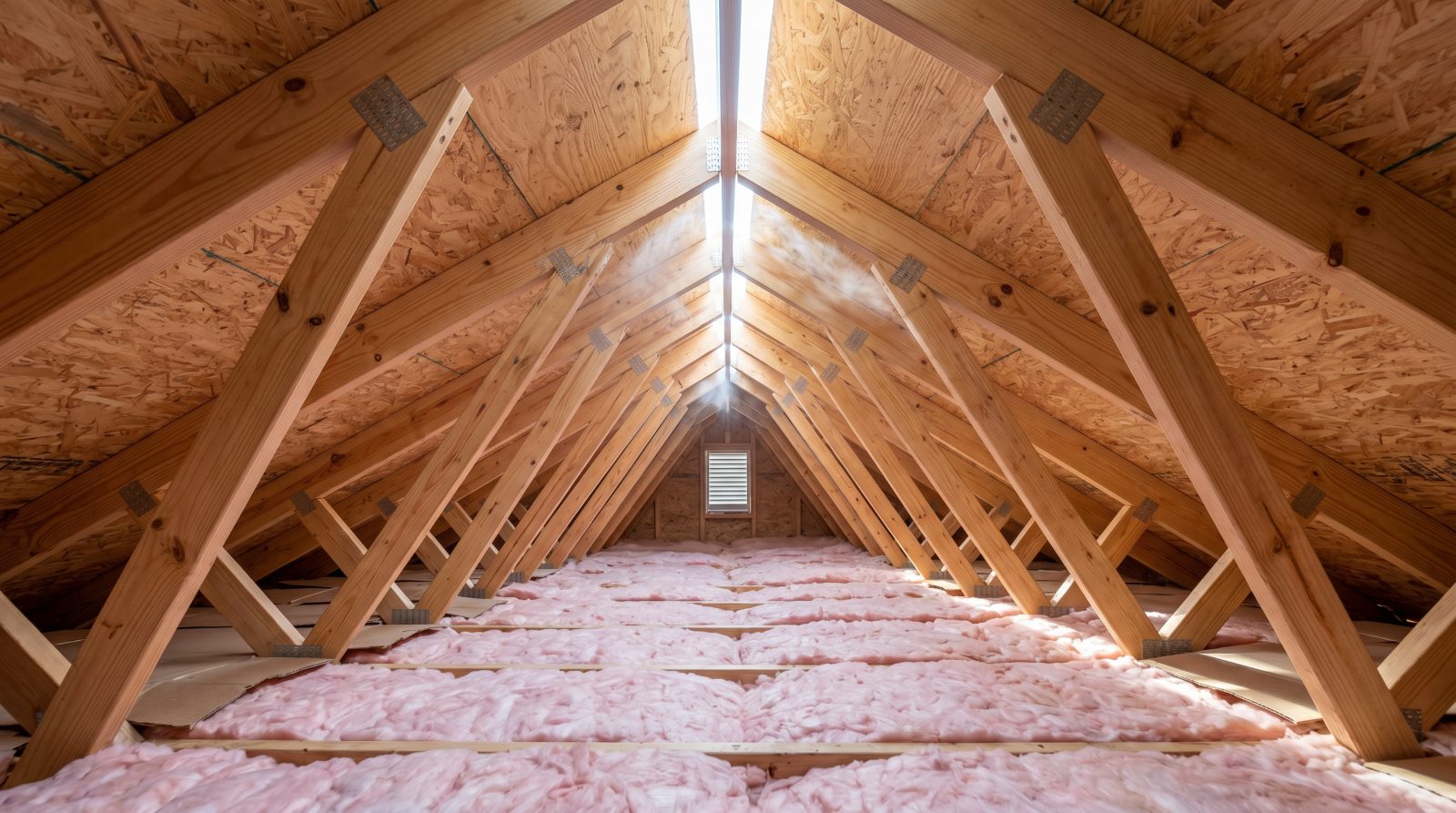
Why Your Attic and Roof Are One System, Not Two
It is tempting to treat the roof as the part that keeps water out and the attic as the part that keeps heat in, two separate jobs handled by two separate trades. But the roof deck, the shingles, the attic air, the insulation, and the ventilation all share the same enclosed space, and they constantly affect one another. The temperature and humidity inside your attic are largely controlled by how well it is insulated and ventilated, and those conditions directly determine how hot your shingles get, whether condensation forms on the underside of the roof deck, and how fast snow melts and refreezes at the eaves.
When insulation is too thin or unevenly distributed, heat from your living space rises into the attic and warms the roof from below. In summer that adds to the already punishing heat shingles absorb from the sun, accelerating the aging of the asphalt. In winter that warmth melts the underside of accumulated snow, which then runs down to the cold eaves and refreezes, building the ice dams that force water back up under the shingles. The same insulation that lowers your heating and cooling bills is, in effect, a roofing component.
This is why a roofing problem is so often actually an attic problem in disguise. Premature shingle wear, recurring leaks at the eaves, a sagging or stained roof deck, and mysterious moisture can all trace back to insulation and ventilation rather than to the roof covering itself. Replacing shingles without correcting the attic underneath them simply restarts the clock on the same failure.
- Insulation controls how much living-space heat reaches the roof deck.
- Ventilation removes the heat and moisture that build up in attic air.
- Together they govern shingle temperature, condensation, and ice-dam risk.
- A 'roof' symptom is frequently an attic-performance symptom.
How Poor Insulation Damages a Roof From the Inside
The most common and most expensive way attic conditions hurt a roof is through trapped heat and trapped moisture. A poorly insulated, poorly ventilated attic becomes a heat trap in summer. Shingle surface temperatures already run far hotter than the outside air on a sunny day, and an attic that radiates additional heat upward from below pushes them higher still. Heat is what breaks down asphalt shingles over time, drying out the oils that keep them flexible and causing the protective granules to loosen and wash away. Chronically overheated shingles simply do not reach the lifespan they were designed for.
Moisture is the quieter, more insidious threat. Everyday activities like cooking, showering, and laundry release large amounts of water vapor into the home, and that vapor naturally migrates upward. If it reaches a cold roof deck and there is not enough ventilation to carry it away, it condenses into water on the underside of the sheathing. Over time this hidden condensation can darken and delaminate plywood or OSB decking, corrode metal fasteners and connectors, and create the damp, dark conditions mold needs to grow. Homeowners often discover this only when a soft spot appears in the roof or a musty smell takes over the attic.
Insulation that is the wrong amount, or installed the wrong way, compounds both problems. Insulation pushed tight against the eaves can block the airflow path that ventilation depends on. Gaps, compression, and missing coverage create cold and warm spots across the deck that drive uneven snowmelt and condensation. And insulation that has absorbed moisture loses much of its R-value, so the attic gets both colder and damper, feeding the cycle.
- Trapped attic heat shortens shingle life and accelerates granule loss.
- Indoor humidity that can't escape condenses on the cold roof deck.
- Hidden condensation rots sheathing, rusts fasteners, and feeds mold.
- Insulation jammed into the eaves blocks the airflow the roof needs.
- Wet or compressed insulation loses R-value and worsens the cycle.
Insulation and Ventilation: A Balance, Not a Trade-Off
One of the biggest misunderstandings in home performance is treating insulation and ventilation as opposites, as if adding more of one means you need less of the other. They are partners. Insulation slows the movement of heat between your living space and the attic. Ventilation continuously exchanges attic air with outside air so that any heat and moisture that do get through are carried away rather than building up. You need both working together, and you need the air barrier between the conditioned home and the attic to be sealed so that warm, humid indoor air is not leaking up in the first place.
A balanced ventilation system relies on intake and exhaust working as a pair. Intake vents, usually located in the soffits at the eaves, let cool outside air enter low in the attic. Exhaust vents near or at the ridge let hot air escape high, where it naturally rises. This low-in, high-out path creates a steady, gentle flow that flushes the attic. If intake and exhaust are unbalanced, or if insulation blocks the soffit intakes, the system stalls and the attic stops breathing even when vents are technically present.
Getting the air-sealing right is the step many homeowners skip. Recessed lights, attic hatches, plumbing and wiring penetrations, and the top plates of interior walls are all common places where conditioned air leaks into the attic. Sealing those gaps before adding insulation is what prevents the indoor humidity that causes condensation, and it lets the insulation actually perform at its rated value. Air-sealing, insulation, and ventilation done together are far more effective than any one of them alone.
- Intake at the soffits plus exhaust at the ridge creates steady airflow.
- Insulation slows heat transfer; ventilation removes what gets through.
- Air-sealing penetrations stops humid indoor air from reaching the attic.
- Blocked soffit intakes can stall the whole ventilation system.
- The three measures work best when designed and installed together.
What Changes by Region and Climate
Because Roof Repairs serves homeowners and businesses across the United States, it is worth being clear that the ideal attic setup is not the same everywhere. In general, colder northern climates call for higher insulation levels to keep heat in and to keep the roof deck cold and uniform, which is also the best defense against ice dams. The goal in snow country is a 'cold roof' where the deck stays near the outside temperature so snow does not melt and refreeze at the eaves. Deep, even insulation plus strong, unobstructed ventilation is what makes that possible.
In hot southern and southwestern climates, the priority shifts toward keeping the attic from becoming a heat reservoir that drives up cooling costs and bakes the shingles. Adequate insulation still matters, but ventilation and reflecting or shedding heat take on greater importance. In mixed and coastal climates, humidity management becomes central, because high outdoor moisture combined with air conditioning can create condensation conditions of its own. Local building codes reflect these differences and typically specify minimum insulation levels by region, so what is right for one home may be under-built for another.
Climate also shapes which symptoms show up first. A homeowner in the Upper Midwest is most likely to notice ice dams and eave leaks; a homeowner in the Southeast is more likely to notice musty attic odors, high summer energy bills, and early shingle aging. The underlying principle is the same everywhere, balance insulation, ventilation, and air-sealing, but the dial settings differ. A professional assessment that accounts for your specific climate is the most reliable way to know where you stand.
- Cold climates: more insulation and a 'cold roof' to prevent ice dams.
- Hot climates: emphasize ventilation and limiting attic heat buildup.
- Humid and coastal areas: moisture control becomes the leading concern.
- Local codes set regional minimums; one-size-fits-all rarely fits.
- The symptoms you see first depend heavily on your climate.
Warning Signs and When to Replace Insulation With the Roof
You do not need specialized tools to spot many of the warning signs that your attic insulation and ventilation are letting your roof down. Energy bills that climb out of step with your usage, rooms that are hard to keep comfortable, and a top floor that is sweltering in summer or chilly in winter all point to an attic that is not holding the line. Visiting the attic itself can reveal even more: insulation that looks thin, patchy, matted down, or stained; daylight or frost on the underside of the roof deck; a musty smell; or rusted nail tips, which is a classic sign of condensation cycling.
On the roof and at the eaves, recurring ice dams, leaks that appear near the edges of the roof after snow, and shingles that are curling or losing granules faster than expected can all reflect attic conditions. Because these signs overlap with ordinary roof aging, it is easy to misdiagnose them, which is why a roofer who looks at the attic, not just the shingles, gives you a far more accurate picture of what is actually happening and what will actually fix it.
The single most cost-effective time to correct attic insulation and ventilation is during a roof replacement. With the roof covering removed, the deck is accessible, ventilation components like ridge and soffit vents can be properly sized and installed as a balanced system, and any insulation problems can be addressed without a separate mobilization. Pairing the work means you replace shingles onto a roof system that will actually let them reach their full life, rather than installing a new roof over the same conditions that wore out the last one.
- Rising energy bills and uncomfortable top-floor rooms.
- Thin, matted, patchy, or stained insulation in the attic.
- Frost, dampness, daylight, or rusted nail tips on the underside of the deck.
- Recurring ice dams and edge leaks after snow.
- Shingles curling or shedding granules ahead of schedule.
- Roof replacement is the ideal moment to fix insulation and ventilation together.
What It Typically Costs to Get the Attic Right
Costs for attic insulation and ventilation improvements vary widely, and any figures here are typical industry ranges meant for planning, not a quote. The final number for your home depends on your region, the size and accessibility of your attic, the type and amount of insulation, the existing ventilation, how much air-sealing is needed, and whether the work is done on its own or as part of a roof replacement. As a general planning guide, adding or topping up attic insulation tends to be a smaller line item than a full roof project, while combining it with air-sealing and ventilation upgrades costs more because more scope is involved. These are only rough estimates and can shift meaningfully by market and by the specifics of your roof.
It is usually more economical to bundle attic work with a roof project than to do it separately. When a crew is already on site and the deck is exposed during a replacement, the incremental cost of properly sizing intake and exhaust ventilation, sealing penetrations, and correcting insulation is far lower than mobilizing for those tasks as a standalone job later. Many homeowners also find that the energy savings from a properly insulated and sealed attic offset a meaningful portion of the cost over time, though actual savings depend on your climate, energy rates, and how leaky the home was to begin with.
The most reliable way to understand your real numbers is to have your specific attic and roof evaluated. A proper assessment looks at insulation levels, the air barrier, the ventilation balance, and the condition of the roof deck together, then lays out what the home actually needs. For a free roof assessment and a clear, no-pressure explanation of your options anywhere in the United States, call Roof Repairs at (669) 259-2777.
- All figures are typical ranges that vary by region, attic size, and scope.
- Cost drivers: insulation type and amount, ventilation, air-sealing, access.
- Bundling attic work with a roof replacement is usually the best value.
- Energy savings can offset part of the cost over time, but vary by home.
- A site assessment is the only way to get numbers specific to your roof.