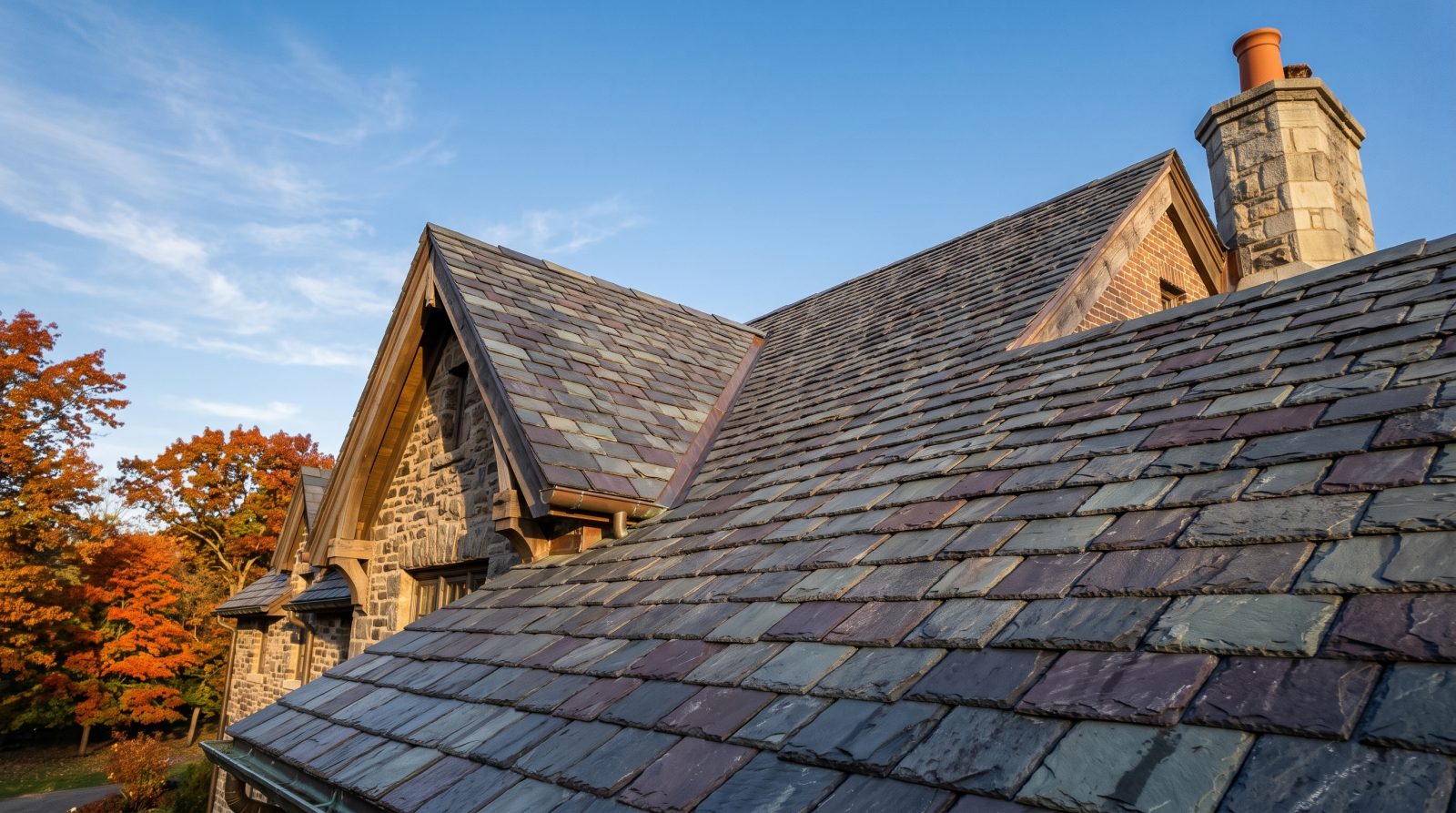
What Slate Roofing Actually Is
Slate is a fine-grained metamorphic rock formed when shale or volcanic ash is compressed under heat and pressure over millions of years. That geology is the whole story: the same forces that give slate its dense, layered structure are what let it be split (or 'cleaved') into thin, flat tiles, and what make it nearly impervious to water and weathering. When you put a stone roof over your head, you are using one of the few building materials that essentially does not wear out on a human timescale.
Not all slate is equal, and the distinction matters a great deal for longevity. Roofing slate is broadly grouped into 'hard' (long-life) and 'soft' (shorter-life) categories based on its mineral makeup and how much water it absorbs. High-quality hard slate is extremely stable; lower-grade or weathering slate can begin to flake, delaminate, and crumble far sooner. Color is also tied to chemistry: grays, blacks, greens, purples, and reds come from the minerals present, and some colors are 'unfading' while others are 'weathering' and shift tone over decades. None of this is a defect in itself, but it is why slate should be specified carefully rather than bought on price alone.
There is also a growing category of synthetic and composite 'slate' made from recycled rubber and plastic polymers, engineered to mimic the look at a fraction of the weight. These are a legitimate product with real advantages, but they are a different material with a different lifespan, and they should not be confused with quarried stone.
- Natural slate: quarried stone, exceptional lifespan, heavy, premium cost
- Hard vs. soft slate: mineral content drives how long it lasts before it flakes or delaminates
- Unfading vs. weathering slate: some colors hold their tone, others shift over decades (both can be high quality)
- Synthetic/composite slate: polymer tiles that mimic the look at much lighter weight and lower cost
The Real Benefits of a Slate Roof
The headline benefit is longevity. A properly installed natural slate roof using quality hard slate can serve for a century or more, and the limiting factor is usually the fasteners and flashings rather than the slate itself. Practically, this means slate is one of the only roofing choices where the roof can credibly outlast the people who install it. That changes the cost math: spread over its service life, slate's high upfront price often works out to a low cost per year compared with materials that need replacing two or three times in the same span.
Slate is also naturally fireproof. Because it is stone, it does not ignite or contribute fuel to a fire, which is a meaningful consideration in wildfire-prone regions of the West and in any area where ember exposure is a concern. It resists rot, insects, and fungal growth, and quality slate stands up well to hail and severe weather. It is dimensionally stable across temperature swings, and it does not break down under UV the way some manufactured products eventually do.
Then there is the aesthetic and resale dimension, which is not just sentiment. Slate has a textured, layered depth and a natural color variation that reads as authentic and high-end, and it is strongly associated with historic, architectural, and luxury homes. For the right property, a slate roof reinforces the character of the house and can be a genuine selling point. It is also among the more environmentally sound choices: it is a natural material, extremely long-lived, and reclaimable rather than landfill-bound at end of life.
- Exceptional lifespan that can exceed a century with quality slate and proper installation
- Naturally fireproof and non-combustible, valuable in wildfire-exposed regions
- Resists rot, insects, UV breakdown, and severe weather including hail
- Distinctive, authentic appearance that suits historic and architectural homes
- Low long-term cost per year and an environmentally durable, reclaimable material
The Honest Drawbacks and Considerations
Weight is the first and most important consideration. Natural slate is dramatically heavier than asphalt shingles, often several times the weight per square (a 'square' being 100 square feet of roof). Many homes are not framed to carry that load. Before any slate roof goes on, the structure should be evaluated, and some homes require reinforcement of the roof framing to handle the dead load safely. This is not optional and it is not a detail to skip; it is central to whether slate is even feasible on a given house.
Cost is the second. Slate is among the most expensive roofing materials, both for the stone itself and for the labor, because installing it well is a genuine craft. Cutting, fitting, hanging, and flashing slate correctly requires experience that not every roofing crew has, and poor workmanship is the most common reason a slate roof underperforms its potential. Repairs and replacement tiles also demand someone who knows how to walk and work on slate without cracking surrounding pieces.
Slate is also brittle underfoot. Individual tiles can crack from impact or from careless foot traffic, so it is a poor choice for roofs that need to be walked frequently, and routine work like satellite-dish or solar mounting must be planned carefully. Finally, it is not suited to low-slope roofs; slate sheds water by overlap and gravity and generally needs adequate pitch to perform. Weighed honestly, none of these are reasons to avoid slate, but they are reasons to go in with clear eyes and the right contractor.
- Heavy: many homes need a structural evaluation and possibly reinforced framing before installation
- Expensive upfront in both material and skilled labor
- Brittle: tiles can crack underfoot, so foot traffic and rooftop mounting must be handled carefully
- Requires real craftsmanship; poor installation is the top cause of premature problems
- Not appropriate for low-slope roofs that lack adequate pitch
Natural Slate vs. Synthetic Slate
Synthetic slate, made from engineered polymers and often recycled content, exists precisely to address natural slate's two biggest hurdles: weight and cost. Composite tiles weigh a fraction of stone, which means many homes can take them without structural reinforcement, and they are typically less expensive to buy and faster to install. They are also more forgiving underfoot and easier to cut and handle, which lowers labor difficulty.
The trade-offs are real, though. Synthetic slate is a manufactured product, so its lifespan, while long for a roofing material, is not the multi-generational lifespan of quality stone. Up close, the best composites are convincing but some products read as less authentic than natural slate, and long-term performance depends heavily on the specific manufacturer and formulation. Color and texture are engineered rather than geological, which is either a benefit (consistency) or a drawback (less natural variation), depending on what you value.
There is no universally 'right' answer. A historic home where authenticity and maximum lifespan matter, on framing that can carry the load, is a natural slate candidate. A home that wants the slate look without a structural retrofit, or on a tighter budget, is often better served by a quality synthetic. The decision should be made on your specific roof structure, budget, climate, and how long you intend to own the home.
- Natural slate: longest lifespan, most authentic, heaviest, highest cost
- Synthetic slate: lighter (often no reinforcement needed), lower cost, easier to install and repair
- Synthetic lifespan is long for roofing but not the multi-generational span of quality stone
- Choose based on your framing, budget, climate, and ownership timeline, not on looks alone
Typical Slate Roofing Costs
Slate is a premium investment, and the figures below are typical industry ranges to help you frame a budget, not a quote. Actual pricing varies significantly by region, roof size and complexity, slate grade and origin, the steepness and number of roof planes, removal of an old roof, any required structural reinforcement, and local labor rates. The only way to know what your roof will cost is a hands-on assessment.
As a general guide, natural slate is one of the highest-cost roofing materials available, with installed pricing that commonly runs several times that of standard asphalt shingles. Synthetic slate typically lands well below natural stone while still sitting above basic asphalt, reflecting the look-and-durability premium. Because slate roofs last so long, many owners evaluate the cost over the roof's full service life rather than the sticker price alone, where slate's cost-per-year can be very competitive.
Two budget items are easy to overlook. First, any structural reinforcement needed to carry the weight of natural slate is a separate cost from the roof itself and should be scoped early. Second, flashings, underlayment, and fasteners are not where to economize: because the slate may last a century, these supporting components should be chosen for durability so they do not become the weak link that forces premature work.
- Natural slate is among the most expensive roofing materials, often several times the cost of asphalt (typical range; varies widely)
- Synthetic slate generally costs less than natural stone while exceeding basic asphalt
- Major cost drivers: roof size, pitch and complexity, slate grade, tear-off, and structural reinforcement
- Budget separately for framing reinforcement when needed, and invest in quality flashings and fasteners
- These are estimates only, not a fixed quote; a hands-on assessment is the only way to price your roof
Maintenance, Repairs, and Making Slate Last
The good news is that quality slate itself needs very little maintenance; the stone simply endures. The reality is that the failures you do see on slate roofs are almost always in the supporting systems, not the slate: corroded or undersized nails, worn-out flashing at valleys, chimneys, and walls, and damage from improper foot traffic. Keeping a slate roof healthy is therefore mostly about protecting those vulnerable points and avoiding well-intentioned damage.
Periodic inspection is the core of slate maintenance. A trained eye looks for slipped or cracked tiles, deteriorating flashing, and any soft slate beginning to flake or delaminate, then addresses small issues before water finds its way in. Individual broken slates can usually be replaced one at a time, which is part of slate's appeal, but it must be done by someone who knows how to lift and re-hang tiles without cracking their neighbors. Matching replacement slate to the existing color and grade matters both for appearance and performance.
A few practices make the biggest difference over the long run. Keep foot traffic to a minimum and use proper techniques and walking boards when access is unavoidable. Keep gutters and valleys clear so water drains freely. Plan any rooftop additions carefully, since penetrations are potential leak points on a roof meant to last generations. And when repairs are needed, use a contractor experienced specifically with slate rather than a general crew, because the skill of the person on the roof is what ultimately determines whether you get a century out of your investment.
Whether you are weighing natural versus synthetic slate, planning a new installation, or caring for a slate roof you already have, expert eyes on the actual roof make all the difference. Call Roof Repairs at (669) 259-2777 for a free roof assessment and a straightforward estimate for your home or business, anywhere in the country.
- Slate itself is low-maintenance; failures usually come from fasteners, flashing, and foot traffic
- Schedule periodic inspections to catch slipped tiles and worn flashing early
- Individual slates can be replaced one at a time, but only by someone experienced with slate
- Minimize foot traffic, keep gutters and valleys clear, and plan rooftop penetrations carefully
- Use a slate-experienced contractor for repairs to protect the roof's long lifespan