
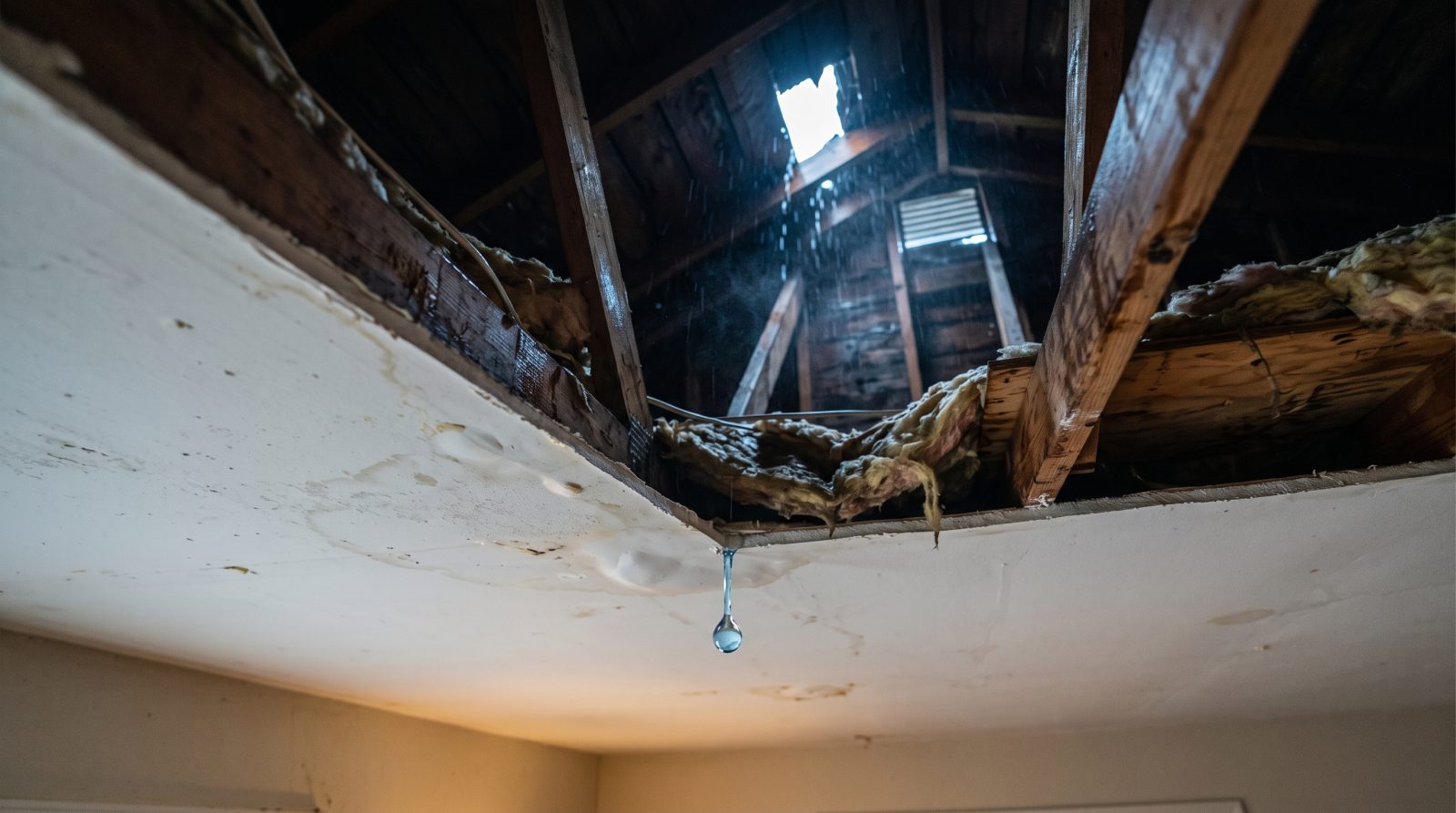
How Long Can You Safely Wait to Fix a Roof Leak?
That little brown ring on your ceiling is a countdown clock. Here's what's actually happening above it, day by day, and why waiting almost always costs you more.
The honest answer: not as long as you'd like
You see a faint brown ring on the ceiling, or a slow drip into a bucket during a storm, and the temptation is universal: it's small, it can wait until the weekend, or until the next paycheck, or until the rain stops. We get it. But here's the uncomfortable truth about roof leaks in 2026 — the clock doesn't care about your schedule, and the damage behind your ceiling is almost always bigger than the stain you can see.
There's no single safe waiting period that applies to every leak. A tiny pinhole during a dry stretch behaves very differently from a torn shingle field heading into a wet month. But the right way to think about it is this: a roof leak is rarely an event. It's a process. The moment water finds a path inside, it starts doing quiet work — wicking along framing, soaking insulation, finding the lowest point — and that process tends to accelerate with every storm.
So while we can't hand you a fixed number of days, we can tell you what's typically happening up there as the hours and days tick by. Once you see it the way a roofer does, you'll understand why 'wait and see' is usually the most expensive strategy there is.
What's happening behind your ceiling: days vs. weeks
The drywall stain is usually the last thing to show up, not the first. By the time water has soaked through enough layers to discolor the ceiling you can see, it has often already traveled through several systems above it. Understanding that timeline is the whole game.
Think of it in phases. In the first hours and days, water is finding its route and saturating materials. Over the following weeks, those wet materials can start to fail, smell, and grow things. Left longer, the problem often stops being about water at all and becomes about structure.
- Hours to a few days: Water enters at the breach, runs down the underside of the deck or along a rafter, and soaks into insulation. Insulation is often the silent victim — once it's wet, it tends to lose much of its insulating value and can stay damp for a long time, quietly feeding everything around it.
- Within the first week or two: Trapped moisture has nowhere to dry. Drywall and ceiling paint absorb it, paint can blister or bubble, and that telltale brown ring spreads. Wood sheathing and framing begin to hold moisture rather than shed it.
- A couple of weeks of damp conditions: This is the window where mold and mildew commonly take hold in dark, humid, poorly ventilated cavities. You may smell a musty odor before you see anything. Fasteners and metal connectors sitting in damp wood can begin to corrode.
- A month and beyond: Repeated wet-dry cycling weakens wood. Sheathing can soften and delaminate, rafters and trusses can start to rot at the wet points, and what began as a shingle repair can grow into a framing and decking job.
The two risks that turn a cheap fix into an expensive one
Almost every reason to act fast comes down to two things: mold and structure. Both are slow to start and stubborn once established, and both are generally far cheaper to prevent than to remediate.
Mold is the one most people underestimate. It doesn't need a flood — it needs moisture, a food source like the paper facing on drywall or organic dust, and time, and an attic can provide all three. Once a colony establishes inside wall and ceiling cavities, you're often no longer talking about a roofing repair; you're talking about remediation, removing and replacing affected materials, and addressing the air quality in your home. That matters even more for anyone in the house with allergies or respiratory sensitivity.
Structure is the second, and it's the one that quietly reshapes the bill. Wood that goes through enough wet-dry cycles loses strength. The roof deck — the sheathing your shingles are nailed to — is often the first structural casualty, softening at the wet zone so fasteners no longer hold the way they should. From there, water can reach rafters, trusses, top plates, and ceiling joists. There's also the danger you can't see coming: water tracking to electrical fixtures, junction boxes, or wiring in the ceiling, which is a genuine safety hazard, not just a cosmetic one.
- Mold and mildew in cavities you can't easily inspect or clean yourself
- Saturated, ineffective insulation that can quietly raise heating and cooling costs
- Softened, delaminated roof decking that compromises how shingles are fastened
- Rot at rafters, trusses, and joists from repeated wet-dry cycling
- Water reaching light fixtures, wiring, or electrical boxes — a real safety concern
When a leak is an emergency vs. when you have a little breathing room
Not every leak demands a midnight phone call, and pretending otherwise just creates panic. The smarter move is to triage. Some situations need someone to stop the water now; others let you schedule a proper assessment in the next few days — but very few genuinely let you do nothing.
Treat it as urgent if water is actively pouring in during rain, if the ceiling is sagging or bulging (that bulge is a pocket of water and it can come down all at once), if a storm physically damaged the roof, or if water is anywhere near electrical fixtures. In those cases the priority is containment and protection, not a perfect permanent repair.
You likely have a shorter window — days, not weeks — if you're seeing a faint, stable stain in dry weather with no active dripping and no odor. 'A short window' is not 'forever.' It means you have time to get a proper set of eyes on it before the next significant rain, not time to forget about it until next season.
- Act now: active dripping in rain, sagging or bulging ceiling, storm damage, water near electrical, fast-spreading stains
- Soon (days): faint stable stain, slow seepage only in heavy rain, a musty smell with no visible water yet
- Either way: document it with photos and protect belongings underneath — both help whoever assesses the roof
Emergency tarping: the smart stopgap (and what it isn't)
When the weather won't cooperate and a permanent repair has to wait, professional emergency tarping is how you stop the bleeding. A properly installed tarp — secured and lapped so water sheds over it rather than under it — buys you time by keeping the next rain out of your home while a real repair is scheduled and the roof can be safely worked on in dry conditions.
But be clear-eyed about what tarping is: a temporary shield, not a solution. A tarp protects the interior; it does not fix the breach, dry out the materials already wet inside, or address mold that may have started. The goal is to halt new water intrusion so the existing damage doesn't compound while you arrange the permanent fix. Think of it as a tourniquet, not surgery.
We'd also gently steer you away from the DIY climb. A wet or storm-damaged roof is genuinely dangerous, tarps that aren't properly anchored can blow off or funnel water into worse places, and a poorly placed one can hide the real entry point and make the eventual diagnosis harder. If you need it tarped fast, that's exactly the kind of call we're glad to take.
Why moving fast almost always saves money
Here's the math that reframes everything. Roofing costs vary widely by region, materials, roof size, and the scope of the work — any honest estimate has to be tailored to your actual roof, not promised from a blog post. But the pattern is consistent: the longer water has access, the more systems it touches, and each additional system it touches tends to multiply the repair.
A small, isolated leak caught early is often a targeted repair — addressing the breach, swapping out a small area of affected materials, and done. Let that same leak run through a wet season and the conversation can shift to replacing soaked insulation, cutting out and remediating mold, replacing sections of decking, and repairing drywall and finishes inside the home. That's not one repair anymore; it's several trades and a lot more disruption. Treat any cost figures you read online as rough industry ranges that vary, not a quote — the only number that means anything is one tied to a real look at your roof.
There's also the part that doesn't show up on an invoice: the stress, the displaced rooms, the worry about air quality, and the gamble of hoping it holds through the next storm. Acting early is rarely the dramatic choice. It's usually just the cheaper, calmer one — and in 2026, with weather that doesn't seem to be getting milder, 'calmer' is worth a lot.
Frequently asked questions
Can a small roof leak really wait until I have time to deal with it?
A small, stable leak in dry weather may give you a short window of days, but typically not weeks or months. The visible stain is usually the last symptom to appear, which means water has often already been at work above it. The safest move is to get it assessed before the next significant rain rather than gambling on how long the dry spell lasts.
How quickly can mold start growing after a roof leak?
Mold needs moisture, a food source, and time, and an attic or wall cavity can provide all three. In damp, dark, poorly ventilated spaces it can commonly take hold within a couple of weeks. A musty smell is often the first clue, frequently before you see anything visible — which is one more reason early action matters.
Will a tarp fix my roof leak?
No. A properly installed emergency tarp is a temporary shield that keeps new water out so the inside damage doesn't keep compounding while a permanent repair is scheduled. It doesn't repair the breach, dry materials that are already wet, or address mold. Think of it as buying time safely, not as a finished repair.
Need roofing help? Get a free assessment.
Call now and get a straight answer about your roof — repair, replacement, or just peace of mind.
Call (669) 259-2777