
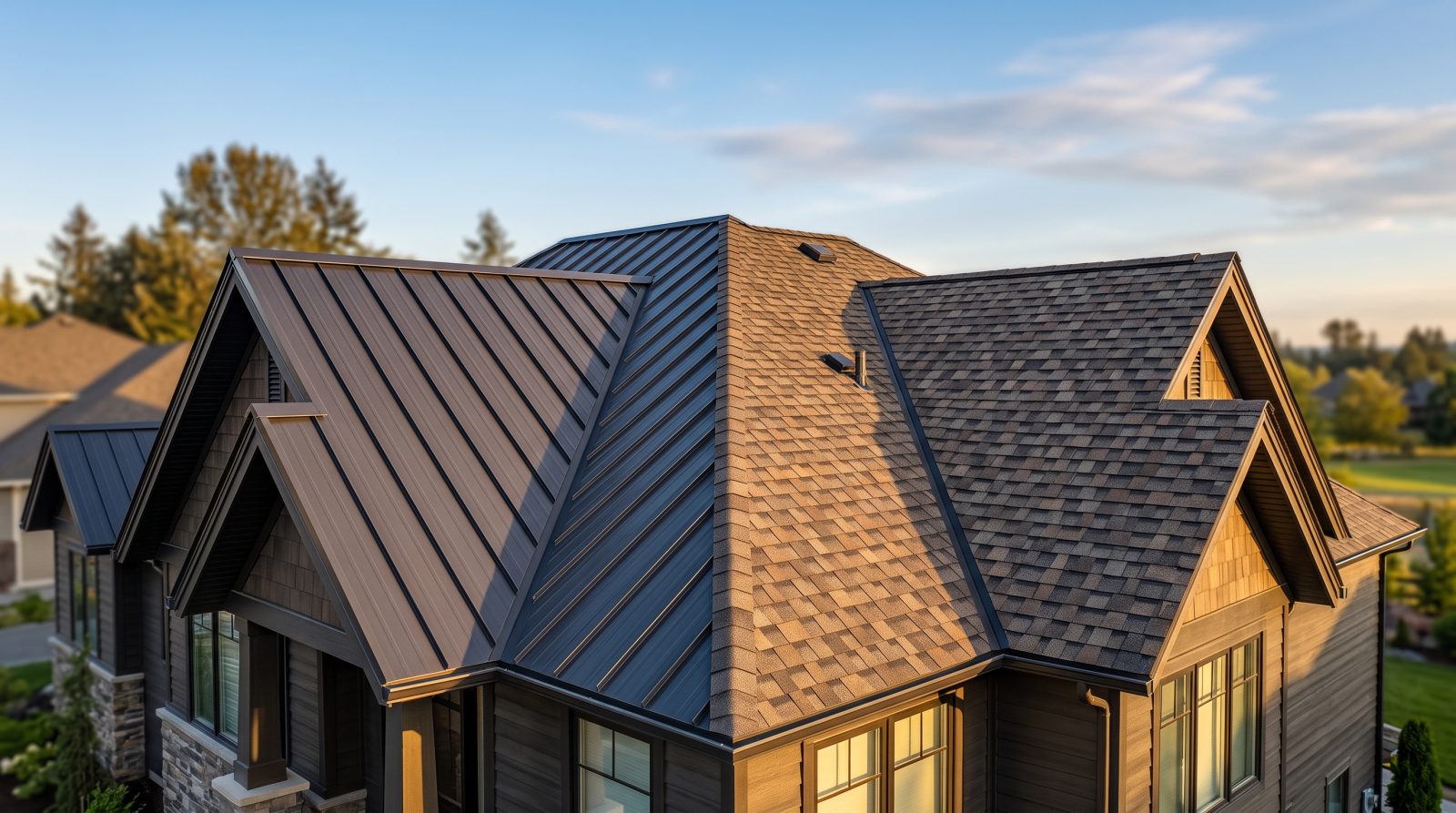
Metal vs. Shingle in 2026: Which Actually Pays Off?
The metal-versus-shingle debate isn't about which roof is "better" — it's about which one pays off for your house, your timeline, and your budget. Here's how to tell them apart in 2026.
The question isn't which roof is better — it's which one pays off for you
Walk down almost any street and you'll see the same two materials competing for your attention: the warm, familiar texture of asphalt shingles and the clean, modern lines of standing-seam metal. Both are excellent roofs. Both are installed on millions of American homes and businesses. And yet homeowners agonize over the choice as if one is a trap and the other is the holy grail. It isn't that simple.
The honest answer is that metal and shingle solve the same problem — keeping water out and your interior comfortable — on two completely different financial timelines. Shingle is the lower-cost, faster, easier-to-repair option that most people reach for. Metal is the higher-upfront, longer-horizon investment that can outlast your time in the house. Whether one 'pays off' depends almost entirely on a single question: how long do you plan to own the building?
In 2026, that math has shifted in subtle but real ways. Material and labor costs have climbed across the board, energy efficiency carries more weight with buyers, and severe weather is pushing more homeowners to think about resilience, not just looks. So let's break down the real trade-offs — cost, lifespan, energy, resale, and the noise myth that refuses to die — so you can make a decision you won't second-guess.
Upfront cost: what you'll actually pay (and why)
Here's the part everyone wants first. As a general industry rule, asphalt shingle is the most affordable mainstream roofing material, and metal typically costs significantly more to install — often roughly two to three times the price per square foot for a quality standing-seam system. These are typical industry ranges that vary widely, not quotes; your real number depends on your region, roof size, pitch, complexity, tear-off, and the specific product line you choose.
Why the gap? Metal is a more expensive material, it demands specialized installers and tooling, and a proper standing-seam job is a precision craft — panels are cut, formed, and seamed to your roof's exact dimensions. Shingles, by contrast, are fast to install with a widely available labor pool, which keeps both material and labor costs down. That speed and simplicity is a genuine advantage, not a knock.
The trap is stopping the analysis at the sticker price. A roof isn't a one-time purchase you forget about — it's a system you'll pay to maintain, repair, and eventually replace. The smarter way to compare is cost per year of service life, which is exactly where metal starts closing the gap and, for long-term owners, often pulls ahead.
- Asphalt shingle: lowest upfront cost, fastest installation, widest availability of crews and materials.
- Metal (standing seam): substantially higher upfront cost, specialized labor, longer install — but a longer runway before you pay again.
- Variables that move your price either way: roof size and pitch, number of penetrations and valleys, tear-off of old layers, ventilation upgrades, and regional labor rates.
Lifespan and ROI: where metal earns its premium
This is the heart of the decision. A quality asphalt shingle roof is generally expected to last a few decades under normal conditions, while a well-installed metal roof is commonly rated to last considerably longer — often described in the trade as roughly two to three shingle lifetimes. That difference is the entire ROI argument in one sentence.
Picture two owners. The first installs shingles, enjoys a lower bill today, and may replace the roof at least once — possibly twice — over the life of the home. The second pays more upfront for metal and, realistically, may never replace the roof again while they own the property. Spread the cost across the years of protection each roof delivers, and metal's higher price tag starts looking less like a splurge and more like prepaying for decades you'd otherwise pay for later.
But ROI only materializes if you stay long enough to collect it. If you're planning to sell in a handful of years, you likely won't live in the home long enough to recoup metal's premium through longevity alone — and that's a perfectly rational reason to choose shingle. The 'pays off' verdict is genuinely personal: it hinges on your time horizon more than on either material's spec sheet.
- Long-term owner (planning to stay many years, or a 'forever home'): metal's longevity tends to favor the lifetime math.
- Medium-term owner: it's a closer call — weigh resale appeal and energy savings alongside lifespan.
- Short-term owner or tight budget today: shingle usually makes the most financial sense.
Energy, resale, and curb appeal in 2026
Energy performance is where metal quietly shines. Metal roofing — especially in lighter or specially coated 'cool roof' finishes — reflects a meaningful portion of the sun's heat instead of absorbing it the way dark asphalt does. In hot and sun-heavy climates, that reflectivity can ease the load on your air conditioning during peak summer. Shingles have closed some of the gap with reflective and 'cool roof' rated lines of their own, so if energy is a priority, ask specifically about reflective options in whichever material you choose rather than assuming the default.
On resale, both materials are accepted by buyers, but they signal different things. A fresh, clean shingle roof reassures a buyer that they won't face an immediate replacement — that peace of mind has real value at the negotiating table. A metal roof, meanwhile, can read as a premium, low-maintenance, weather-tough upgrade that may help a listing stand out, particularly in markets where buyers value durability and a modern look. Neither guarantees a specific dollar return, and any added value varies by neighborhood and buyer expectations.
Curb appeal is more subjective than people admit. Architectural shingles deliver that classic, dimensional, blends-with-the-neighborhood look that suits the majority of homes. Standing-seam metal brings crisp, contemporary lines and a striking palette of finishes — fantastic on modern, farmhouse, and mountain-style homes, but potentially out of step in a traditional subdivision. Match the roof to the house and the street, not just to a trend.
- Hot, sunny climate and high cooling bills: reflective metal (or a cool-roof shingle) deserves a serious look.
- Selling soon: a newer roof of either type reassures buyers; metal can differentiate a premium listing.
- Architectural fit matters: metal suits modern/farmhouse styles; architectural shingle blends almost anywhere.
Busting the noise myth (and other metal misconceptions)
Let's put the biggest one to rest. The idea that a metal roof turns your home into a drum during a rainstorm comes from a different era — think of an uninsulated barn or shed where metal panels were fastened straight to open rafters with nothing underneath. A modern residential metal roof is a completely different animal: it's installed over solid roof decking, underlayment, and your home's existing attic insulation. In practice, a properly installed metal roof on a typical house is not meaningfully louder in the rain than shingle.
A second myth is that metal attracts lightning or is dangerous in a storm. Metal roofing does not increase your risk of a lightning strike, and because it's noncombustible, many homeowners actually value its fire resistance. A third worry is dents — quality metal systems are engineered to take normal weather, though, like any roof, extreme hail can leave cosmetic marks. And the 'it'll rust' fear ignores that modern metal roofing uses protective coatings specifically designed to resist corrosion over the long haul.
Shingle has its own myths to clear up, too. It's not 'cheap' in the sense of disposable — a well-installed architectural shingle roof is a robust, proven system. The real differentiator is that shingle is far easier and cheaper to repair in spots, which is a genuine plus when a single storm damages one area rather than the whole roof.
- Rain noise: a non-issue on modern metal installed over decking, underlayment, and attic insulation.
- Lightning: metal does not attract strikes; its noncombustibility is often a safety plus.
- Repairs: shingle wins on easy, low-cost spot repairs; metal wins on rarely needing them at all.
So which should you choose? A quick decision framework
Strip away the noise and the choice comes down to a few honest questions about your situation. Start with your time horizon, layer in your budget, then factor in climate, architectural style, and how much you value low maintenance versus low upfront cost. There's no universally 'right' roof — only the right roof for your circumstances.
If you're staying put for the long haul, hate the idea of ever replacing a roof again, and the budget is there, metal is a compelling, near-permanent investment that can pay dividends in longevity and energy performance. If you need the most roof for the least money today, plan to move within several years, or want the flexibility of inexpensive spot repairs, shingle is the practical, proven, and entirely respectable choice. Both are smart decisions when matched to the right owner.
The single best move you can make is to stop choosing in the abstract. Costs, lifespans, and energy benefits described here are typical industry ranges that vary widely by region, material, roof size, and scope — the only way to know what each option means for your specific home or building is to have your actual roof assessed by a professional who can measure, inspect, and walk you through real numbers for both.
Ready for that step? Call us at (669) 259-2777 for a free roof assessment, and we'll give you honest, side-by-side numbers for metal and shingle on your actual roof — no pressure, just the information you need to choose with confidence.
- Choose metal if: you're a long-term owner, want maximum lifespan and low maintenance, live in a hot/sunny or severe-weather climate, and the upfront budget fits.
- Choose shingle if: you want the lowest upfront cost, plan to sell within a few years, value easy spot repairs, or want a look that blends with a traditional neighborhood.
- Either way: get a real assessment of your roof before you commit a dollar — call (669) 259-2777.
Frequently asked questions
Is a metal roof really worth the higher cost over shingles?
It depends almost entirely on how long you'll own the home. Metal typically costs more upfront but is commonly rated to last considerably longer than shingle — often described as roughly two to three shingle lifetimes — so long-term owners can come out ahead on cost-per-year and may never replace the roof again. If you plan to sell within a few years, you likely won't own it long enough to recoup the premium through longevity, which makes shingle the more practical choice. The smartest way to decide is to compare real, assessed numbers for both on your specific roof.
Are metal roofs noisy when it rains?
This is the most persistent myth in roofing. The 'rain on a tin roof' sound comes from metal fastened directly over open framing, like an old barn. A modern residential metal roof is installed over solid decking, underlayment, and your attic insulation, so in a typical home it isn't meaningfully louder in the rain than asphalt shingle.
Which roof is better for energy savings and resale?
For energy, metal — especially in reflective or 'cool roof' finishes — reflects more solar heat and can ease cooling costs in hot, sunny climates, though reflective shingle lines have narrowed the gap. For resale, both are accepted by buyers: a fresh roof of either type reassures buyers there's no looming replacement, while metal can help a premium listing stand out. Actual savings and added value vary by climate, neighborhood, and buyer, so treat them as general benefits rather than guarantees.
Need roofing help? Get a free assessment.
Call now and get a straight answer about your roof — repair, replacement, or just peace of mind.
Call (669) 259-2777